
1-805-484-2992
Quotes - Engineering - SalesCummins 6CT and QSC Coolers
Jacket water and aftercooler duties
The 6CT and QSC blocks live in the middle of the working fleet. Published marine ratings across the family run in the region of 200 to 600 horsepower, covering shrimp boats, crew boats, small ferries and a good many auxiliary sets. What distinguishes them from the smaller B blocks is that these installations frequently carry more than one seawater heat exchanger, so a replacement affects more than one duty.
The 6CT and QSC family covers roughly 200 to 600 HP in propulsion and auxiliary service. Two seawater duties often run on one boat here, so we look at the whole raw water circuit before selecting.
Turbocharged and aftercooled ratings put a charge air cooling duty on the raw water side alongside the jacket water cooler, and many boats add a gear oil cooler to the same header. That matters because the raw water pump has a finite flow and head, and a jacket water cooler selected in isolation with an extra pass can quietly starve the aftercooler downstream. We ask for the whole circuit for that reason.
For a Cummins 6CT or QSC heat exchanger replacement, send the model and rating, what else is on the raw water header, the old part number or nameplate, connection sizes and thread type, and the water source. Copper-nickel tubes with bronze bonnets and zinc anodes is the standard build; titanium is worth considering in brackish and silty water. Call 1-805-484-2992.
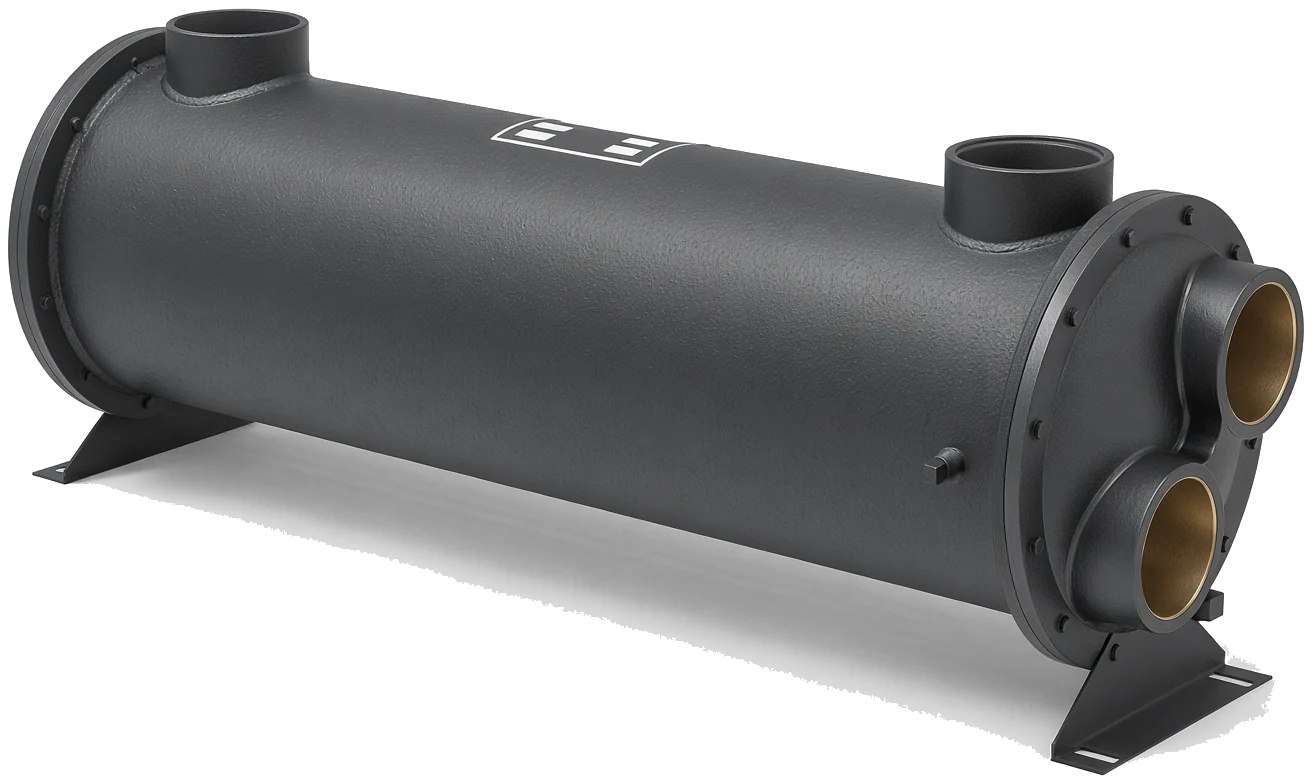
 HC Series
 Charge Air
 Brackish Water
 Gear Oil
Selecting Against The Whole Circuit
On these boats a jacket water selection is checked against everything else drawing from the same pump.
Duty Inputs
- Model and rating, aftercooled or not
- Jacket water rejection, aftercooled or not from the data sheet
- Design seawater or river water temperature
- Raw water pump flow and head
- Order of coolers on the header
We Supply
- Jacket water shell and tube cooler
- Charge air seawater cooler where needed
- Copper-nickel or titanium bundles
- Bronze bonnets and zinc anodes
- Pressure drop for each unit
Duty Profile
- Raw water on the tube side throughout
- Coolant or air on the shell side
- Pass count balanced across the circuit
- Silt tolerance in the velocity chosen
- Anodes accessible on every unit
| MODEL / RATING | HORSEPOWER | DUTY | TYPICAL SELECTION |
| 6CT 8.3 marine | About 200 to 300 HP | Continuous propulsion | B Series larger frames |
| 6CTA 8.3 marine | About 300 to 450 HP | Propulsion, aftercooled | HC Series lower frames |
| QSC 8.3 marine | About 380 to 600 HP | High output propulsion | HC Series mid frames |
| 6C auxiliary set | About 200 to 350 HP | Generator prime power | AB Series fixed tube |
| Charge air duty | Aftercooled ratings | Seawater to charge air | Separate seawater cooler, call for rating |
| Gear oil duty | Sized on oil load | Reduction gear cooling | Reduction Gear Cooling |
Aftercooled Ratings And Charge Air
A second seawater duty
On aftercooled 6CTA and QSC ratings the raw water side has two jobs: taking heat out of the engine coolant and taking heat out of the charge air. Those are separate heat exchangers with separate duties, and the charge air side is often the one nobody thinks about until inlet air temperature starts climbing and the engine loses power.
If your inquiry is for a jacket water cooler on an aftercooled engine, tell us wether the charge air cooler shares the same raw water supply. The pressure drop we add on one unit is head the other does not get. See Charge Air Cooling.
Silt, chemistry and temperature
Many boats on these engines work inshore, in estuaries, or well up rivers, and that water is not the clean cool seawater a standard selection assumes. It carries more silt, its chemistry swings with rainfall and tide, and it is often warmer, which accelerates both corrosion and growth inside the tubes.
The practical answers are a velocity chosen to keep silt moving, a cleaning interval that reflects reality, and titanium tubes where the water is genuinely aggressive. Tell us where the boat works when you inquire, because the water decides the material as much as the duty does.
Related


APPLICATIONS • ENGINE COOLING
Charge Air Cooling
The second seawater duty on an aftercooled engine
+ Learn More
ENGINEERING • MATERIALS
Titanium Or Copper-Nickel
Choosing tube material from the water the boat works in
+ Learn MoreSeawater and material questions
Usually yes. QSC ratings generally run higher than the equivalent 6CTA, so the jacket water heat rejection is greater and the frame moves up. Send the model and rating rather than the family name, and tell us what is currently fitted so the envelope can be checked at the same time.
On aftercooled ratings the charge air is cooled by its own heat exchanger, separate from the jacket water cooler, and often fed from the same raw water supply. If yours needs replacing tell us both duties together so the pressure drop across the circuit is shared sensibly rather than allocated to one unit.
Not always, but it is worth pricing. Brackish and river water brings silt, variable chemistry and often higher temperature, all of which shorten copper-nickel tube life. If your anodes disappear fast or the last bundle came out pitted, titanium removes the failure mode. Tell us where the boat works.
Symptoms include one cooler performing while another downstream does not, temperatures that recover only at higher engine speed, and a strainer that has to be spotless to keep things cool. Give us the pump capacity and the circuit layout and we will check the head budget before selecting.
Yes. Auxiliary sets on this block often run more hours than the main engine, so we specify with fouling allowance and anode access in mind rather than sizing tight to the clean duty. Fixed tube frames rated to 300 PSI suit the duty, with code construction available if required.

