
1-805-484-2992
Quotes - Engineering - SalesCummins QSM11 Heat Exchanger
Duty cycle as much as rating
The QSM11 tends to live a repetitive life. Published marine ratings sit in the region of 330 to 715 horsepower, and the vessels carrying them, ferries, crew boats, dive boats and small passenger craft, generally run a fixed daily pattern: hard acceleration off the berth, a sustained transit, then idle alongside. That cycle matters, because a cooler sized only against the peak rating spends most of its life at part load and then has to deliver at the top.
The sizing route still starts with the jacket water heat rejection from the engine data sheet for your rating and duty class. What the duty cycle changes is how much fouling allowance is sensible and how the raw water side behaves at low speed. A boat that idles alongside for hours between runs is letting silt settle in the tubes and growth get established, which shows up as reduced capacity on the next hot transit.
For a Cummins QSM11 heat exchanger replacement, send the rating, the old part number or nameplate, connection sizes and thread type, the daily pattern the boat runs, and the water source. Copper-nickel tubes, bronze bonnets and zinc anodes is the standard build; titanium is common on boats lying in warm or polluted berths. Call 1-805-484-2992 or email Sales@HeatX.com.
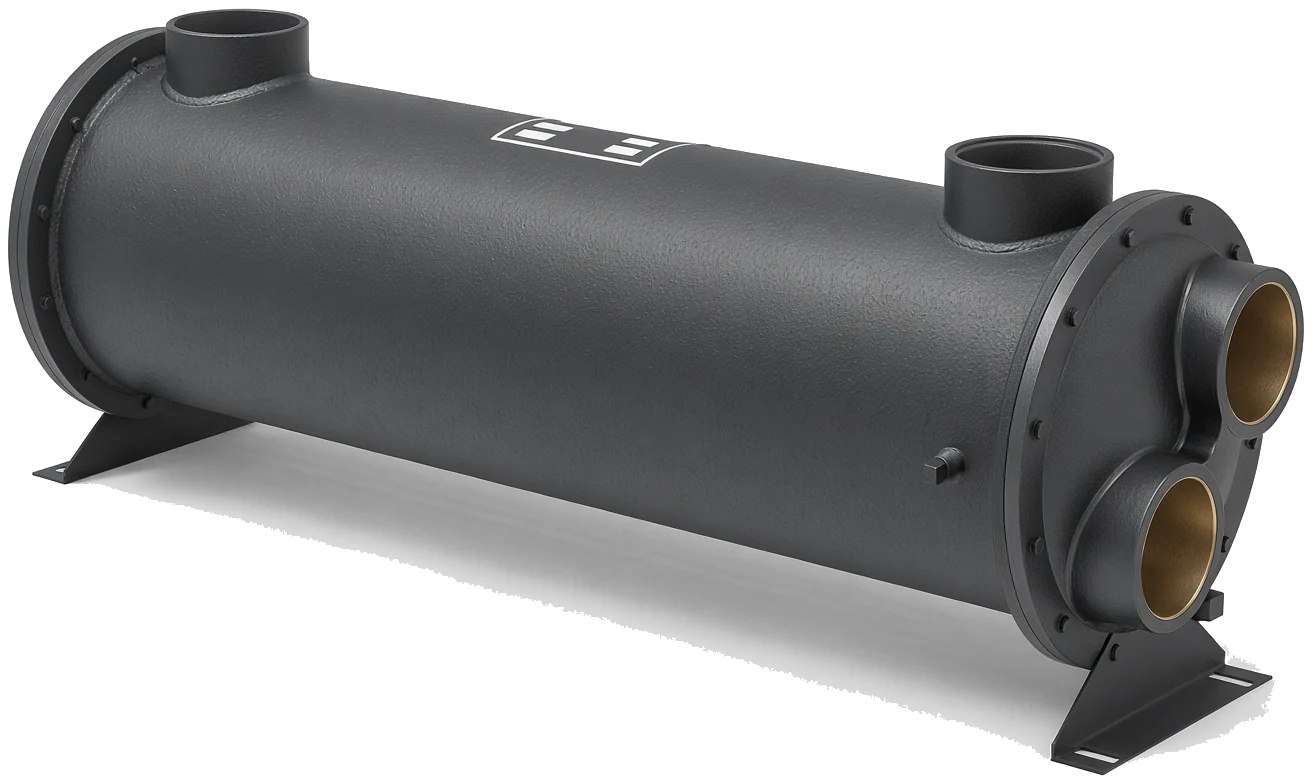
 HC Series
 Ferry Duty
 Bundle Spares
 Cleaning
Sizing To A Daily Pattern
On a scheduled vessel the operating cycle is an input to the selection, not background detail.
Duty Inputs
- Rating and duty class
- Jacket water rejection for the duty class from the data sheet
- Daily running pattern and idle time
- Design seawater inlet temperature
- Cleaning window in the schedule
We Supply
- Shell and tube cooler with fouling margin
- Copper-nickel or titanium bundle
- Bronze bonnets with anode ports
- Spare bundle to hold ashore
- Clean and fouled performance figures
Duty Profile
- Seawater on the tube side
- Coolant on the shell side
- Velocity kept up at part load
- Straight bores for quick rodding
- Anodes reachable without unshipping
| MODEL / RATING | HORSEPOWER | DUTY | TYPICAL SELECTION |
| QSM11 continuous rating | About 330 to 440 HP | Continuous propulsion | HC Series mid frames |
| QSM11 intermittent rating | About 440 to 610 HP | Passenger and crew boat | HC Series mid to upper |
| QSM11 high output | About 610 to 715 HP | High output propulsion | HC Series upper frames |
| QSM11 auxiliary set | About 330 to 500 HP | Prime power | AB Series fixed tube |
| Warm or polluted berth | Any QSM11 rating | Seawater duty | Titanium tubes |
| Gear oil duty | Sized on oil load | Reduction gear cooling | Reduction Gear Cooling |
Idle Time Is Not Free
What happens when the boat sits
A boat that runs two hours and sits six has stagnant seawater in its tubes for most of the day. In warm water that is where growth establishes, and where silt already in the bores has time to settle and consolidate. The result is a cooler that loses capacity faster than it's running hours suggest it should.
There are two useful responses. Keep tube velocity up when the engine does run, which usually means more passes rather than fewer, and flush the raw water side before any extended lay up. Where the berth water is warm or polluted, titanium tubes remove the corrosion consequence entirely.
Designing for the window you have
A passenger vessel on a schedule has a very specific cleaning window, often a single day or a night. The cooler should be built so that window is enough: straight tube bores that can be rodded, bonnets that come off without breaking shell piping, and anode ports reachable in place.
Tell us the window you have and we will make sure the selection suits it. Where the schedule is tight, holding a spare bundle ashore turns a cleaning job into a swap. See Cleaning and Descaling and Tube Bundles.
Related


VESSELS & ENGINES • BY VESSEL
Passenger Vessels
Timetabled boats and the cooling margin they need
+ Learn More
ENGINEERING • SERVICE
Cleaning And Descaling
Rodding and chemical cleaning inside a short window
+ Learn MoreMatching the old cooler
It depends on the rating, which across the family runs roughly 330 to 715 horsepower, and on your seawater temperature and flow. Most QSM11 duties land in the mid to upper HC frames. Send the rating, duty class and the daily pattern the boat runs and we will size it against the data sheet.
Idle time. A boat that runs two hours and sits six has stagnant seawater in the tubes most of the day, which lets growth establish and settled silt consolidate. Keeping tube velocity up when the engine runs and flushing before lay up both help; titanium removes the corrosion consequence.
It should be, if it is built for it. Straight tube bores that can be rodded, bonnets that come off without breaking shell piping, and reachable anode ports are what make that practical. Tell us the window you have and we will confirm the selection suits it.
Check the tube to tubesheet joints as well as the tube walls. Repeated hard acceleration from a berth cycles temperature across the shell side while the tubes stay at seawater temperature, and those joints are a common origin for slow loss. A shell side pressure test will confirm it.

