
1-805-484-2992
Quotes - Engineering - SalesAuxiliary Power
Cooling the Gensets
A generator set is not a small propulsion engine, it is a different duty. It sits cold, starts on demand, picks up hotel load or a deck winch inside a minute or two, and reaches full heat rejection long before anything else in the machinery space has warmed up. Then it may run for eight hours or shut down after twenty minutes. That thermal cycling is what a marine genset heat exchanger has to absorb, and it is why an auxiliary cooler often shows distress before the main engine's does.
A ship service generator starts cold, takes load in minutes and may run for an hour or a week. That duty cycle wears coolers differently from a propulsion engine, and it is why gensets so often outlive two exchangers.
The loads are smaller, which usually means smaller frames. A 20 kW genset may be served by a two-inch or three-inch shell; a 150 kW unit sits in the middle of the B and HC ranges; a 400 kW ship service set on a workboat can want a frame close to what a small propulsion engine uses. What does not change is the marine build: copper-nickel tubes, bronze bonnets, zinc anodes, and seawater on the tube side where it can be cleaned.
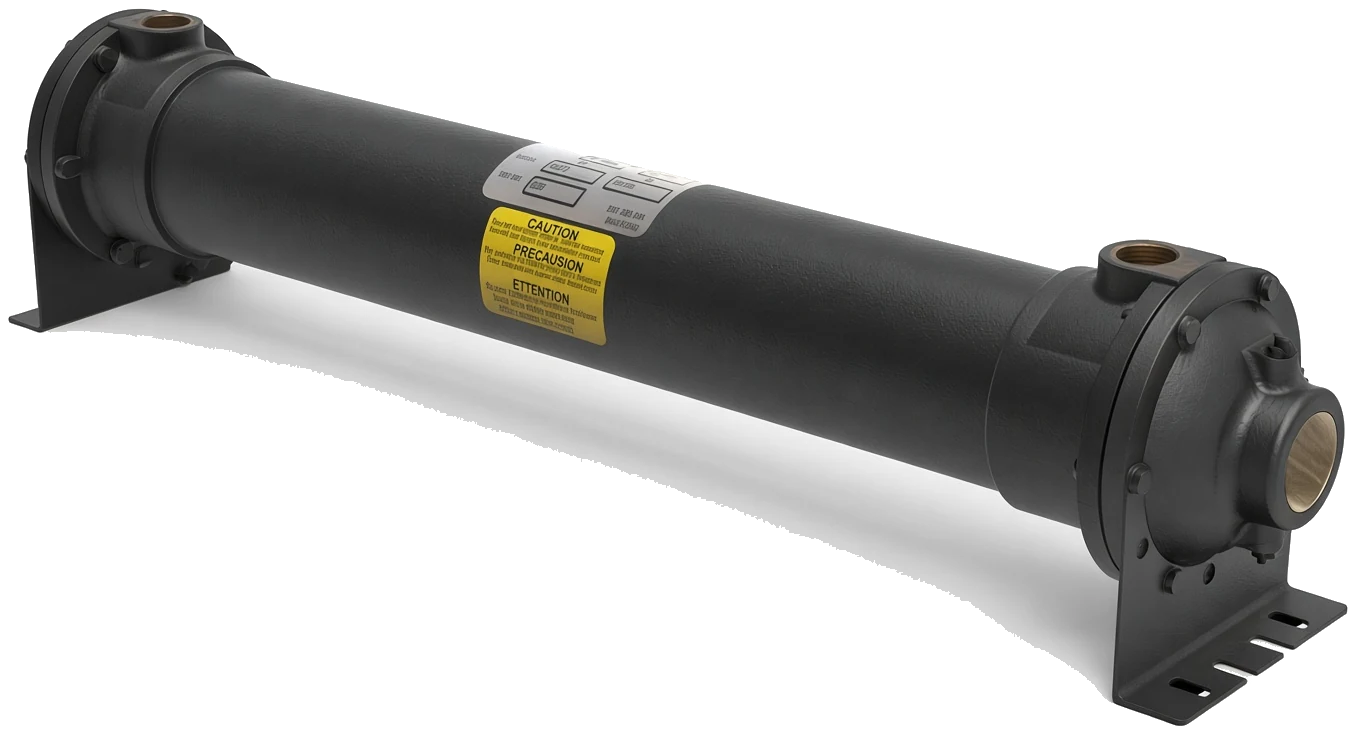
For genset work we usually need less than you would expect: the set make and kW rating, the engine model underneath it, the old cooler part number or a nameplate photo, and the connection sizes. Most auxiliary coolers fall inside frames we can identify from that alone.
Request a QuoteCycling Is the Load
Every cold start puts the tubesheet and tubes through a temperature swing, and over a decade those cycles do more to a genset cooler than running hours ever will.

Layup Routine
What stops winter damage
- Flush the raw water side with fresh water
- Drain or fill with inhibited fluid
- Fit new anodes before storage

Fit Check
Measure the hole, then the cooler
- Clearance inside the sound shield
- Hose approach and bonnet rotation
- Bracket centers and shell diameter
Sizing an Auxiliary Engine Cooler
Generator sets are sold by electrical output, but the cooler is sized on what the engine rejects. A 100 kW set needs roughly 140 to 150 horsepower of engine behind it depending on efficiency and power factor, and the heat rejection to jacket water for that engine is what we work from, read off the engine data sheet rather than assumed from the kW badge.
- Sized on engine heat rejection, not alternator kW
- Start-stop duty means repeated thermal cycling
- Small B frames cover most yacht and fishing sets
- AB fixed tube suits skid-mounted ship service sets
- Sound shield clearance often decides the frame length
- Copper-nickel tubes, bronze bonnets, zincs as standard
Why Genset Coolers Die Early
A propulsion engine gets looked at. A genset gets started. The raw water side goes years without a rod-out, the zincs go unchecked because the anode plugs are behind the sound shield, and the whole set sits full of stagnant seawater through a winter layup where chlorides concentrate and pit the tube ends.
- Stagnant seawater through layup pits tube ends
- Anode plugs behind a shield get forgotten for years
- Shore power and weak bonding accelerate tube attack
- Long suction hose runs collapse and starve flow
- A genset cooler is cheap next to a lost set
Operating questions
Work from the engine, not the alternator. A 100 kW set typically sits behind 140 to 150 horsepower of diesel, and we size on that engine's published heat rejection to jacket water, the jacket flow and your worst-case seawater temperture. Send the set and engine model and we will name the frame.
Three reasons: it cycles cold to hot far more often, it is usually behind a sound shield where anodes go unchecked, and it spends long periods full of stagnant seawater during layup. None of those are thermal problems, which is why a bigger cooler is not the fix.
Only if the raw water and coolant circuits are genuinely common and both sets never run together at full load. In practice seperate coolers are safer, because one set stays available while the other is serviced and neither depends on the other's pump.
Yes, and arguably more than large ones, because the surface area protecting the tubesheet is smaller and consumption is proportionally faster. Fit them, check them at every haul-out and after any long period on shore power, and keep a spare set with the filters.
Usually. Measure overall length, shell diameter, connection sizes and thread type, note the bonnet material and whether the bundle is removable, and photograph the installation. From that we can identify the frame and quote a current equivalent from the B, HC or AB range.
Give the generator set its own raw water supply. The main engine pump only turns when the main engine runs, and a genset earns most of its hours at anchor or alongside with the mains shut down. A tee off the main circuit also starves the genset cooler at idle, when pump delivery is lowest, and lets a lost main-engine impeller take the generator with it. Separate pump, separate strainer, separate seacock.
Related

VESSELS & ENGINES • BY VESSEL
Yachts
Where genset cooling and quiet running drive the selection.
+ Learn More


