
1-805-484-2992
Quotes - Engineering - SalesCoolers For Cummins Marine Diesels
B and C blocks, N14, QSM11 and the K family
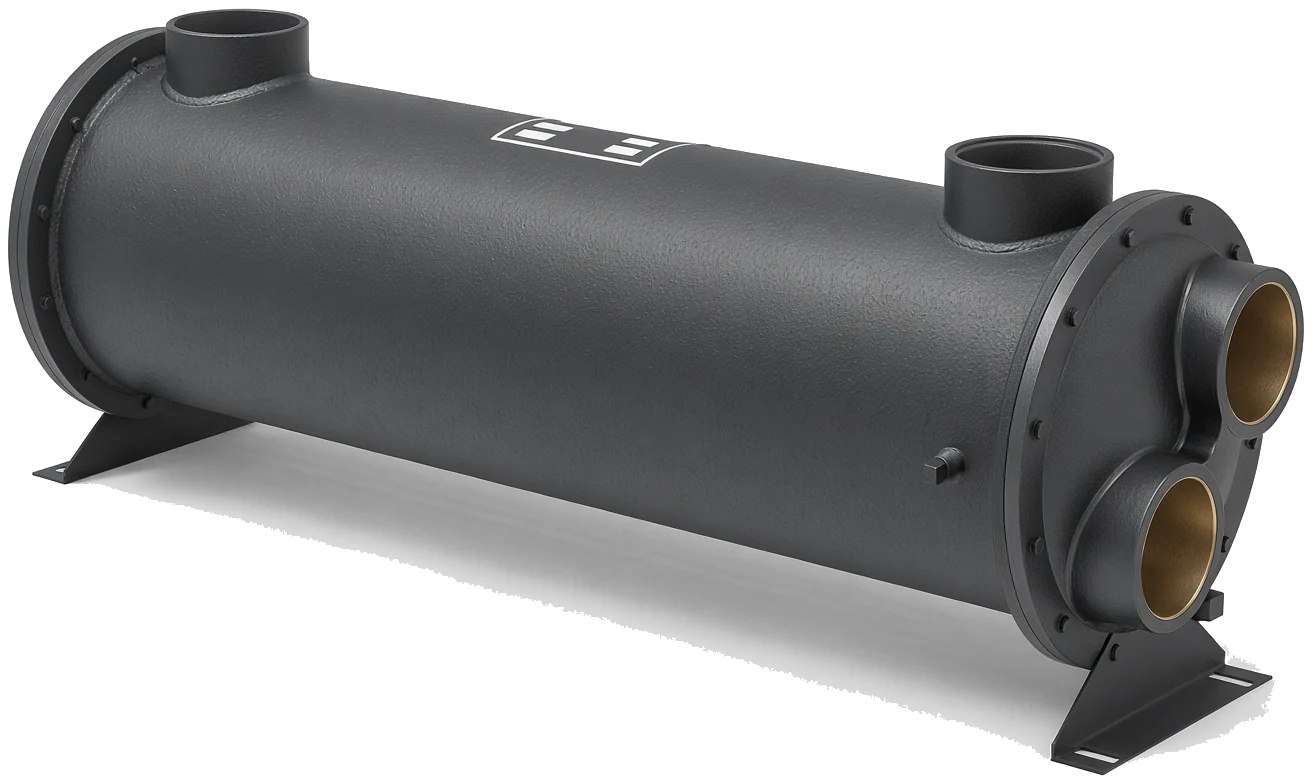
Cummins engines cover an unusually wide band of marine work, from a 6BT in a small trawler to a pair of KTA50s in an offshore supply boat. The cooling hardware spans the same range: compact raw water coolers on the smaller blocks, and large shell and tube jacket water coolers on the K family. What does not change is the failure mode. Scale and salt eventually take the tubes, the zincs go unreplaced, and the unit starts weeping or fails a pressure test.
Coolers for the Cummins engines found in fishing fleets, tugs, ferries and gensets. Every model page carries the horsepower band, the duty split and the information we need to confirm a replacement that fits the existing piping.
Selection for a Cummins jacket water cooler replacement runs from the rating rather than the block. A 6CT and a QSC share architecture but not necessarily heat rejection, and the same is true across the KTA19 rating spread. We work from the jacket water heat rejection figure on the engine data sheet for your rating, the seawater inlet temperature you design to, and the raw water flow the pump can actually deliver.
To get a replacement moving, send us the engine model and rating, a photo of the nameplate or the old part number on the cooler, the connection sizes and thread type, and whether the raw water is seawater, brackish or fresh. Copper-nickel tubes, bronze bonnets and zinc anodes are the standard marine option set, with titanium tubes available. Call 1-805-484-2992 or email Sales@HeatX.com.
| MODEL / RATING | HORSEPOWER | DUTY | TYPICAL SELECTION |
| Cummins 6BT and QSB | About 130 to 425 HP | Light propulsion, gensets | B Series jacket water |
| Cummins 6CT and QSC | About 200 to 600 HP | Propulsion and auxiliary | HC Series jacket water |
| Cummins NT855 and N14 | About 250 to 500 HP | Workboat propulsion | HC Series, lube oil cooler |
| Cummins QSM11 | About 330 to 715 HP | Propulsion and prime power | HC Series mid frames |
| Cummins KTA19 | About 500 to 800 HP | Heavy duty propulsion | HC Series larger frames |
| Cummins KTA38 and KTA50 | About 1000 to 1800 HP | Main propulsion, offshore | Large HC frames, call for rating |
Duty Inputs
- Engine model and rating
- Jacket water heat rejection figure
- Seawater inlet temperature
- Raw water flow available
- Allowable pressure drop
Marine Build
- Tubes: copper-nickel or titanium
- Bonnets: bronze with anode ports
- Anodes: zinc, replaceable
- Shell: steel or 316 SS
- NPT or SAE connections
Service Items
- Tube bundles
- Bonnet and gasket sets
- Zinc anodes by the box
- Cleaning and descaling advice
- Pressure test on request
Rating Before Block
Two engines with the same block casting can carry very different jacket water loads, so we size from the rating on your nameplate.
B And C Block Installations
6BT, QSB, 6CT and QSC cooling
The B and C blocks turn up in everything from small trawlers to harbor launches to generator sets, and they are the engines most likely to be running a compact cooler in a tight space. When one fails, the replacement question is usually as much about envelope and connection geometry as it is about surface area, because the piping was routed around whatever was fitted originally.
Send dimensions with the rating on these engines. Shell diameter, overall length, connection sizes and positions and the mounting arrangement decide what will physically go back. Smaller frames in the B range answer many of these duties; higher-rated C blocks generally move up into the HC range.
N14 And QSM11 In Workboat Service
The middle of the range
The NT855, N14 and QSM11 sit in the band where jacket water and lube oil coolers are almost always separate units sharing one raw water line. That sharing matters: the pressure drop budget and the available flow have to cover both, and a replacement sized in isolation can starve the other cooler on the same circuit.
When you send a nameplate for one of these, tell us what else is on the raw water header, including any gear oil cooler or hydraulic cooler. The pass arrangement we select depends on it. Flow and Pressure Drop sets out how that arithmetic is handled.
Fitting a replacement
Not necessarily. The blocks are related but ratings and heat rejection differ, and the installations often differ more. We size from the rating on your engine and the heat rejection on that data sheet, then check the envelope and connections against what is currently fitted before quoting a replacement.
It depends where in the range your KTA19 is rated, what seawater inlet temperature you design to and how much raw water flow you have. The band sits in the larger HC frames. Send the rating and the flow figure and we will select against the data sheet rather than guess from the model.
Yes, titanium tubes are an option on the shell and tube frames used for these duties. They are worth specifying where raw water is warm, sandy, polluted or chlorinated, or where the vessel lies in a berth for long periods. Copper-nickel remains the standard build for clean, cooler seawater.
Measurements. Shell diameter, overall length, connection sizes, thread type and positions, and mounting center distances, plus the engine model and rating. Two clear photographs from different angles help a great deal. From that we specify a replacement that goes back in to the same space on the same piping.
Yes. Hydraulic oil coolers are sized on heat load, oil grade and allowable pressure drop. Many vessels run winches, cranes or thrusters off the same raw water header as the engine, so tell us the whole circuit and we will make sure the selections work together.
The heat rejection for your rating is unchanged by the conversion, so the surface area is worked the same way as for any Cummins on this page. What the conversion adds is a raw water circuit that does not exist yet: sea chest, strainer, pump and hose all have to be chosen before the pass arrangement can be fixed. Tell us the pump you intend to fit and the hose run, and the selection is made against that flow.
Related

ENGINES • CATERPILLAR
Caterpillar Engines
Model bands and selections across the CAT marine range
+ Learn More
ENGINEERING • MATERIALS
Copper-Nickel Tubes
Why 90/10 remains the standard marine tube material
+ Learn More
VESSELS & ENGINES • BY VESSEL
Commercial Fishing
Duty cycles and water conditions that shorten cooler life
+ Learn More
