
1-805-484-2992
Quotes - Engineering - SalesZinc Anode Protection
What it protects and for how long
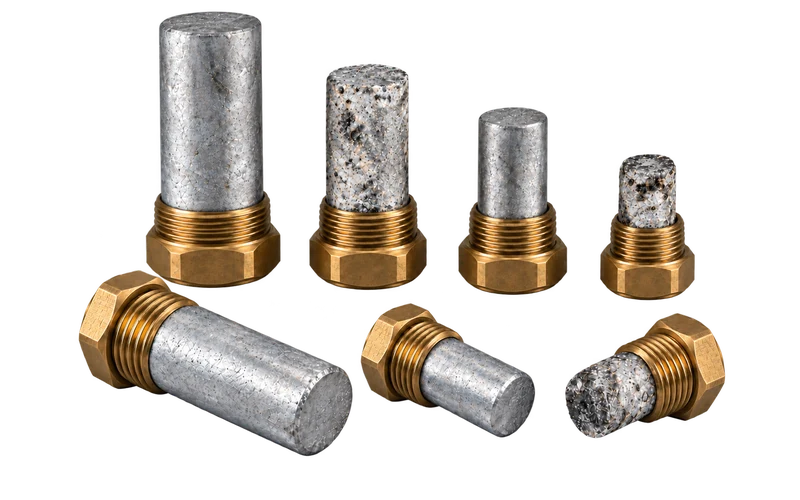
A zinc anode is a deliberately sacrificed piece of metal, and its job is to be the least noble thing in the wetted assembly. Threaded into a tapped port in the bonnet, in electrical contact with the casting and therefore with the tubesheet and the tube ends, it corrodes preferentially and supplies the current the cooler would otherwise draw from those components. Nothing else in a marine heat exchanger delivers so much protection for so little money, and nothing else is neglected quite so consistently.
A zinc pencil anode costs a few dollars, threads into the bonnet, and stands between the seawater and your tube ends. It is the cheapest insurance on the vessel and the item most often forgotten.
What the anode is protecting deserves saying precisely, because it is not simply the tubes. The most vulnerable feature in a shell and tube cooler is the rolled joint where each tube enters the tubesheet: two dissimilar alloys, mechanically stressed, in a tight crevice, sitting in an electrolyte. That is where a cooler without functioning anodes leaks first, and it is why tube-end attack rather than mid-tube wastage is the classic signature of anode neglect.
Replacement intervals cannot be handed out as a single number. A zinc's life depends on water temperature and conductivity, on how much active metal is in the circuit, on stray current, on how many hours the pump actually runs, and on how much zinc was fitted in the first place. What we can give you is a method: inspect early, record what you find, and let the observed wastage rate set the interval for that specific installation.
Read The Wastage
How fast the zinc disappears is a measurement, and it tells you more about your seawater circuit than any other single observation.
Fitting
- Clean the port threads to bare metal
- No sealant on the electrical face
- Sealant on the pipe threads only
- Both bonnets, not just the inlet
- Correct thread and zinc length
Inspecting
- First check soon after commissioning
- Compare inlet and outlet bonnet zincs
- Replace at about half consumed
- Note the shape of the wastage
- Log the date and the condition
Diagnosing
- Untouched zinc means no contact
- Weeks-long life means heavy current
- Uneven wastage means flow pattern
- Crumbling zinc means poor alloy
- Zinc debris can block tubes
| WHAT YOU FIND | MEANING | RISK | ACTION |
| Zinc looks new after months | No electrical contact | Tubes unprotected all along | Clean threads, refit without sealant |
| Half consumed at inspection | Normal healthy protection | None | Replace and keep the interval |
| Consumed to a stub | Interval too long | Tube-end attack starting | Shorten the interval |
| Gone in a few weeks | Heavy galvanic or stray current | Rapid attack once zinc gone | Review metals and bonding |
| One bonnet far worse | Uneven current distribution | Local tube-end attack | Fit anodes both ends, inspect tubes |
| Zinc crumbled into fragments | Poor anode quality | Debris blocking tubes | Fit proper marine anodes |
Setting The Interval Honestly
Measure the first one, then schedule
The only reliable way to set an anode interval is to observe the first cycle. Fit new anodes at commissioning or at the next service, then pull them deliberately early, at perhaps six to eight weeks of running, and look. If roughly a quarter of the zinc has gone, you have a rough three to six month schedule. If half has gone, halve that.
Many working vessels settle in the three to six month range, but a hard-driven boat in warm high-conductivity water can strip an anode in six weeks and a lightly used vessel in cold water can go a year. Once you have two observations from your own installation, you have a better interval than any general recommendation could give you.
Fitting So The Anode Actually Works
The electrical path is the whole point
Protection depends on current flowing from the zinc through the plug, into the bonnet casting, and on to the tubesheet and tube ends. Anything that interrupts that path defeats the anode. The commonest error is wrapping the whole plug in thread tape or smearing sealant across the seating face, which produces a watertight joint and an electrically isolated anode.
Clean the tapped port to bare metal, use sealant only where it is needed on the pipe thread to stop weeping, and make sure the zinc is the right length for the bonnet so it sits in the flow and not against a pass partition. Anodes belong in both bonnets on a multi-pass unit, not only in the inlet end.
When Anodes Vanish Too Fast
The circuit is telling you something
Rapid consumption means the assembly is drawing a large protective current, and the causes are worth chasing rather than feeding with more zinc. Cast iron bonnets on a seawater cooler are a frequent one. Mild steel piping or adaptors bolted straight to bronze connections are another. Warm, highly conductive tropical water raises the rate on its own.
Then there is stray current, from a shore power fault, a poorly bonded system or a nearby vessel on the same dock, which can consume anodes across the whole boat rather than just at the cooler. If your cooler anodes and your shaft and rudder anodes are all going quickly, look at the electrical system before you look at the plumbing.
Operating questions
Set the interval from your own first observation rather than a rule. Fit new anodes, pull them at six to eight weeks of running, and scale from what you see. Many working vessels land between three and six months. Replace once about half the zinc is gone, because a wasted anode stops protecting early.
No, it usually means they are not electrically connected. Thread sealant across the seating face, paint in the port, or heavy corrosion product on the threads will isolate a perfectly good zinc. Clean the port to bare metal and refit with sealant only on the pipe thread, then check again after a few weeks.
On a multi-pass seawater cooler, yes. Current distribution is not uniform, and an anode in the inlet bonnet does relatively little for the tube ends at the far end of the unit. Marine builds are supplied with ports at both ends for that reason, and comparing the two zincs at inspection is a useful diagnostic.
The assembly is drawing heavy current and the cause is worth finding. Look for cast iron bonnets on a seawater unit, mild steel piping or adaptors against bronze, and any shore power or bonding fault putting stray current into the water. Warm high-conductivity water raises consumption on its own too.
Poor quality anodes can crumble rather than waste evenly, and the fragments end up in the tube bores or against the pass partition where they restrict flow. Use proper marine grade pencil anodes of the correct length for the bonnet, and check the tube ends for debris whenever you have the bonnets off.
Related
HEAT EXCHANGERS • ANODES
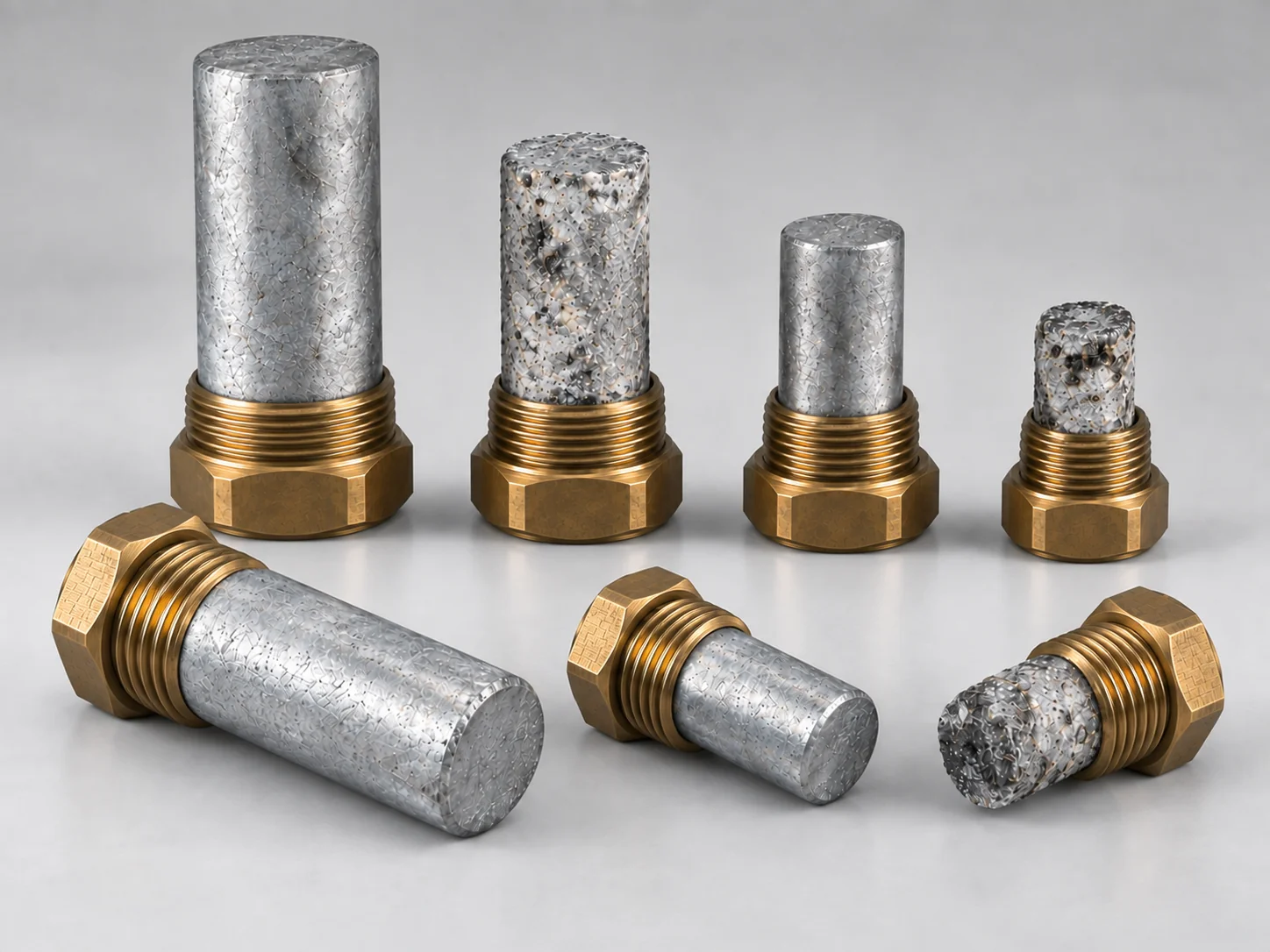
Zinc Anodes
Pencil anodes and plugs matched to the frames we supply
+ Learn More
ENGINEERING • MATERIALS
Bronze Bonnets
Why the casting material sets the anode consumption rate
+ Learn More
APPLICATIONS • ENGINE COOLING
Generator Sets
Standby sets that sit idle and still need anode service
+ Learn More
