
1-805-484-2992
Quotes - Engineering - SalesSizing By Horsepower
A bracket, then a confirmed selection
Horsepower is the only number everybody has, so that is where a marine jacket water cooler selection starts. Jacket water heat rejection broadly tracks engine output, and for a first cut that relationship is close enough to name a frame size and give you a price. On the HC Series the jacket water range runs from around 10 HP on a four-pass 614 up to around 1250 HP on a two-pass 1772, which spans most marine propulsion and generator set installations we quote.
Horsepower gets you to a frame size in one step, which is why everyone starts there. Heat rejection from the engine data sheet is what confirms it, and seawater temperature is what catches people out.
Where horsepower alone falls down is in the spread between engines at the same rating. Rejection to jacket water depends on the duty rating, on whether the charge air is cooled by the same circuit or separately, on the thermal efficiency of the particular engine family, and on how much of the fuel energy leaves in the exhaust. A continuous duty commercial rating rejects meaningfully more over a working day than a high-output pleasure rating at the same nominal horsepower.
So the confirmed selection needs the published rejection figure at your actual continuous rating, taken from the engine data sheet, along with the seawater design temperature and the flows available on both sides. That last point matters more than people expect: a cooler that works in cold northern water can be short of margin in the tropics, because the temperature difference driving heat across the tube wall shrinks as the seawater inlet rises.
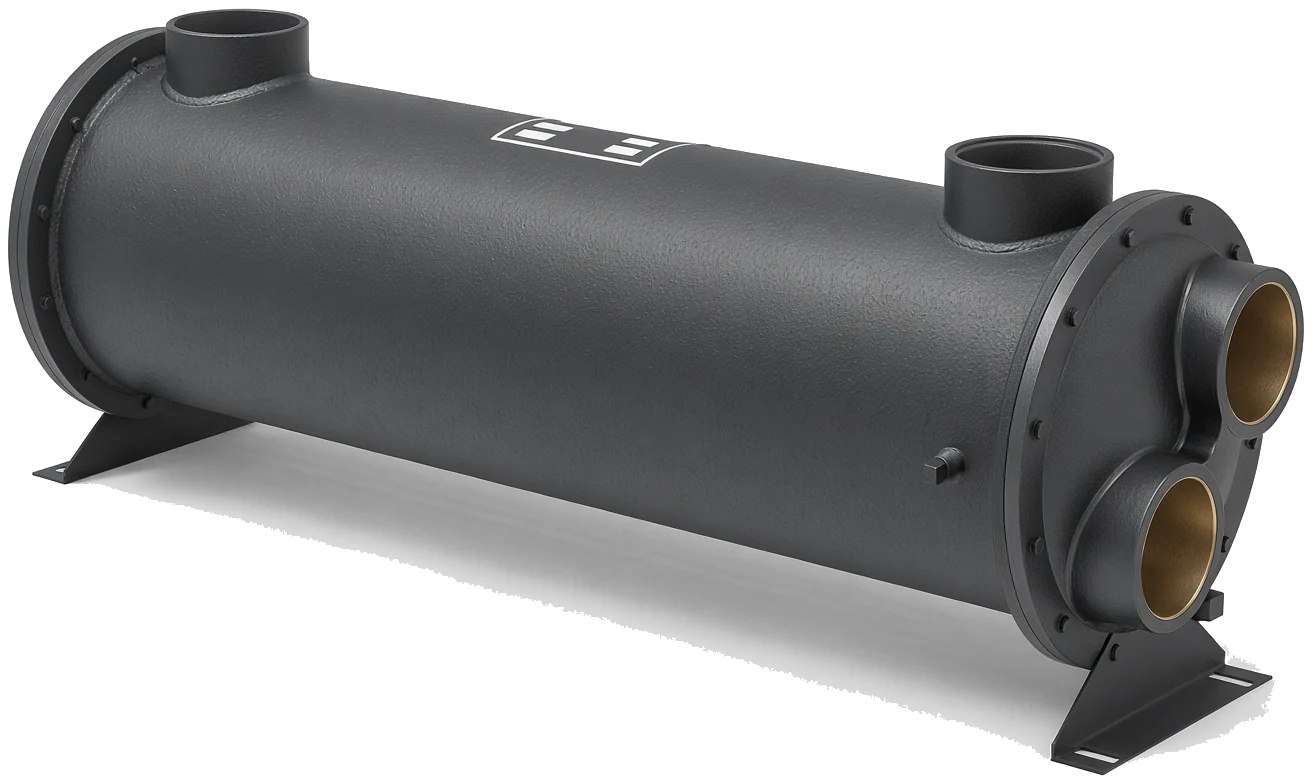
Design For Summer
A cooler sized on cold water and half load will hold temperature beautifully for years and then fail you on the hottest afternoon at full power.
First Cut
- Engine make and model
- Continuous rating in horsepower
- Propulsion or generator duty
- Existing cooler frame if any
- Space envelope available
Confirming
- Jacket water heat rejection
- Coolant flow and temperature limit
- Seawater design inlet temperature
- Seawater flow at working speed
- Allowable drop on both sides
Result
- Frame size and tube length
- Pass arrangement and tube count
- Material option codes
- Calculated pressure drops
- Firm part number and price
| ENGINE BRACKET | TYPICAL DUTY | FRAME RANGE | NOTES |
| Under 100 HP | Small propulsion, auxiliary sets | Smaller HC and B frames | Four-pass arrangements common |
| 100 to 300 HP | Workboat propulsion, gen sets | Mid HC frames, larger B frames | Confirm coolant flow available |
| 300 to 600 HP | Commercial propulsion | Upper mid HC frames | Watch seawater pump capacity |
| 600 to 1000 HP | Larger propulsion and sets | Large HC frames | Two-pass arrangements typical |
| 1000 to 1250 HP | Heavy propulsion | Two-pass HC-1772 region | Call for a confirmed rating |
| Above 1250 HP | Multiple or special units | Call for a rating | Often two coolers in parallel |
Where Heat Rejection Comes From
The data sheet, not a rule of thumb
Every engine manufacturer publishes heat rejection to jacket water for each rating of each model, and that figure is the input a cooler selection actually needs. It is stated at a specific rating and a specific coolant temperature, so read it at the rating you run rather than the maximum on the plate, and note whether charge air cooling is included in the same circuit.
We do not quote heat rejection numbers for specific engines as fact, because they vary by rating, generation and configuration and getting one wrong helps nobody. What we do is take the figure from your data sheet and size against it. The engine pages describe the arrangement and typical selection for each family.
What Seawater Temperature Does
The driving temperature difference
Heat crosses the tube wall in proportion to the temperature difference between the two fluids. A jacket water circuit held at a fixed temperature against 60 degree seawater has a far larger driving difference than the same circuit against 90 degree tropical water, and the surface required rises accordingly. The same cooler is therefore not the same cooler in two different oceans.
This is the single most common reason a replacement selected on horsepower alone disappoints. If the vessel works the Gulf in summer, tell us, and we will size against a realistic summer seawater temperature rather than an annual average. It usually costs one frame size, and it is much cheaper than a warm engine at full load.
Passes, Flow And Frame Size
Three variables that trade against each other
For a given duty there is more than one valid answer. More passes give higher velocity and a better film coefficient, so a smaller frame does the job, at the price of higher pressure drop and less erosion margin on the copper-nickel. Fewer passes need a physically larger frame but run gentler and are easier on the pumps.
Where marine work differs from industrial is that the pumps are usually already installed and not negotiable. So we work within the flow and drop your existing raw water and coolant pumps can deliver, which frequently rules out the smallest frame that meets the heat duty. That interaction is the subject of the flow and pressure drop page.
What owners ask us
For a bracket and a budget price, yes, and that is how most inquiries start. For a firm selection we want the published jacket water heat rejection at your continuous rating plus the seawater design temperature, because two engines at the same horsepower on different duty ratings can need different frames.
On the engine data sheet or technical specification for your specific model and rating. It is stated as heat rejected to jacket water at a given output, sometimes with charge air cooling shown separately. Read it at the rating you actually run rather than the maximum, and send us the whole line if you are unsure.
Substantially. Heat transfer is driven by the temperature difference between the fluids, so warm tropical seawater cuts the available difference and increases the surface required for the same duty. A cooler sized for cold northern water can run short of margin in the Gulf in summer, typically by about one frame size.
The jacket water selection runs from roughly 10 HP on a four-pass 614 up to roughly 1250 HP on a two-pass 1772. Above that we look at larger arrangements or two coolers in parallel, and we would want to call the rating rather than guess. Below 10 HP the smaller B frames are usually more sensible.
By the heat load in the oil circuit, the oil grade and its viscosity at operating temperature, the oil flow rate, and the pressure drop the system can tolerate. Viscosity has a large effect on both the film coefficient and the shell-side drop, so send the oil specification rather than scaling from engine power.
Often it does. A generator set runs at fixed speed and spends long periods near its continuous rating, so the cooler sees the full published rejection for hours at a time, while a propulsion engine at the same nameplate figure may rarely hold full load. We bracket both from horsepower, then confirm the generator against its continuous rating and the propulsion engine against how the vessel actually runs, which can put them one frame apart.
Related

ENGINES • CUMMINS
Cummins QSM11
A typical mid-range selection worked from the data sheet
+ Learn More
ENGINEERING • SELECTION
Replacing a Cooler
Matching a discontinued unit from measurements and duty data.
+ Learn More
APPLICATIONS • ENGINE COOLING
Gen Set Cooling
Sizing for standby sets that run at fixed load
+ Learn More
