
1-805-484-2992
Quotes - Engineering - SalesCoatings For Salt Air
Protecting the fin block, not the tubes
Every corrosion page on this site so far has been about what happens inside the tubes. Air-cooled coolers have the opposite problem. There is no seawater in the unit at all, so tube alloy and zinc anodes are irrelevant, and the vulnerable component is the aluminum fin block exposed to the air the vessel breathes. Salt aerosol carried in that air settles on the fins, absorbs moisture from humidity, and holds a chloride solution in contact with very thin aluminum stock indefinitely.
The failure is gradual and easy to miss because nothing leaks. Fin material corrodes to a white powdery product, the bond between fin and tube degrades, and the effective heat transfer surface shrinks. The symptom on the vessel is oil temperature creeping up over two or three seasons with no obvious cause, and by the time it is measurable a significant fraction of the fin surface has already gone. Bar-and-plate cores are compact and efficient, which means there is not much metal to spare.
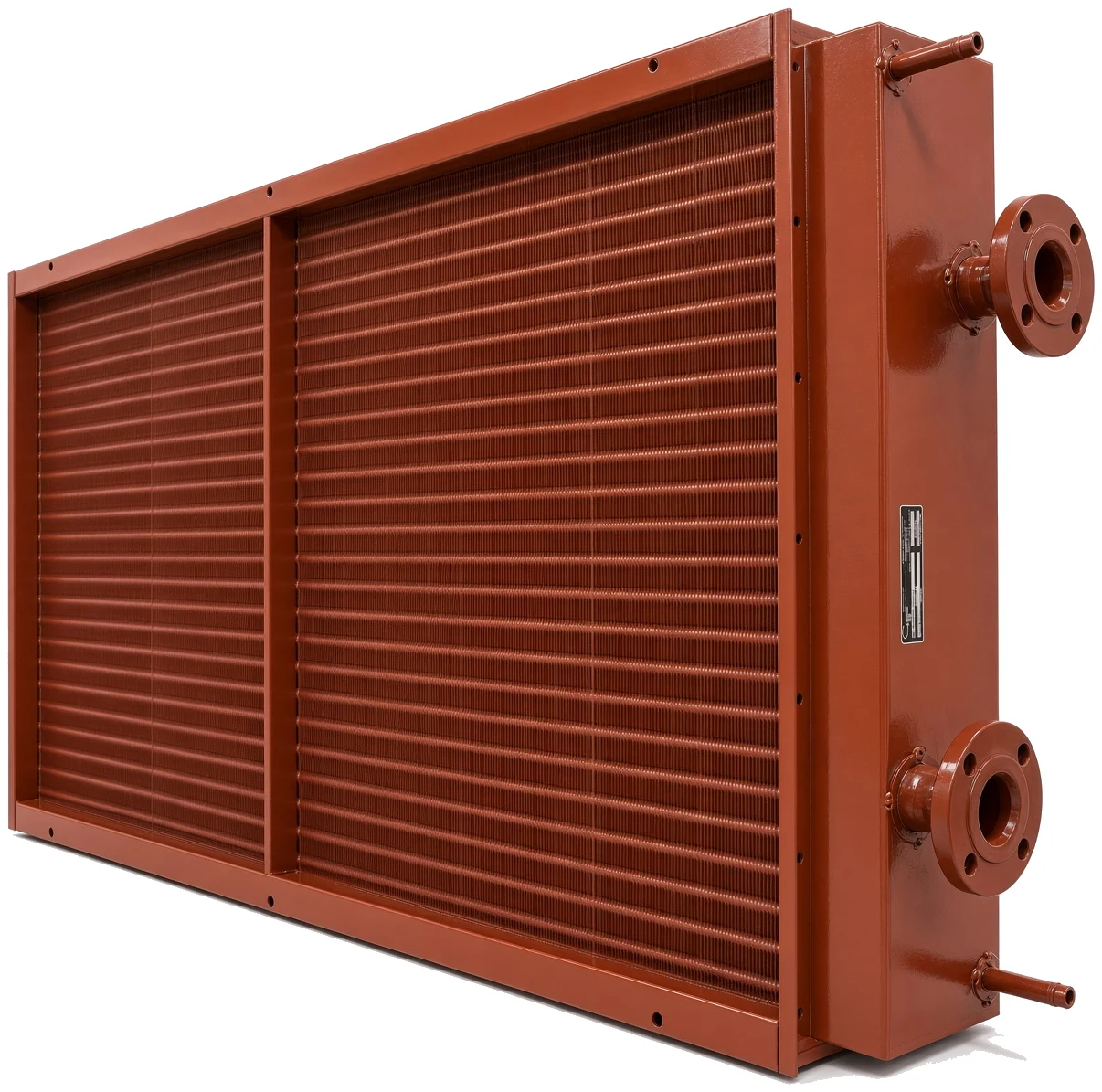
The answer is a coating applied to the finished core before the unit goes into service. We apply Heresite, a baked phenolic system, to the aluminum cores on the A, H and DCS series air-cooled coolers we supply for marine work. It is thin enough that the thermal ratings are unchanged, continuous enough to keep chloride solution off the metal, and it goes on at build time, which is the only sensible moment to do it.
Coat It At Build
A coating applied to a clean new core lasts the life of the cooler; a coating brushed onto corroded fins seals the damage in and buys nothing.
Exposure
- Open deck and weather deck mounting
- Engine rooms breathing outside air
- Ventilated machinery spaces
- Dockside and shoreside installations
- Anywhere spray reaches the core
What It Does
- Baked phenolic film over the core
- Keeps chloride solution off aluminum
- Applied to fins, tubes and headers
- Ratings unchanged by the coating
- Applied before the unit ships
What It Is Not
- Not a field repair for corroded fins
- Not a substitute for cleaning
- Not protection against impact damage
- Not needed on closed dry spaces
- Not a seawater-side treatment
| INSTALLATION | SALT EXPOSURE | COATING | REASON |
| Open deck crane or winch cooler | Direct spray and aerosol | Specify Heresite | Worst exposure on the vessel |
| Engine room with outside air intake | Continuous aerosol | Specify Heresite | Ventilation carries salt to the core |
| Sealed air-conditioned space | Minimal | Optional | Little chloride reaches the fins |
| Dockside shoreside unit | Coastal aerosol | Specify Heresite | Same mechanism, longer exposure |
| Inland or freshwater service | None | Not required | No chloride source |
Why Aluminum Fins Are The Weak Point
Thin stock, large area, chloride film
Aluminum relies on a natural oxide layer that behaves well in clean air and poorly under a persistent chloride film. Fin stock in a bar-and-plate core is deliberately thin because that is what makes the core light and efficient, so there is very little metal thickness available before the fin is structurally gone rather than merely marked.
Salt aerosol also does something water alone does not. It is hygroscopic, so a salt deposit pulls moisture out of humid air and stays wet long after any spray has dried. The core therefore spends most of its life under a thin electrolyte film rather than occasionally getting wet, and that continuous exposure is what drives the loss.
What Heresite Adds And What It Costs
A baked film with no rating penalty
Heresite is a phenolic coating applied and then baked, which gives a hard continuous film that follows the fin geometry rather than bridging and blocking the air passages. Because the film is thin its effect on air-side heat transfer is negligible, and the pressure, temperature and flow ratings of the coolers are unchanged by it: 250 PSI and 250 degrees Fahrenheit on the bar-and-plate cores we supply.
The cost is modest at build time and the coverage is complete because the whole core is processed rather than sprayed in place. That is the argument for deciding at the order stage. The coating page covers the process itself and which series it is available on.
Coatings Are Not A Cleaning Substitute
Salt still has to come off the core
A coated core does not become maintenance free. Salt deposits and airborne dirt still accumulate in the fin passages and still restrict airflow, and a blocked core runs hot regardless of how well protected the metal underneath is. Periodic fresh water washing of the air side remains worthwhile on any marine installation.
What the coating changes is the consequence of leaving salt on the metal between washes, which on an uncoated core is permanent loss and on a coated core is nothing. Wash with fresh water at low pressure, from the discharge side back through the core where access allows, and avoid high pressure jetting that will bend fins.
Before you request a quote
It puts a baked phenolic film over the whole finished core so that salt-laden moisture never reaches the aluminum underneath. The film follows the fin geometry rather than bridging the air passages, so it is thin enough to leave the thermal performance and the pressure and temperature ratings unchanged.
Not measurably. The film is very thin relative to the fin thickness and does not block air passages, so the rated performance of the cooler stands as cataloged. That is a large part of why a baked phenolic system is used rather than a heavier paint that would bridge the fin gaps and cost airflow.
Not usefully. Coating over existing fin corrosion seals the damage in and does nothing to restore surface that has already been lost, and adhesion on degraded aluminum is poor. Coating is applied to a clean new core at build time, so specify it when the cooler is ordered rather than after a season on deck.
If that engine room draws outside air on a saltwater vessel, yes. Ventilation carries salt aerosol straight onto the fin block, and uncoated cores in ventilated machinery spaces degrade within a couple of seasons. A genuinely sealed, conditioned space is a different case and the coating becomes optional.
Often, if seawater is conveniently available. A shell and tube oil cooler with copper-nickel tubes is unaffected by salt air and is usually more compact for the same duty. Air cooling wins where there is no seawater supply, where the equipment moves, or where you do not want another hull penetration.
Related

HEAT EXCHANGERS • AIR COOLED
Heresite Coating
The coating process and the series it is available on
+ Learn More
APPLICATIONS • OIL COOLING
Hydraulic Cooling
Deck hydraulics and where an air cooled unit fits
+ Learn More
APPLICATIONS • OIL COOLERS
Deck Coolers
Crane and deck machinery oil cooling on exposed mountings
+ Learn More
