
1-805-484-2992
Quotes - Engineering - SalesCummins KTA38 and KTA50 Cooling
Beyond a single frame selection
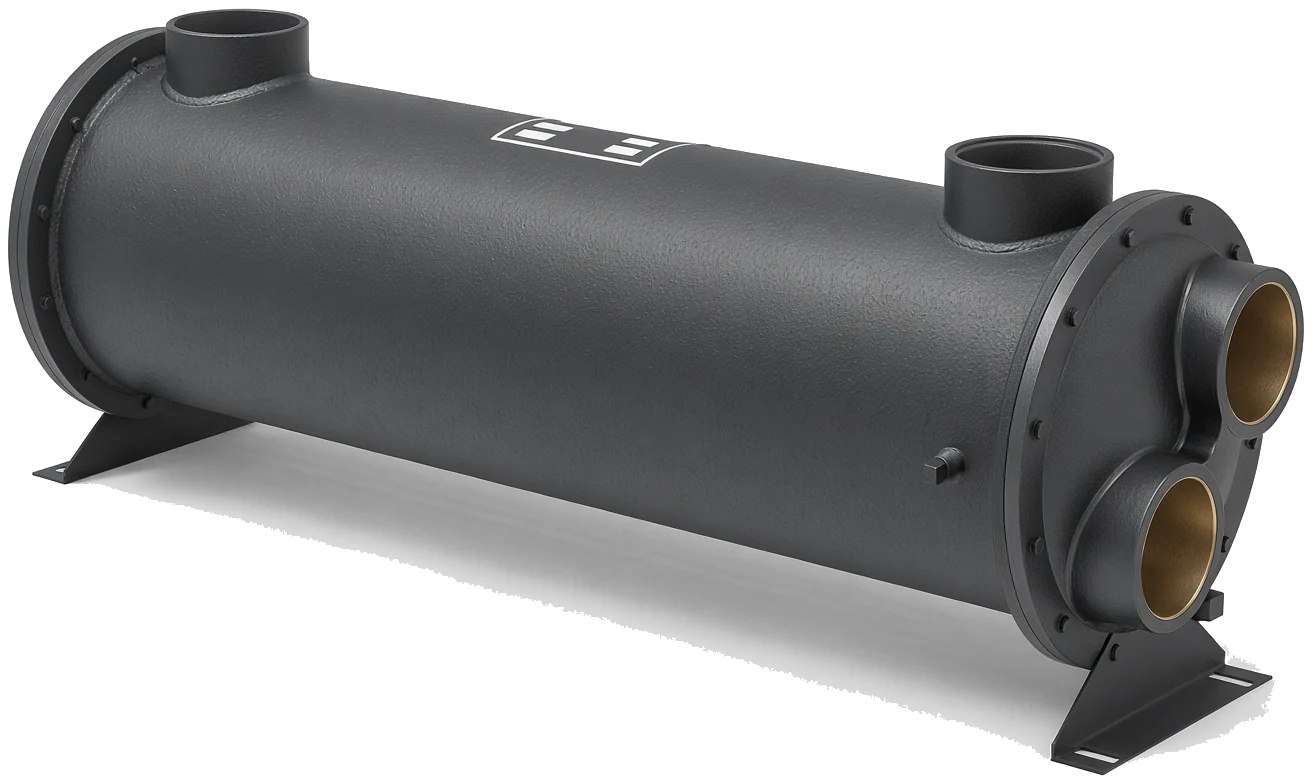
These engines sit at the top of what shell and tube jacket water cooling covers as a single unit. Published marine ratings for the KTA38 and KTA50 run in the region of 1000 to 1800 horsepower, and the jacket water selection published for these frames reaches roughly 1250 horsepower on the largest two-pass unit. So the answer for most KTA50 installations, and for the upper KTA38 ratings, is either the biggest frame under genuinely favorable conditions or two units sharing the load.
At roughly 1000 to 1800 HP these are the largest jacket water duties in the catalog. The answer is usually an arrangement rather than a single unit, quoted with performance and pressure drop stated.
We work these individually. The inputs are the rating and duty class, the jacket water heat rejection from the engine data sheet, the design seawater inlet temperature, the measured raw water flow at the cooler and the head already consumed by the sea chest, strainer and piping. From those we propose an arrangement, state the clean and fouled duty and give the pressure drop on both sides, so your engineers can check the selection rather than take it on trust.
For a Cummins KTA38 or KTA50 heat exchanger replacement, send the rating, the existing part numbers if they survive, the connection sizes and thread type, and the space, route and lifting access in the machinery space. Copper-nickel is standard; titanium bundles are frequently specified at this size. Call 1-805-484-2992 or email Sales@HeatX.com.
 Parallel Units
 Titanium Bundles
 Offshore Duty
 Bundle Service
Working A Large K Family Duty
The proposal covers the arrangement, the performance in both conditions and everything the yard needs to install it.
Duty Inputs
- Rating, duty class and data sheet
- Design seawater inlet temperature
- Measured raw water flow at the cooler
- Head consumed upstream of it
- Realistic cleaning interval
We Supply
- Single largest frame or parallel pair
- Copper-nickel or titanium bundles
- Bronze bonnets with multiple anodes
- Weights, lifting points and drawings
- Clean and fouled duty plus pressure drop
Duty Profile
- Seawater tube side, coolant shell side
- Two pass to protect the head budget
- Each unit isolatable in service
- Symmetrical piping on parallel units
- Anode inventory stated per unit
| MODEL / RATING | HORSEPOWER | DUTY | TYPICAL SELECTION |
| KTA38 continuous rating | About 1000 to 1150 HP | Continuous propulsion | Largest HC Series frame, call for rating |
| KTA38 intermittent rating | About 1150 to 1400 HP | Workboat propulsion | Two units in parallel |
| KTA50 continuous rating | About 1300 to 1550 HP | Offshore propulsion | Parallel arrangement |
| KTA50 high output | About 1550 to 1800 HP | High output propulsion | Parallel arrangement, call for rating |
| K38 or K50 prime power | About 1000 to 1500 HP | Prime power generation | Parallel or largest frame with ASME |
| Warm or sandy raw water | Any rating in the range | Seawater duty | Titanium tube bundles |
The Case For Two Units
Capacity, handling and redundancy
Splitting a large K family duty across two coolers solves three problems at once. It reaches a total capacity no single frame in this range will carry, it breaks the installation into pieces a machinery space can actually accept, and it leaves partial capacity available when one unit is isolated for cleaning or repair.
The requirement is that the flow splits evenly, which means symmetrical branch piping, isolation valves each side of each unit and a verified flow check at commissioning. Uneven branches leave one unit overworked and the other fouling in slow water, which defeats the purpose.
Where a bundle is a serious item
A tube bundle for one of these frames is a substantial piece of hardware and an unplanned replacement takes a vessel out of service for days. On offshore and government boats working warm, sandy or polluted water, titanium tubes remove the corrosion and erosion failure mode outright, and the bundle ceases to be something you plan to renew on a cycle.
The decision is made on water conditions, duty hours and the cost of downtime rather than on unit price. If your last bundle came out pitted or your anode consumption is extreme, that is the evidence. See Seawater Coolers.
Related


APPLICATIONS • OIL COOLERS
Hydraulic Oil Coolers
Deck machinery and thruster oil heat on the same header
+ Learn More
VESSELS & ENGINES • BY VESSEL
Offshore And Government
Vessels where downtime is measured in contract days
+ Learn MoreQuestions on this engine
Usually not at the upper ratings. The published jacket water band for these frames reaches roughly 1250 horsepower on the largest two pass unit, and KTA50 ratings run well above that. Two units in parallel is the normal answer. Send your rating, seawater temperature and measured flow for a firm view.
Symmetrical branch lengths to each unit, isolation valves on both sides of each, independent vents and drains, and a flow check at commissioning to confirm the split. Asymmetry biases the flow, so one unit overworks while the other fouls in slow water. We supply the piping requirements with the quote.
With a parallel arrangement and proper isolation, yes, at reduced capacity. Whether that reduced capacity is acceptable depends on what the vessel is doing at the time, so plan it into the operating profile rather than assume it. It is one of the main reasons operators choose two units.
Yes. Those are sized on oil heat load, oil grade and allowable pressure drop. On vessels with this much hydraulic capacity, several coolers may share the seawater header with the main engine units, so send the full list and we will balance the circuit as a system.
The arrangement with full option codes, clean and fouled performance, pressure drop both sides, connection schedule, dry and operating weights, lifting point positions and the anode inventory per unit. Where the arrangement is parallel, the piping symmetry and valve requirements come with it. Call 1-805-484-2992.

