
1-805-484-2992
Quotes - Engineering - SalesAlloys For Seawater
Materials Of Construction
Every marine cooler is a stack of different metals sharing one electrolyte. Seawater runs through the tubes, wets the tubesheet face and fills the bonnets, so the tube alloy, the tubesheet, the bonnet casting and the anode are all part of the same electrochemical system. Get the combination right and the cooler runs for a decade with nothing more than anode changes. Get one component wrong and the mistake shows up as a leak, usually at the tube ends where the metals meet.
Four alloys do almost all the work in a marine cooler, and choosing between them is not a matter of taste. Each page here explains what the metal does in seawater, where it stops working, and what we build with it.
The tube alloy is the first decision and the one with the widest consequences. Copper-nickel, in the 90/10 and 70/30 grades, is the marine standard because it builds a stable protective film in chloride water and because copper-bearing surfaces resist the biofouling that would otherwise close the tubes. Titanium is metallurgically superior in seawater and we fit it without hesitation where the water demands it, but for the great majority of jacket water and oil cooling duty copper-nickel does the job at a fraction of the price.
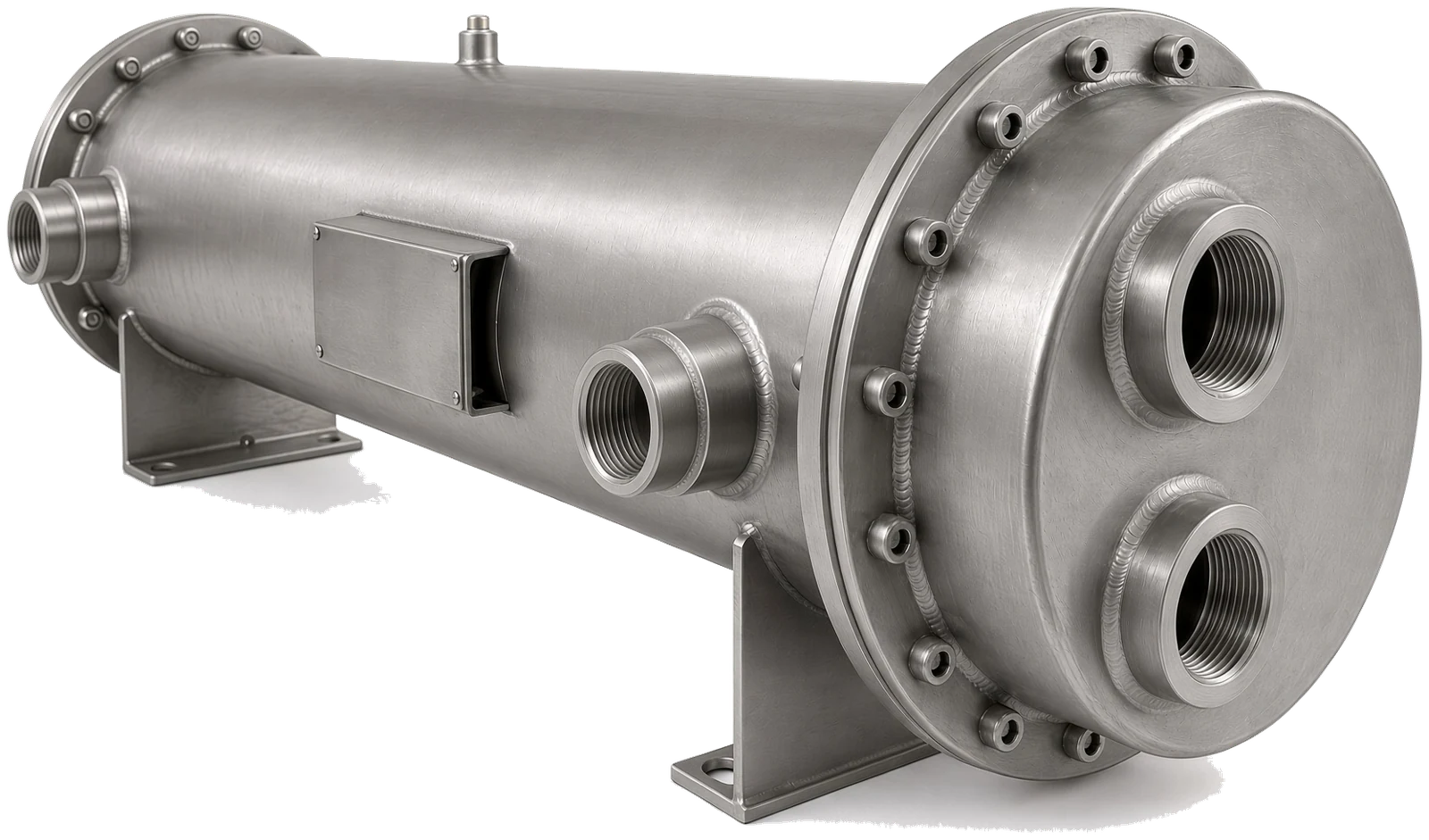
The marine option sets we ship reflect all of this: copper-nickel tubes, bronze bonnets and zinc anodes on the B, HC and AB frames, with titanium tubes available where the water is aggressive. Tell us the water temperature, the velocity and whether the cooler will sit idle between runs and we will tell you which combination to buy.
Request a Quote



Why Copper-Nickel Dominates Marine Work
Copper-nickel does two useful things at once. It grows an adherent cuprous oxide film in seawater that slows further attack, and the copper content keeps marine growth from taking hold inside the tubes. A stainless or titanium tube in the same service will foul biologically and need mechanical cleaning far sooner, which matters more on a fishing boat than any datasheet corrosion rate.
The commercial argument is just as strong. Copper-nickel tubing costs a small multiple of copper and a fraction of titanium, and the frames are built around it, so a marine cooler with CN tubes, bronze bonnets and zincs is a catalog item rather than a special. That is the B Series and HC Series marine option set in one sentence.
When Titanium Earns Its Price
Copper-nickel has three known enemies: chlorine or hypochlorite dosing, sulfide-polluted harbor water, and long periods of stagnation where the protective film cannot maintain itself. Add sand or silt in suspension and the film is scoured off mechanically. Any of those on a permanent basis moves the sensible answer to titanium.
Titanium is effectively immune to seawater corrosion at any concentration and at temperatures well above anything an engine room produces, which is why evaporators, watermaker condensers and chiller condensers so often specify it. We build titanium shell and tube units and fit titanium tubes as the T option on the shell-and-tube frames. The comparison page sets out the trade honestly rather than selling one side.
Bonnets, Tubesheets And Anode Ports
Bonnets take the whole seawater flow and turn it through the pass arrangement, so they see the most turbulence in the unit and they carry the zinc anodes. Cast bronze is the marine choice because it is close enough to the tube alloy galvanically that the anode has an easy job, and because it survives being unbolted and rebolted for cleaning many times over.
Tubesheets are where the tube ends are rolled, and the tube-to-tubesheet joint is the most electrochemically sensitive spot in the cooler. Brass is standard on the B frames and works well with copper-nickel tubes; 316 is available where the specification calls for it. Replacement bonnets and gaskets are stocked for the frames we supply.
Aluminum Cores And Salt Air
Air-cooled oil coolers avoid seawater entirely and pick up a different material problem. Bar-and-plate aluminum cores are light, efficient and completely at home in a machinery space, but on an open deck or in an engine room breathing salt air the fins corrode and the heat transfer surface disappears from the outside in.
The answer is a baked phenolic coating over the finished core. We apply Heresite to the A, H and DCS series cores for salt-air service, and the ratings are unchanged by it. The coatings page under Corrosion Control explains what the coating does and where it does not help.
The Cheapest Right Alloy
The correct material is the least expensive one that still survives the water you have, and knowing where that line falls is the whole job.
Frequently asked
For ordinary raw seawater at sensible tube velocities, 90/10 is the right specification and the one almost every marine cooler ships with. The 70/30 grade buys higher allowable velocity and better resistance in warm, polluted or sulfide-bearing water. It costs more, so we reccomend it where the service actually needs it.
Only with care. 316 stainless stays passive while seawater keeps moving over it, but it pits and crevice-corrodes quickly once the water goes still, which happens every time the vessel shuts down. For raw seawater tubes we specify copper-nickel or titanium and keep 316 for the shell, tubesheet and closed-loop side.
Cast iron bonnets corrode rapidly in seawater and consume the zinc anodes far faster than bronze does. Bronze sits close to copper-nickel on the galvanic scale, so the tube ends are not driven anodic, and the castings survive repeated removal for cleaning. Cast iron is fine on closed fresh water duty only.
Yes. The anodes are not protecting the copper-nickel from the water so much as protecting the whole assembly from itself. Bronze, brass, copper-nickel, steel piping and any bronze valve upstream form a galvanic circuit, and the zinc is what takes the current instead of the tube ends and the tubesheet.
Titanium, in almost every case. Evaporators and watermaker condensers see hot, concentrated seawater and often intermittent operation, which is exactly the combination copper-nickel dislikes. Our titanium evaporators and condensers are rated per duty, so send the capacity, temperatures and flows and we will call the rating.
They need to be close on the galvanic scale, not identical. Copper-nickel tubes rolled into a brass tubesheet is the standard marine pairing because the two alloys sit near each other and the bonnet anode covers the small difference at the rolled joint. Moving the tubesheet to 316 is acceptable where a specification calls for it, but the rolled joint then becomes the spot the anodes work hardest to protect, so keep them fresh.

