
1-805-484-2992
Quotes - Engineering - SalesProtecting The Cooler
Corrosion Control
Nothing on a vessel corrodes by accident. Every failure we see in a marine heat exchanger traces back to a mechanism that was predictable and usually preventable: a galvanic cell nobody accounted for, a tube velocity above the alloy limit, seawater standing still in a bonnet for a month, or salt-laden air eating an uncoated aluminum fin block. These pages take each mechanism in turn, explain how to recognize it from what the failed part looks like, and set out the practical defense.
Seawater attacks a cooler four ways: galvanic current, erosion at the tube inlets, stagnation in layup, and salt air on the outside. Each has a defense, and each defense is cheap compared with a new bundle.
The single most effective measure remains the zinc anode. It costs a few dollars, threads into a tapped port in the bonnet, and takes the corrosion current that would otherwise come out of the tube ends and the tubesheet. The reason it fails so often as a defense is not that anodes do not work, but that nobody opens the bonnet to look at them. An anode that has wasted away is not protecting anything and has not been for some time.
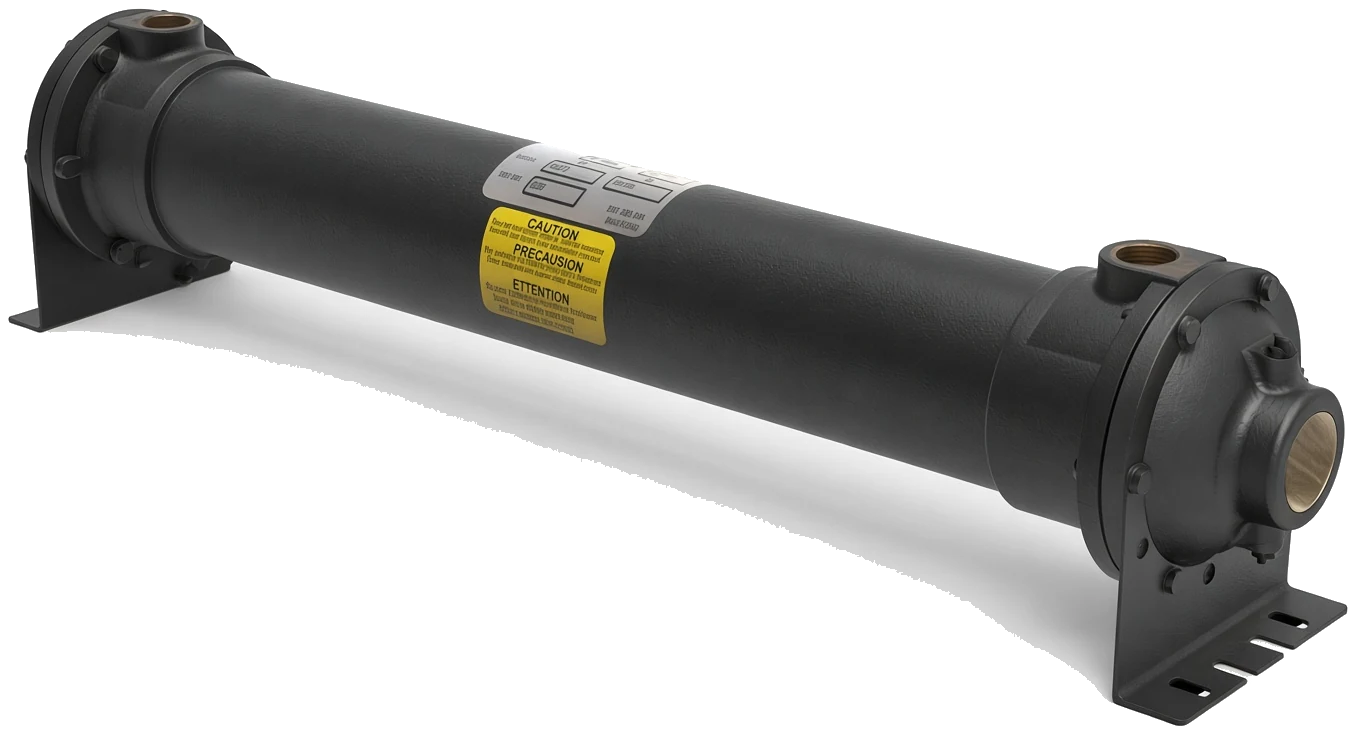
Every marine cooler we ship can be built with zinc anode ports in the bonnets, and we stock replacement anodes and plugs for the frames we sell. If you are consuming anodes faster than expected, send us the installation details and photographs of the wasted zinc and we will tell you what the rate is pointing at.
Request a Quote


How The Anode Actually Works
A zinc anode works because zinc is more electrochemically active than the copper alloys around it. Wired into the same electrolyte through the bonnet casting, it corrodes preferentially and supplies the current that would otherwise be drawn from the tube ends. That only continues while the anode has metal left and while the electrical path between anode, bonnet and tubesheet is clean.
Two things break the protection quietly. A heavily wasted anode has too little surface left to supply the current even though it looks present, and an anode threaded into a corroded or paint-fouled port makes poor electrical contact from new. Clean the threads, fit the anode without sealant on the electrical face, and treat wastage rate as a diagnostic reading rather than a nuisance.
Dissimilar Metals In One Circuit
A cooler does not exist in isolation. Whatever the seawater flows through before and after it is part of the same circuit: bronze seacocks, a steel strainer body, a stainless pump volute, rubber hose with a wire helix. Every junction between two different alloys is a potential cell, and the one that corrodes is always the more active metal with the smaller area.
The practical rules are short. Keep bronze against bronze at the cooler connections where you can, avoid mild steel adaptors on seawater lines, use isolating unions if you must transition, and never let a small piece of active metal serve a large area of noble metal. The galvanic corrosion page goes through the common pairings on a vessel.
Velocity, Erosion And Pass Count
Copper-nickel relies on its oxide film, and that film has a mechanical limit. Above a certain tube-side velocity the water strips it faster than it can reform, and the tube thins from the inside starting at the inlet where the flow is most turbulent. The classic evidence is a horseshoe-shaped groove a few inches into the tube, uniform across the inlet-pass tubes.
Velocity is set by the flow divided by the free area of one pass, so pass count is the design lever. A four-pass unit runs four times the velocity of a single-pass unit with the same flow. Selecting a smaller frame to save money often means adding passes, and that is where a cooler quietly gets specified in to an erosion problem.
Corrosion Outside The Water
An air-cooled oil cooler on a workboat deck or in a ventilated machinery space never touches seawater and still corrodes. Salt aerosol settles on the aluminum fins, holds moisture, and eats the thin fin stock preferentially. The core loses surface from the outside long before anything structural fails, so the symptom is oil temperature creeping up over a couple of seasons.
Heresite is a baked phenolic coating applied to the finished core, thin enough not to change the rating and continuous enough to keep the salt off the metal. We coat the A Series, H Series and DCS Series cores for marine service. It is worth doing before installation, not after the fins have already started to go.
Zinc Or Tubes
Something in the cooler is going to corrode, and the only question worth asking is whether it costs six dollars or six thousand.
Fitting a replacement
Pull them. A working anode loses metal steadily and shows clean sacrificial wastage. An anode that comes out looking new after six months is not electrically connected, usually because of sealant on the threads or a corroded port. An anode that comes out as a stub was doing its job and needed changing sooner.
Fast consumption means the cooler is supplying a lot of current. Common causes are cast iron bonnets on a seawater unit, steel piping bolted directly to bronze connections, stray current from a shore power fault or a bonding problem, and warm high-conductivity water. Send us the installation details and we will help narrow it down.
Copper-nickel has a well established erosion threshold and 90/10 is the more sensitive of the two marine grades. Rather than quoting a single number for every case, we calculate the velocity from your actual seawater flow and the free area of the pass arrangement, then choose the frame and pass count that keeps it below the limit.
It corrodes faster. Standing seawater goes anoxic under deposits, chlorides concentrate in crevices, and the protective films on copper alloys cannot maintain themselves without flow. Stainless is worst affected. Flush the seawater side with fresh water, drain what you can, and fit new anodes before the boat sits.
If the space breathes outside air on a saltwater vessel, yes. Engine room ventilation carries salt aerosol straight onto the fin block, and uncoated aluminum fins degrade within a couple of seasons. The coating adds little to the price at build time and nothing to the pressure or temperature ratings.

