
1-805-484-2992
Quotes - Engineering - SalesCleaning And Descaling
Get the surface back before buying a bigger cooler
A large share of the coolers we are asked to replace do not need replacing, they need cleaning. Fouling on the seawater side develops slowly enough that nobody notices the day it started, and the effect is a steady loss of effective surface area. The engine holds temperature at low load and runs hot at full power, exactly as an undersized cooler would, and the two are easy to confuse. Pulling the bonnets and looking at the tube ends settles it in twenty minutes.
A fouled cooler is the commonest cause of a warm engine and the cheapest to fix. Rodding through the bonnets restores most lost performance in an afternoon, and chemical descaling handles what a rod cannot.
There are three kinds of deposit and they need different treatments. Soft mud, silt and organic matter come out mechanically with a rod and a bucket of fresh water. Marine growth, barnacle set and mussel spat also come out mechanically but need more persuasion and sometimes a scraper at the tube entries. Hard mineral scale, the pale gray crust that builds up over years of warm seawater service, resists rodding and needs an inhibited chemical clean to remove.
Both routes have hazards worth knowing. Mechanical cleaning with the wrong tool scores the tube bore, and a scored copper-nickel tube erodes preferentially at the scratch afterwards. Chemical cleaning with an uninhibited acid strips the protective oxide film the alloy depends on, and can attack the brass tubesheet and bronze castings as well. Neither of those is a reason to avoid cleaning; both are reasons to use the correct method and to pressure test afterwards.
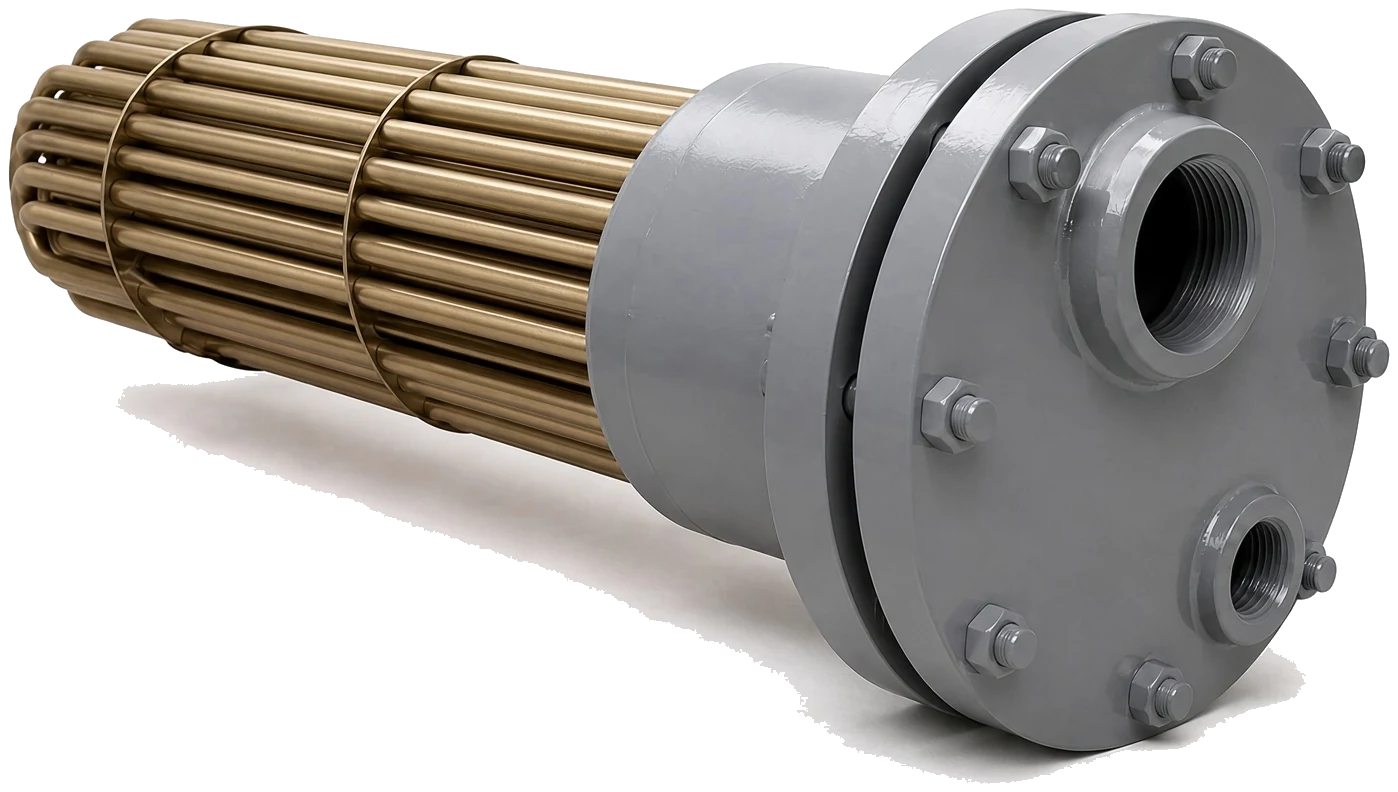
Look Before Replacing
Twenty minutes with the bonnets off will tell you whether you have a fouling problem or a sizing problem, and they need completely different money.
Mechanical
- Nylon or brass rod, never steel
- Rod every tube, not a sample
- Flush with fresh water after
- Scrape growth at the tube entries
- Inspect bores with a light
Chemical
- Inhibited product for copper alloys
- Circulate rather than soak
- Watch temperature and dwell time
- Neutralize and flush thoroughly
- Fit new anodes afterwards
Afterwards
- Pressure test both sides
- Renew bonnet gaskets
- Fit new zinc anodes
- Record what was found
- Reset the cleaning interval
| DEPOSIT | APPEARANCE | METHOD | CAUTION |
| Silt and mud | Soft gray or brown fill | Rod and fresh water flush | Check the strainer as well |
| Marine growth | Barnacle and mussel shell at entries | Rod plus entry scraping | Do not score the tube bore |
| Slime film | Thin brown biological layer | Rodding, chemical if persistent | Returns quickly if flow is low |
| Hard mineral scale | Pale gray adherent crust | Inhibited acid circulation | Uninhibited acid attacks the alloy |
| Oil side sludge | Dark varnish on shell surfaces | Solvent flush on the shell side | Check oil condition and filters |
| Zinc debris | White fragments at tube ends | Remove by hand and flush | Fit proper marine anodes |
Rodding Done Properly
Every tube, right tool, fresh water
Take both bonnets off, support them so the flange faces are not resting on grit, and work through every tube rather than the ones that look worst. Use a nylon or brass rod sized to the bore; a steel rod or an improvised piece of studding will score copper-nickel, and afterwards the score becomes the place the tube erodes first.
Flush with fresh water as you go so the loosened deposit leaves the unit rather than packing at the far end. When the bores are clear, look through them with a light: a clean copper-nickel tube shows an even dull surface, and bright polished patches or visible grooving at the inlet mean you have an erosion problem as well as a fouling one.
Chemical Descaling Safely
Inhibited products, circulated not soaked
Hard mineral scale needs acid, and the choice of product matters more than the strength. Use a descaler formulated and inhibited for copper alloy heat exchangers, mixed and used at the stated concentration, and circulate it through the tube side with a small pump rather than filling the unit and leaving it. Circulation keeps fresh chemical at the scale face and keeps the reaction predictable.
Watch the dwell time and stop when the reaction slows rather than leaving it overnight for good measure. Neutralize and flush thoroughly with fresh water afterwards, then fit new zinc anodes, because the cleaning process will have consumed part of any zinc left in the bonnets and stripped the film the alloy needs to rebuild.
The Shell Side And The Oil Side
Different fouling, different chemistry
Coolant-side fouling in a closed circuit is usually modest if the inhibitor has been maintained, and shows as a light scale or corrosion product on the outside of the tubes. Oil-side fouling is different: oxidized oil forms a dark varnish that insulates well and does not respond to water-based cleaning at all.
For oil-side deposits a solvent flush through the shell is the practical route, followed by a check of the oil condition and the filtration that let it get that way. Persistent oil-side fouling on a lube oil cooler usually means the oil is running hotter than intended, which is itself a cooling problem worth solving.
Points to settle before ordering
Take the bonnets off and look at the tube ends, which takes twenty minutes and answers the question directly. Before that, compare the seawater outlet temperature with the inlet at a known load. A small rise with the engine running hot points at fouled tubes or an air-bound shell rather than insufficient surface.
A nylon or brass rod or brush sized to the tube bore. Do not use steel rod, drill bits or improvised studding, because scoring copper-nickel leaves a groove that erodes preferentially afterwards and shortens the life of the tube. Work through every tube and flush with fresh water as you go.
An inhibited descaler formulated for copper alloy heat exchangers, used at the stated concentration and circulated rather than left to soak. Uninhibited acids strip the protective oxide film the alloy depends on and can also attack the brass tubesheet and bronze bonnets, so the product choice matters more than the strength.
Yes, both sides separately. Cleaning sometimes opens a tube that was already thin and temporarily sealed by it's own deposit, and it is far cheaper to discover that on the bench than after the vessel is back in the water. Renew the bonnet gaskets as part of the same job.
Let the temperatures tell you rather than the calendar. Log the seawater rise across the cooler at a consistent load and clean when it falls off noticeably. Vessels in warm silty water often need annual attention; a boat in cold clean water with a good strainer can go several seasons between cleans.
Related

ENGINEERING • CORROSION
Velocity Limits
What bright polished tube bores are telling you
+ Learn More
APPLICATIONS • SEAWATER
Raw Water Cooling
Strainers and intakes that keep fouling out of the cooler
+ Learn More
APPLICATIONS • OIL COOLERS
Lube Oil Coolers
Oil side varnish and what it says about oil temperature
+ Learn More
