
1-805-484-2992
Quotes - Engineering - SalesFreshwater Generation
Making Water at Sea
Every method of making fresh water at sea concentrates salt somewhere, and that is the hard part. A flash evaporator takes seawater, heats it with engine jacket water or steam, drops the pressure so part of it boils, condenses the vapor into distillate and discharges the remainder as brine that is saltier than what came in. A reverse osmosis watermaker does the same job with pressure instead of heat, and its energy recovery and cooling exchangers still handle concentrated feed. Either way there is a stream hotter and saltier than seawater passing through tubes.
That combination defeats copper alloys. Copper-nickel depends on a protective film that thins as temperature rises and as chloride concentration increases, and brine at elevated temperature attacks it on both counts at once. Add the velocity that evaporator and condenser sections run at, and the service life you would expect from a jacket water cooler simply is not available. This is why a titanium evaporator is the normal specification for this duty rather than a premium option.
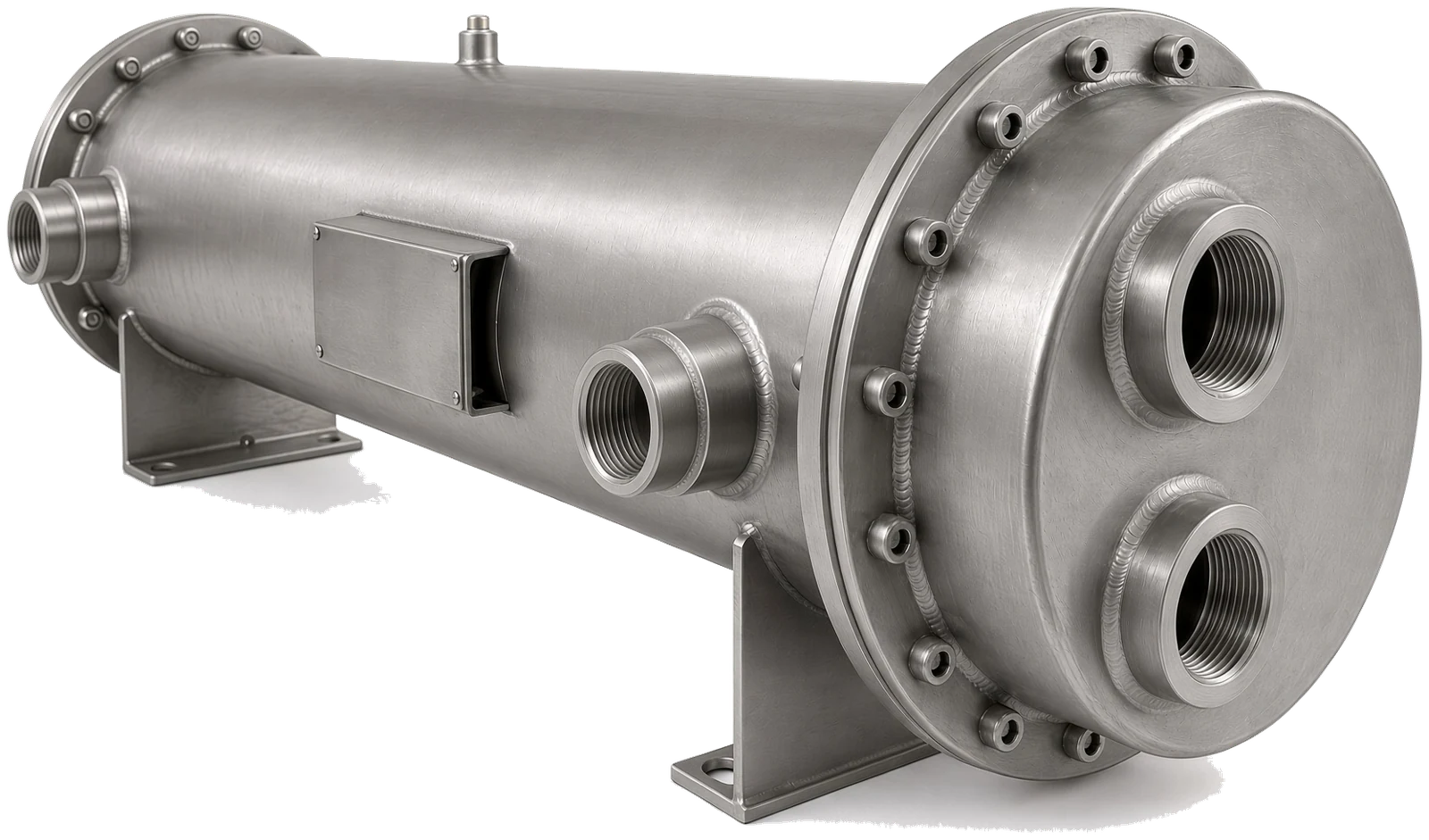
Evaporator and condenser ratings depend on brine concentration, temperature and pressure, so these are quoted per duty rather than read off a table. Call 1-805-484-2992 with the plant details and we will provide a rating.
Request a QuoteBrine Is the Difference
Concentrated brine at elevated temperature attacks the protective film copper alloys rely on, which is why titanium tubes are the baseline for evaporator duty rather than the upgrade.

Plant Data
What lets us rate the unit
- Rated output and heat source
- Feed and brine temperatures
- Operating vacuum or pressure

Output Falling
Check before replacing
- Scale on the brine side surfaces
- Vacuum holding at design
- Heat source temperature adequate
Using Engine Heat to Make Water
The elegant part of a flash evaporator is that the heat is already there. Jacket water leaving the engine at its normal operating temperature carries more than enough energy to boil seawater under vacuum, and taking some of it does not disturb the engine provided the jacket circuit is arranged and controlled properly.
- Every freshwater method concentrates salt somewhere
- Hot brine defeats the film copper alloys rely on
- Titanium is the baseline specification, not an upgrade
- Jacket water is the usual heat source on flash plants
- Evaporator ratings depend on brine and vacuum
- Titanium tolerates acid descaling routines well
Scale on the Brine Side
As seawater concentrates, calcium carbonate and eventually calcium sulfate come out of solution and deposit on the hottest surfaces. That is why evaporators run below a defined brine temperature and why plants use chemical dosing or acid cleaning routines. Scale on an evaporator tube is a capacity problem first and a corrosion problem later, since deposits create the stagnant crevices under which attack starts.
- Carbonate scale limits brine temperature by design
- Scale costs capacity before it causes corrosion
- RO plants need cooling rather than heating duties
- Jacket cooler must carry full load with the plant off
- Ratings quoted per duty, so call with plant details
Points to settle before ordering
Because the duty combines hot fluid and concentrated brine, and both attack the protective film copper alloys depend on. Titanium is unaffected by chlorides at any concentration and by the temperatures involved, and it also tolerates the acid cleaning routines that remove carbonate scale.
Yes, that is the normal arrangement on a flash evaporator, and the heat is already being rejected anyway. The point to check is that the jacket water cooler can carry the full engine load with the evaporator shut down, since the evaporator is effectively taking part of that load when it runs.
Check scale on the brine side surfaces, whether the plant is holding its design vacuum, and whether the heat source is arriving at temperature. Any of the three reduces output. If the surfaces are clean and vacuum and heat are correct, then loss of exchanger surface is the remaining explanation.
Not reliably, because brine concentration, temperature and operating vacuum all move the numbers. Send the plant make, rated output, heat source and the feed and brine conditions, and we will confirm a rating and a part number rather than guess from a table.
Often not. RO reject at ambient temperature is less aggressive then hot evaporator brine, so copper-nickel frequently suffices for pump cooling and feed duties. Chlorinated feed or warm harbor water changes that. Describe the system and we will recommend the material honestly.
Related

HEAT EXCHANGERS • TITANIUM
Titanium Range
Titanium tube options across the shell and tube frames.
+ Learn More
VESSELS & ENGINES • BY VESSEL
Offshore
Deployed vessels that depend on freshwater generation.
+ Learn More
ENGINEERING • MATERIALS
Stainless in Sea
Why stainless behaves differently from titanium in seawater.
+ Learn More
