
1-805-484-2992
Quotes - Engineering - Sales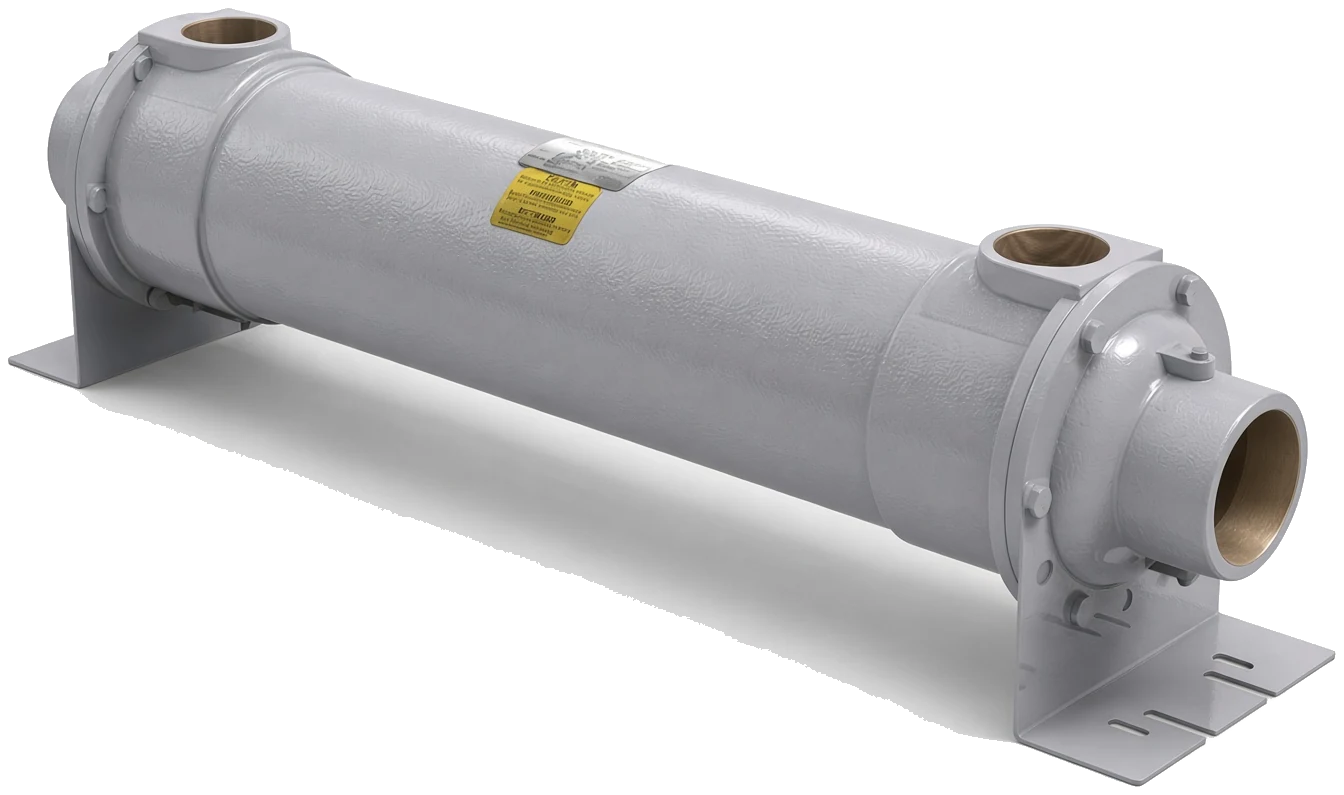
AB Series Heat Exchangers
Fixed tube shell and tube construction from 1.4 to 308 square feet, in one, two and four pass arrangements, rated 300 PSI and 300 degrees, with ASME construction available where class or a survey calls for it.
| PRODUCT | TYPE | STYLE | RATING |
|---|---|---|---|
| Heat Exchanger | Shell & Tube | Fixed Tube Marine Build | 300 PSI / 300°F |
Specifications
Configuration & Size
Shell Diameter:
2 in to 8 in
Tube Length:
To suit 1.4 to 308 sq ft
Tubes:
Copper-nickel (CNT) standard
Passes:
SP, TP and FP arrangements
Brand:
American Industrial
Materials
- Tubes: 90/10 Copper-Nickel
- Tubesheet: Fixed, welded to shell
- Bonnets: Bronze with anode bosses
- Shell: Steel, ASME option available
AB Series Construction
Fixed tubesheets, single to four pass
The AB Series is fixed tube construction, and that single decision drives everything else about it. Both tubesheets are welded into the shell rather than one floating free, so the bundle does not withdraw. In exchange the unit is compact for its surface area, has no bundle-to-shell bypass lane, and is straightforward to build to ASME with a code stamp when a survey or a class society asks for one. Surface areas run from 1.4 square feet up to 308 square feet.
Shells run from 2 inches to 8 inches in diameter, in single pass, two pass and four pass arrangements written SP, TP and FP in the part number. The marine build is CNT copper-nickel tubes with B bronze bonnets and Z zinc anodes, so a typical number reads AB-702-B6-TP-CNT-B-Z. Ratings are 300 PSI and 300°F, which puts it alongside the HC frames on pressure while keeping a shorter overall envelope.
On board it earns its place two ways. As a jacket water cooler it suits installations where space along the shell axis is tight, because no bundle withdrawal clearance is needed. As an oil cooler it handles lube and hydraulic duty well, since the fixed construction supports long tube runs at high shell-side pressure without the bypass losses a removable bundle carries.

Fixed tube means the shell side is cleaned chemically rather than mechanically, so it belongs where the shell-side fluid is a closed loop or clean oil. Put the seawater in the tubes, where a brush and a rod can still reach it, and the arrangement works for decades.
Request a QuoteAB Series Applications





Fixed tubesheet construction explained
In a fixed tube exchanger both tubesheets are welded to the shell and the tubes run straight between them. There is no floating head and no bundle to withdraw, which removes the annular gap that lets shell-side fluid bypass the bundle in a removable design. For a given shell diameter that means more tubes and a shorter unit for the same surface area.
The consequence is thermal expansion. With both ends anchored, differential expansion between tubes and shell shows up as stress rather than movement, so the arrangement suits duties where the two fluids sit within a moderate temperature range of each other. Jacket water against seawater and oil against seawater both qualify comfortably. Steam or high temperature differentials do not.
Specifying the AB Series
In a fixed unit both tubesheets are welded into the shell, so the bundle stays put and the shell side is cleaned chemically. A removable bundle lifts out for mechanical cleaning but needs clear space the length of the unit to withdraw into. Fixed construction is shorter overall and has no bundle bypass gap.
Yes, ASME construction is available across the range and is specified at order rather than added later. It affects documentation, inspection and lead time. If your vessel operates under a class or government regime that requires coded pressure vessels, say so at inquiry and we will quote the coded build from the start.
CNT is copper-nickel tubes, B is bronze bonnets and Z means zinc anodes are fitted. That trio is the marine option set and it is what makes the frame suitable for raw seawater on the tube side. Without it you have an industrial closed-loop unit that will not survive a season on salt water.
More than the equivalent water duty, often several times more, because oil has a much lower film coefficient and the coefficient falls further as the oil cools through the unit. Size against the cold end of the duty and state the allowable pressure drop, including the cold start condition, and the selection will hold up in service.
Only where the two fluids differ widely in temperature. With both tubesheets anchored, differential expansion becomes stress rather than movement. Jacket water or oil against seawater keeps the differential moderate and the construction is entirely at home there. Steam duty and large temperature differentials belong on a different geometry.
An AB number carries the frame, the connection code, the pass arrangement and then the material options: AB-702-B6-TP-CNT-B-Z is the 702 frame with B6 connections in a two pass arrangement, copper-nickel tubes, bronze bonnets and zinc anodes. SP, TP and FP in that fourth position are single, two and four pass. The full cataloged list with every shell size, surface area and connection table is held on file with our sales desk. If you are matching an existing unit, call us with the number on the nameplate and we will read it back to you option by option.

