
1-805-484-2992
Quotes - Engineering - SalesScheduled Service
Cooling to a Timetable
A passenger vessel on a schedule has a duty cycle nothing else quite matches. Twenty to forty berthings a day, each one with ahead and astern engagements, ramp work and a hold on the fenders, then a night alongside and the same again tomorrow. Engine hours accumulate at moderate load while the reduction gear takes a beating that no rating table describes. On a double-ended ferry with two gears and two shafts, that clutch duty doubles.
A ferry runs to a timetable the public can read. That changes what matters about a heat exchanger: not just whether it holds temperature, but whether it can be swapped between the last run and the first one.
The second constraint is the maintenance window. Ferries and excursion boats do not go out of service for a week; they get an overnight, or a Sunday, or a scheduled short docking booked a year in advance. That means the important qualities of a ferry heat exchanger are that it fits the existing envelope exactly, that it arrives before the window opens, and that the crew can pull a bonnet in the space available without unbolting half the engine room.
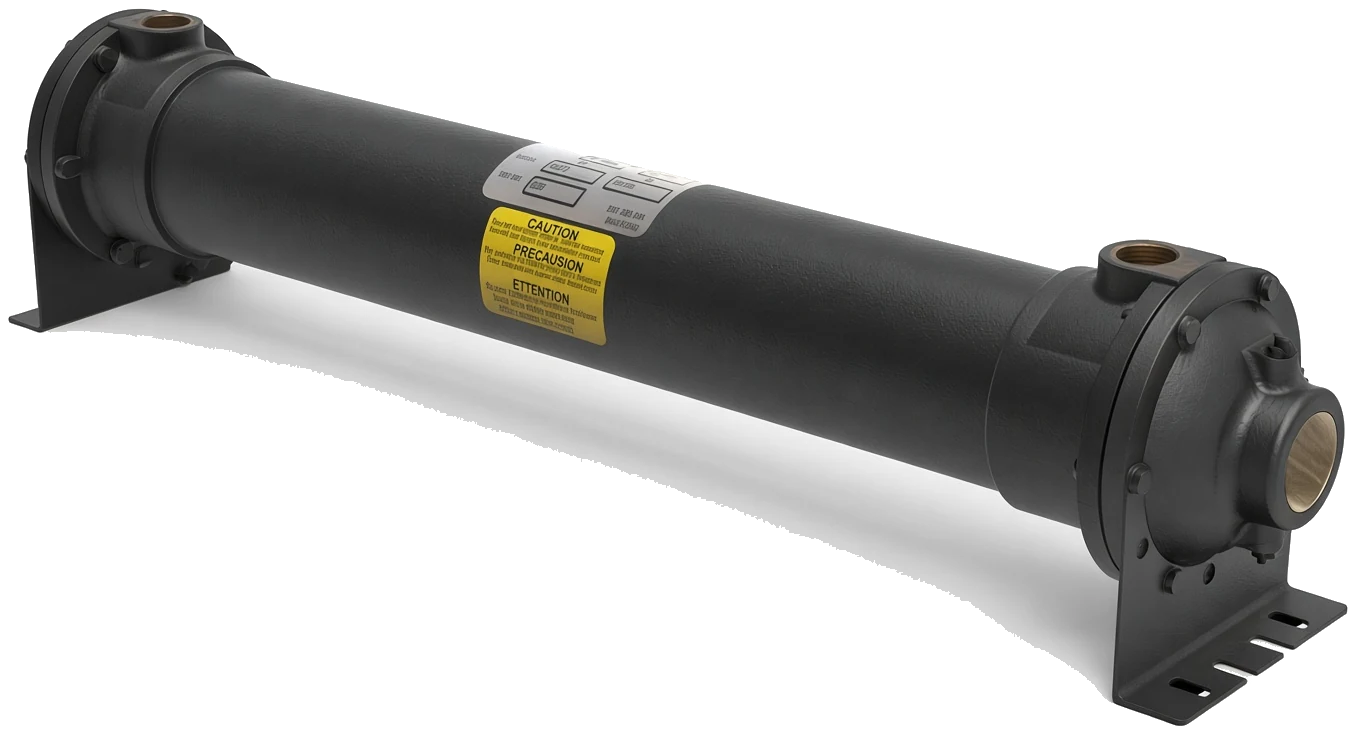
For scheduled operators we work backwards from the window. Tell us the date the boat is available and what has to be changed, and we will confirm what is on the shelf and what needs lead time, so nothing arrives the day after the docking closes.
Request a QuoteThe Window Is the Spec
On a scheduled vessel a cooler that fits perfectly and arrives late is the same as a cooler that does not fit at all.

Plan the Window
Get the dimensions first
- Overall length and shell diameter
- Bonnet pull clearance each end
- Connection sizes and orientation

Vessel File
Records that save a sailing
- Part number and tube material
- Anode part number and count
- Dates fitted and cleaned
Berthings Wear the Gear
Engine hours describe a ferry poorly. What describes it is engagement count: every berthing takes at least one ahead and one astern engagement, and a busy route can produce several hundred a week per gear. That is clutch slip energy going into a modest oil charge, over and over, and it is why gear oil coolers on scheduled boats wear out ahead of anything else.
- Engagement count describes ferry duty better than hours
- Double enders double the reduction gear clutch duty
- Air conditioning is a critical system, not a comfort
- Maintenance windows are overnight, not weekly
- Exact envelope match matters more than catalog size
- Complete spare units justified on critical duties
Air Conditioning Is Not Optional
On a passenger vessel the air conditioning is not a convenience, it is part of the service. A chiller condenser that has lost capacity to fouling means a warm saloon on the hottest day of the year, complaints, and in some cases a canceled charter. Condensers also run seawater at higher velocity than a jacket cooler, and often in harbor water at its warmest.
- Chiller condensers foul in warm harbor water
- Titanium worth costing out on condenser duty
- ASME construction available where inspection requires
- Bonnet pull clearance decides serviceability
- Records turn a failure into a same-day order
Sizing questions
Because berthings, not hours, are the load. Each berthing needs ahead and astern engagements, and clutch slip energy goes into a modest oil charge hundreds of times a week. Sizing on a cruise condition underestimates the peak, which is why we size these units for the berthing cycle.
It depends on the frame, so ask early. Give us the dimensions and the date the vessel is available and we will tell you what is on the shelf, what has lead time, and whether accepting a different connection orientation would let us hit your window.
For gear oil and jacket water on a route with no relief vessel, yes. For less critical duties a spare bundle, gasket set and anodes usually suffice. The test is simple: if the failure cancels sailings and the replacement has lead time, hold a complete unit.
Very often, yes. A fouled seawater condenser raises head pressure and cuts capacity without alarming. Check the condensing pressure against seawater temperature before condemning the compressor, and clean or replace the condenser. Titanium tubes are worth considering if this recurs.
Yes. AB Series units are available with ASME construction and we supply pressure test and material documentation with them. Tell us at inquiry, because code construction affects lead time and cost and cannot be added to a unit already built.
Treat the twin as suspect. Two gears on the same hull have seen the same water, the same anode neglect and the same engagement count, so when one bundle fails from pitting or fouling the other is normally a season or less behind it. Changing both in a single window costs one extra unit and saves a second docking. Where the failure was a one-off, such as a lost anode plug, inspect the other bundle and keep it running.
Related

APPLICATIONS • SEAWATER
Chiller Condensers
Air conditioning condensers and why they loose capacity quietly.
+ Learn More
HEAT EXCHANGERS • PARTS
Bonnets
Bonnets and gasket sets to keep a scheduled boat running.
+ Learn More
ENGINES • DETROIT DIESEL
Series 60
A common passenger vessel engine and its cooler selections.
+ Learn More
