
1-805-484-2992
Quotes - Engineering - SalesPrivate Vessels
Low Hours, Hard Life
The thermal duty on most yachts is undemanding and the failures are still frequent. A sportfisher might run three hundred hours a year, hard for six of them and idle for the rest, and a motor yacht may do less. Yet the coolers on those boats fail regularly, because the enemy is not heat load. It is a marina berth with shore power connected, stagnant seawater sitting in tubes for weeks, stray current from a dock with a marginal ground, and a set of zinc anodes that has been quietly gone for two seasons.
A yacht's coolers rarely die of overwork. They die of eleven months on shore power in a marina, standing seawater, and anodes nobody pulled since the boat was new. The duty is easy; the environment is not.
Sportfishers add a genuinely hard thermal duty on top: wide open throttle running out to the canyons, high sustained load in warm water, then trolling for hours at low RPM where raw water flow falls off and the engine room gets hot. That combination punishes marginal selections. Motor yachts instead concentrate their load in auxiliaries: gensets running all night at anchor, air conditioning working through a Caribbean afternoon, and zero-speed stabilizers that run the hydraulic pack with the mains shut down.
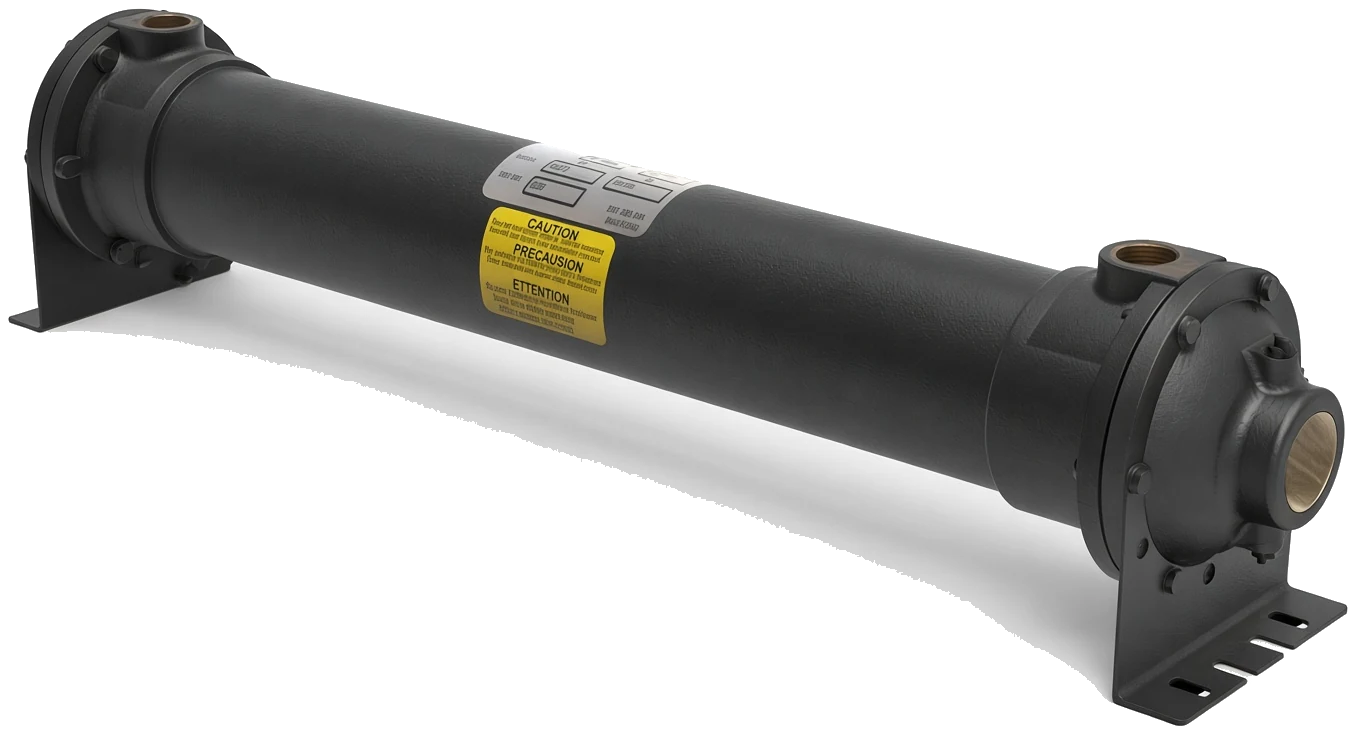
If a boat has lost tube ends in under five years, stop and look at the electrical system before buying another cooler. Bonding, shore power ground and neighboring boats matter more than tube alloy in a marina, and a new cooler will go the same way.
Request a QuoteMarinas Kill Coolers
Stray current in a berth destroys tube ends faster than any amount of running, which is why low hour boats so often need coolers a working boat would not.

Marina Check
Before you blame the cooler
- Shore power ground and bonding
- Anode consumption rate
- Other underwater metal condition

Layup Routine
One hour that adds years
- Fresh water flush the raw side
- Drain or fill with inhibited fluid
- Fit new anodes before storage
The Marina Problem
A boat plugged into shore power for months is electrically connected to every other boat on the dock through the ground conductor. Where one of them has a fault, or the dock wiring is tired, current finds its way through the water and through any metal it can reach. The tube ends and tubesheet of a seawater cooler are ideal targets, and they pit and thin far faster than any chemical corrosion would manage.
- Low hours does not mean low wear on a marina boat
- Stray current pits tube ends within a season or two
- Trolling can produce the highest coolant temperatures
- Raw water flow falls with engine RPM at low speed
- Gensets accumulate more hours than the main engines
- Zero speed stabilizers run with no incidental cooling
Trolling Is Harder Than It Looks
At trolling speed a belt-driven raw water pump turns slowly and delivers less flow, while the engine still makes meaningful heat and the engine room ventilation is barely working. Sportfishers commonly see their highest coolant temperatures not at wide open throttle but after two hours of trolling in flat calm summer conditions.
- Anode consumption rate is a diagnostic, not a chore
- Standing seawater over a layup does real damage
- Air conditioning condensers foul without alarming
- Engine room access often decides the frame choice
- Check bonding before buying a second cooler
Operating questions
Almost certainly not thermal duty. Marina stray current, spent zinc anodes and standing seawater through layups destroy tube ends independently of running hours. Check the shore power ground and bonding and the anode consumption rate before fitting a replacement, or the new unit will follow the old one.
At low RPM the belt-driven raw water pump delivers less flow while the engine still makes real heat, and engine room ventilation is minimal. Verify raw water flow at trolling RPM, check the strainer and impeller, and consider extra surface if the pattern persists with a clean system.
Inspect at every haul-out and replace anything more than half consumed. If they are disappearing in weeks rather than seasons, you have a stray current problem to solve first. Keep two sets aboard, because the awkward part is usually access to the plugs, not the part cost.
It is worth costing out, especially for boats that live in warm harbors or near chlorinated discharges. Condenser duty runs seawater fast and warm, which is harder on copper alloys than jacket water service. For temperate cruising, copper-nickel with maintained anodes is still sensible.
That is most of what we do on yachts. Send overall length, shell diameter, connection sizes and thread type, mounting centers, and the clearance at each end for pulling a bonnet. We will find a frame that fits and, where needed, rotate the bonnets to suit the piping.
Titanium moves the attack rather then ending it. Stray current from a dock looks for the most anodic metal in the seawater path, and with titanium tubes that becomes the bronze bonnets, the tubesheet and the raw water pump body. Sort out the shore power ground and bonding first, then choose the tube material on where the boat cruises. In warm harbor water with the electrics corrected, titanium is a sound upgrade; as a fix for a wiring fault it is an expensive detour.
Related

APPLICATIONS • ENGINE COOLING
Genset Cooling
The auxiliary engines that actually accumulate the hours.
+ Learn More
APPLICATIONS • JACKET WATER
B Series
Small frames with bronze bonnets and zincs for yacht duty.
+ Learn More
ENGINES • OTHER MARINE
Volvo Penta
A common yacht and sportfisher engine and its cooler needs.
+ Learn More
