
1-805-484-2992
Quotes - Engineering - SalesInlet Air
Cooling the Charge
A turbocharger raises inlet pressure and, unavoidably, inlet temperature. Hot charge air is thin air, and thin air limits how much fuel can be burned cleanly. The aftercooler pulls that temperature back down, restoring density, dropping peak combustion temperature and keeping NOx and smoke in check. On a marine diesel the heat taken out of the charge air can approach the heat taken out of the jacket water, which is why treating the aftercooler as a minor component is a mistake.
Cooling the compressed inlet air is what lets a turbocharged marine diesel make its rating. When the charge air circuit loses capacity the engine smokes, runs hot on exhaust and quietly gives back horsepower nobody notices until the survey.
Marine installations cool that air in one of two ways. Some engines run the aftercooler directly on raw seawater, with the water passing through tubes inside an air housing. Others use a separate low temperature coolant loop that is itself cooled by a shell-and-tube exchanger against seawater, a central cooling arrangement that keeps salt water out of the aftercooler entirely. Which one you have decides what fails and what a replacement looks like.
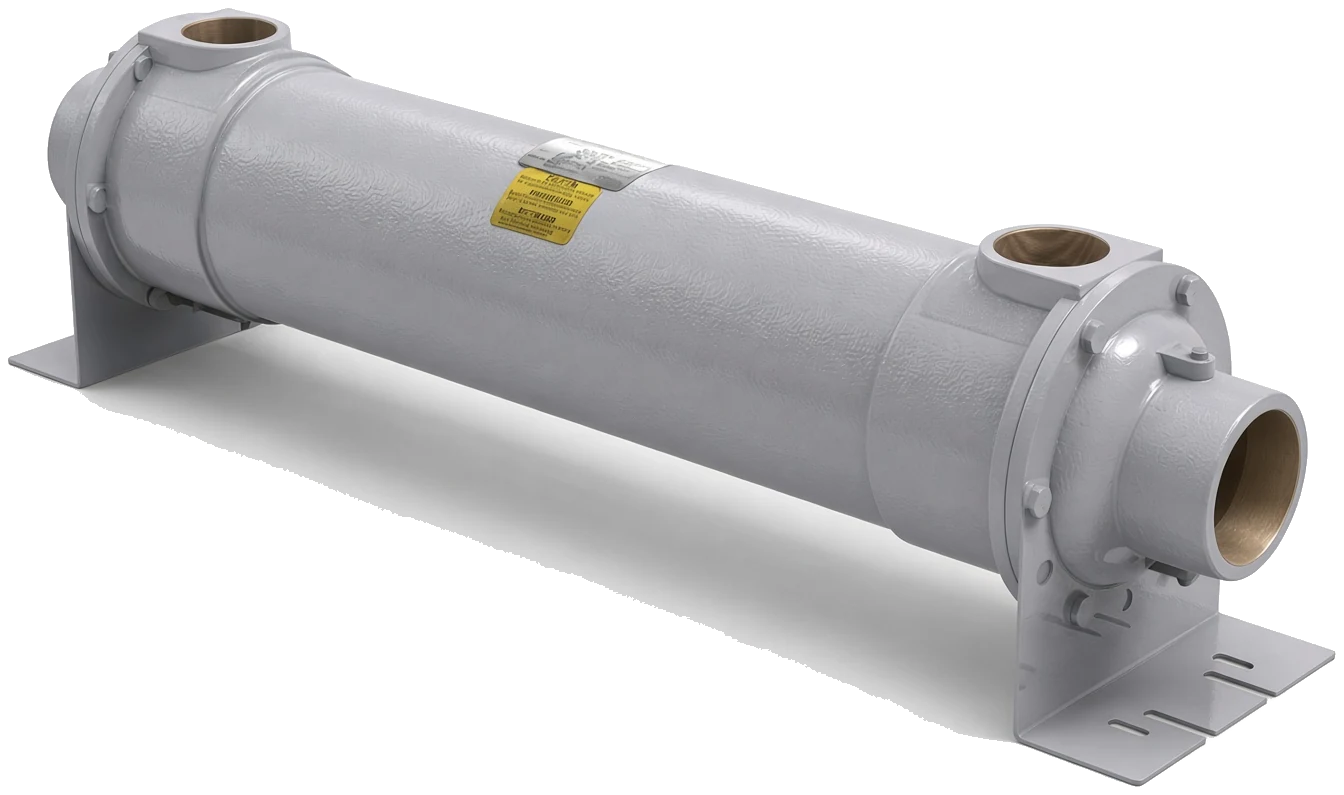
If your engine cools charge air through a separate low temperature circuit, the exchanger between that circuit and the sea is standard shell-and-tube work and we can size it from the circuit heat load and flow. Send the engine model and the old part number and we will confirm the frame.
Request a QuoteAir Side Fails First
On a seawater aftercooler the tubes usually outlive the air side, because salt carried in through the air filter attacks aluminum fins the water never touches.

Measure Performance
Prove the loss before you buy
- Manifold air temperature under load
- Seawater or circuit inlet temperature
- Exhaust gas temperature trend

Inspect the Housing
Signs of salt attack
- White powder on fin edges
- Loose or collapsed fin pack
- Coolant staining in the air path
Why Manifold Temperature Matters
Every degree the aftercooler fails to remove shows up as less oxygen in the cylinder for the same manifold pressure. The engine responds by burning the same fuel with less air, which produces smoke, raises exhaust gas temperature and pushes the turbocharger further up its map. Sustained, that costs turbine life as well as fuel.
- Charge air heat can rival jacket water heat rejection
- Manifold temperature is the honest performance check
- Salt attacks the air side, not the water side
- Central cooling concentrates seawater into one exchanger
- Titanium tubes where the water is chlorinated or hot
- Heresite protects aluminum cores in spray service
Salt on the Air Side
Marine engine rooms breathe salt-laden air. On a charge air cooler the air side fins collect that salt, and unlike a seawater tube it never gets rinsed. Aluminum fin stock corrodes into a white powder, the fin bond to the tube degrades, and the cooler loses transfer long before anything leaks. Engine room ventilation and filter placement make a real difference to how fast this happens.
- Smoke and high exhaust temperature come before leaks
- Air side pressure drop matters as much as water side
- Low temperature circuits are ordinary shell-and-tube work
- Housing envelope usually fixes the frame length
- Nameplate photo speeds identification of an old unit
Design questions
In common marine usage they mean the same thing: the exchanger that cools compressed air after the turbocharger and before the inlet manifold. Strictly an intercooler sits between two compression stages and an aftercooler follows the last one, but on a single-stage marine diesel the terms are used interchangeably.
Compare manifold air temperature under load against the cooling water temperature. As the cooler loses surface that gap widens. Supporting evidence is black smoke under acceleration, exhaust gas temperature climbing over seasons, and a rating the engine used to make and now does not.
It is worth considering if the vessel works in warm chlorinated harbor water, has stray current history, or has already lost one cooler to tube-side attack. For ordinary open-water raw seawater duty, copper-nickel tubes with zinc anodes remain the sensible and cheaper choice.
On many installations yes, and it is a sound move if aftercooler corrosion keeps recurring. You add a coolant loop, a circulating pump and one shell-and-tube exchanger against seawater. Call 1-805-484-2992 with the engine data and we will size the exchanger for the study.
That is an internal leak in the cooler core, and it needs attention immediately. Coolant entering the inlet manifold can hydraulic a cylinder on start. Isolate the engine, confirm the source, and plan on a replacement core rather than a repair attempt on a corroded fin pack.
Related

APPLICATIONS • ENGINE COOLING
Jacket Water
The main coolant loop and how its cooler is sized.
+ Learn More
HEAT EXCHANGERS • TITANIUM
Seawater Coolers
Titanium tube coolers for chlorinated and high velocity water.
+ Learn More
ENGINES • OTHER MARINE
MTU Engines
Cooling replacements for high speed MTU propulsion diesels.
+ Learn More
