
1-805-484-2992
Quotes - Engineering - SalesTube Bundle Replacement
Judging what is worth saving
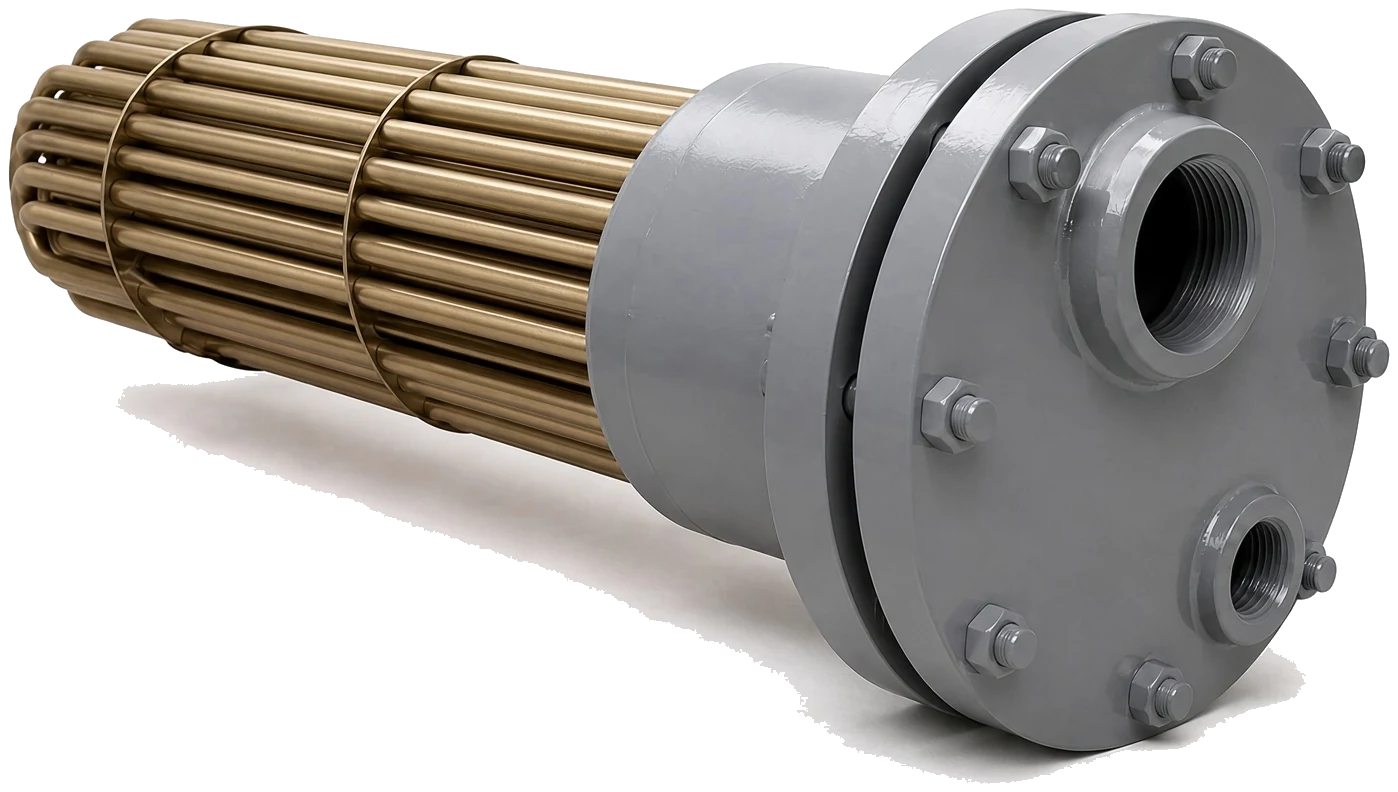
Tubes are the thinnest metal in a cooler and they carry the aggressive fluid, so they fail first and they fail long before the shell does. That asymmetry is what makes bundle replacement such good value. A shell that has only ever seen inhibited coolant or oil can be structurally as good as new after fifteen years, and the bonnets, being bronze, are often serviceable after a clean and a new gasket. Replacing only the part that failed is faster, cheaper and produces a cooler that performs exactly as a new one does.
Shells and bonnets usually outlive tubes. If the shell wall is sound and the flange faces are flat, a new bundle restores the cooler to new condition for a fraction of a complete unit.
The judgement is whether the rest of the unit deserves a new bundle. Three checks decide it: the shell wall thickness and internal condition, the flatness and integrity of the bonnet flange faces, and whether the frame was correctly sized in the first place. Any one of those failing changes the answer. A thin shell is not worth a new bundle, pitted flange faces will not seal, and putting a new bundle in an undersized cooler buys you the same warm engine you already have.
There is also a middle option that gets overused. Plugging leaking tubes is a legitimate repair for one or two, costs a little surface, and gets a vessel home or through a season. Once several tubes in the same pass are plugged, the flow redistributes onto the remaining tubes at higher velocity, the lost surface starts to show on the gauge, and the honest answer becomes a bundle rather than more plugs.
Three Checks Decide
Shell wall, flange faces, original sizing: if all three pass, a new bundle is the cheapest way to a cooler that behaves like new.
Bundle Only
- Shell wall sound and unpitted
- Flange faces flat and clean
- Frame correctly sized originally
- Bonnets serviceable or replaceable
- Failure confined to the tubes
Whole Cooler
- Shell thinned or pitted through
- Flange faces beyond machining
- Unit was undersized from new
- Multiple previous repairs
- Discontinued frame with no parts
Before Refitting
- Clean the shell bore thoroughly
- Check baffle and support condition
- Renew all gaskets
- Fit new zinc anodes
- Pressure test before installation
| FINDING | MEANING | DECISION | NOTE |
| One or two leaking tubes | Isolated failure | Plug and monitor | Costs a little surface each |
| Several tubes in one pass leaking | Erosion or general wall loss | Replace the bundle | Plugging worsens velocity |
| Leaks plus wasted anodes | Galvanic attack at tube ends | Bundle plus anode review | Fix the cause as well |
| Shell wall thin on inspection | Shell at end of life | Complete cooler | A bundle is wasted money |
| Flange faces pitted | Will not seal a new gasket | New bonnets or complete unit | Bonnets available separately |
| Engine always ran warm | Original selection marginal | Larger frame | Do not rebuild the mistake |
Getting The Old Bundle Out
Access, clearance and patience
On a removable bundle design the tube nest withdraws from one end, which is why pull clearance matters at installation and why a cooler bolted into a tight space is harder to maintain than the same cooler on a bulkhead with room in front of it. Support the bundle as it comes out rather than letting it hang on the tubes, and keep it level so the baffles do not catch on the shell bore.
Fixed tube construction, as used on the AB Series, does not have a withdrawable nest, so the repair route there is tube plugging or replacement of the complete unit. Knowing which construction you have before you start avoids wasted work, and the frame designation tells us immediately if you call it in.
Inspecting The Shell While It Is Open
The one chance you get
With the bundle out, the shell interior is visible for the only time in its service life. Look for general thinning, pitting, and any erosion at the nozzle entries where the shell-side fluid impinges. Check the baffle condition and the tube support arrangement if any remains in the shell, and clean the bore properly so grit does not score the new tubes on assembly.
This is also the moment to check the flange faces carefully. Light gasket residue and minor marking are normal and clean up; deep pitting across the sealing band means the face will not hold a new gasket. Replacement bonnets are available separately for the frames we supply.
Upgrade While It Is Apart
A different alloy or a different pass count
A bundle replacement is the natural point to change what failed rather than repeat it. If the tubes eroded at the inlets, a bundle with fewer passes lowers velocity, or 70/30 copper-nickel buys headroom at modest extra cost. If the water is chlorinated, silty or the vessel sits idle for long periods, titanium tubes remove the corrosion question altogether.
It is also the moment to add anode ports if the original did not have them, or to move from cast iron to bronze bonnets on a seawater cooler. Both changes pay for themselves quickly in anode consumption and tube-end life. Tell us why the original failed and we will specify the replacement to address it.
Service life questions
A bundle is substantially cheaper and usually quicker, provided the shell wall is sound, the bonnet flange faces will seal a new gasket, and the frame was correctly sized originally. If any of those three fail, a complete cooler is the better buy and a bundle would be money spent on a unit at end of life.
Removable bundle designs can, and that covers most of the shell and tube frames used for marine engine cooling. Fixed tube construction, as on the AB Series, has the tubes rolled into tubesheets welded to the shell, so the repair options there are tube plugging or replacement of the complete unit.
One or two is a reasonable repair with a small surface penalty. Beyond that the plugged tubes push their flow onto the remaining tubes in the pass, raising velocity and erosion risk, while the lost surface starts to show as a warmer engine at full load. Several plugged tubes in one pass means order a bundle.
Consider it, because a retube is the cheapest moment to fix the cause rather than the symptom. Inlet erosion suggests less passes or the 70/30 grade. Chlorinated, silty or long-stagnant water suggests titanium. Tell us how the original failed and we will specify a bundle that does not repeat it.
The frame size from the nameplate, the pass arrangement, and photographs of the shell interior and both bonnet flange faces so we can confirm the rest of the unit is worth rebuilding. If the plate is unreadable, send the shell diameter, tube length between tubesheets and connection sizes instead.
Related

ENGINEERING • SELECTION
Replacing a Cooler
Measurements that identify a frame with no nameplate
+ Learn More
HEAT EXCHANGERS • TITANIUM
Titanium Coolers
Retube options that remove the corrosion question
+ Learn More
VESSELS & ENGINES • BY VESSEL
Tugs and Workboats
Rebuild planning around commercial operating schedules
+ Learn More
