
1-805-484-2992
Quotes - Engineering - SalesCoolant, Charge Air and the Sea Outside
An engine builder publishes a jacket water temperature band and expects you to stay inside it. Too cold and combustion suffers, fuel dilutes the oil and the crankcase sweats. Too hot and you are into detonation, liner distortion and head gasket trouble. On a marine installation nothing but the sea is available to carry that heat away, so a heat exchanger stands between the treated engine coolant and raw seawater that may be silty, warm, or full of jellyfish in August.
A marine diesel needs its coolant, its charge air and its oil held inside limits the engine builder set, using whatever seawater the boat is floating in. These pages cover each of those loops and the coolers that carry them.
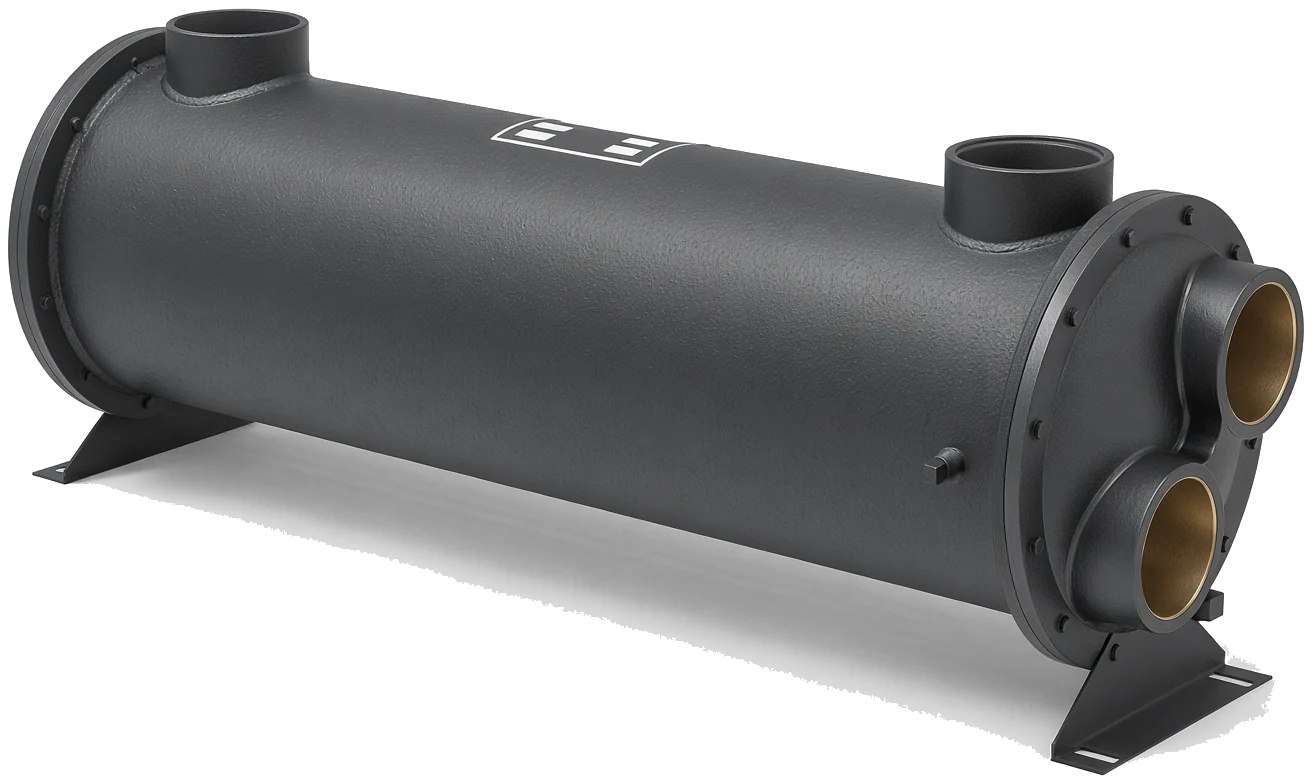
If the failed unit sits between the engine's coolant pump and the raw water pump, this is your page. The jacket water cooler carries the largest heat load aboard and decides whether the thermostat band holds in August water. It is selected from the engine's published heat rejection and jacket flow rather than horsepower alone, with the frame matched to the envelope the old unit left. Most jacket duty falls on the HC Series, with the B Series below it on small auxiliaries and the AB fixed-tube range where a skid or sound shield fixes the layout.
Choose this page when the symptom is smoke and high exhaust temperature rather than a rising coolant gauge. Charge air is the other half of a turbocharged engine's heat balance and it fails in a different place: the aluminum fin side that salt-laden engine room air reaches, not the water side. The arrangement on your engine decides the replacement path. A seawater aftercooler is a housing-and-core problem; a low temperature circuit cooled against the sea is ordinary shell-and-tube work, with titanium tubes where the water is warm or chlorinated, sized from circuit heat load and flow.
Auxiliary engine coolers are small, started cold and forgotten, and that combination earns them their own page. A genset cooler is sized from the engine's heat rejection behind the alternator, not the kilowatt badge, so a 100 kW set is treated as roughly a 140 to 150 horsepower engine. Frames are modest, mostly the small end of the B Series on yachts and fishing boats and AB fixed-tube units on skid-mounted ship service sets, but the duty is repeated thermal cycling plus long idle periods full of stagnant seawater. Sound shield clearance often decides the frame length.
Engine builders publish heat rejection to jacket water in BTU per hour at each rating, along with the flow the belt-driven pump delivers. Those two numbers, plus the temperature band, are the whole thermal problem on the shell side. We never quote a heat rejection figure as fact for your engine because ratings vary by build; we ask you to read it off the data sheet for the serial number you actually have.
The HC Series covers the bulk of marine jacket water duty, running from roughly 10 HP on a four-pass 614 frame up to about 1250 HP on a two-pass 1772. Below that band, small auxiliaries and sailboat diesels often sit on a B Series frame. Above it, larger propulsion engines are usually served by more than one exchanger or by a central cooling arrangement.
A turbocharged engine rejects a large fraction of its heat into the compressed inlet air, and cooling that air is what makes the rating possible. On many marine engines the aftercooler runs on raw seawater or on a separate low-temperature circuit, and on either arrangement it lives closer to salt than the jacket cooler does.
Every engine cooling job starts with two numbers off the engine data sheet: heat rejection at your rating and jacket flow from the engine pump. Add the hottest seawater the boat will work in and the selection is fixed. Call 1-805-484-2992 and we will pull the frame that meets it.
Cooling the Main Engine




Sized for August
An engine cannot be cooled below the seawater temperature plus the exchanger approach, so a cooler chosen on spring water will run hot every summer it survives.
Charge Air Is Its Own Problem
A turbocharged engine rejects a large fraction of it's heat into the compressed inlet air, and cooling that air is what makes the rating possible. On many marine engines the aftercooler runs on raw seawater or on a separate low-temperature circuit, and on either arrangement it lives closer to salt than the jacket cooler does.
Related Applications
Keel Cooler or Heat Exchanger
Keel coolers have real advantages. No raw water pump, no sea chest, no strainer to clear, and nothing inside the hull to leak into the bilge. On a workboat in silty river water that beats a heat exchanger on maintenance alone, and we say so.
What they cost you is hull penetration, vulnerability to grounding and debris, a fixed capacity you cannot change without hauling the boat, and fouling you cannot clean without a diver. Where speed, hull form, class requirements or engine room layout point the other way, a shell-and-tube cooler is the right answer, and the comparison page sets out exactly when.
Aftercooling on a Turbocharged Marine Diesel
The symptoms of a failing charge air circuit are distinct: black smoke, high exhaust temperature and a rating the engine can no longer hold, well before any coolant is lost. The charge air page goes through the failure modes and the exchangers that serve the circuit.
This section covers all of it, including the question owners ask most often: whether to keep a keel cooler or go to a shell-and-tube heat exchanger. We answer that honestly, because the keel cooler is genuinely the better answer on some hulls. Where a shell-and-tube cooler is the right call, we tell you which frame covers your horsepower and what to send us to get a marine jacket water cooler replacement on the shelf before the boat is down.
Engine Cooling

APPLICATIONS • JACKET WATER
AB Series
Fixed tube marine coolers at 300 PSI in one, two or four pass.
+ Learn More
ENGINES • CUMMINS
Cummins Coolers
Replacements for the 6BT, QSM11, KTA19 and larger blocks.
+ Learn More
ENGINEERING • SERVICE
Cleaning Tubes
Descaling a fouled seawater side before condemning the cooler.
+ Learn More
