1-805-484-2992
Quotes - Engineering - SalesGasketed Plate
The Gasketed Plate Unit
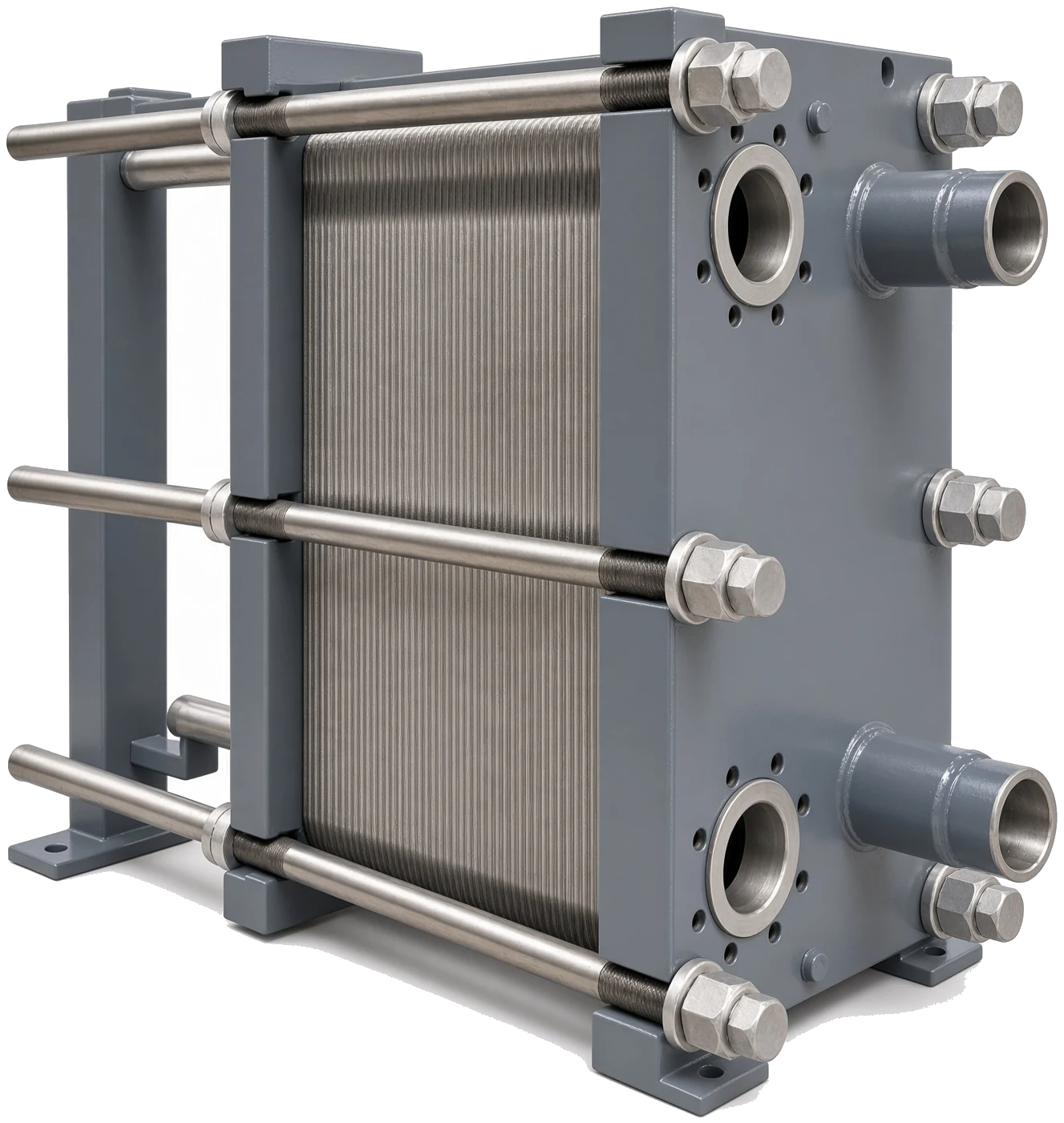
A gasketed plate heat exchanger for seawater is four things bolted together: a stack of pressed titanium plates, a gasket on every plate, a carbon steel frame and pressure plate, and the tie bolts that clamp the lot. The plates do the heat transfer, the gaskets route the two fluids and seal them from each other and from the outside, and the frame carries the pressure. Nothing is welded across the fluid boundary, which is why the unit can be opened, cleaned, re-gasketed and closed again on board.
The seawater side sees titanium and elastomer and nothing else. The fixed frame plate carries all four connections, two for seawater and two for the fluid being cooled, and the connection ports through the plate pack are lined so seawater never reaches the steel frame. The fluid on the other side is typically fresh water from a central cooling loop, chilled-water or refrigerant condensing duty on larger vessels, lube oil on larger vessels, or jacket water on larger installations where the load has outgrown a bundle. Where the other fluid is a refrigerant or runs at a pressure a gasket should not see, the same frame takes laser-welded plate pairs instead; that is the Semi-Welded option.
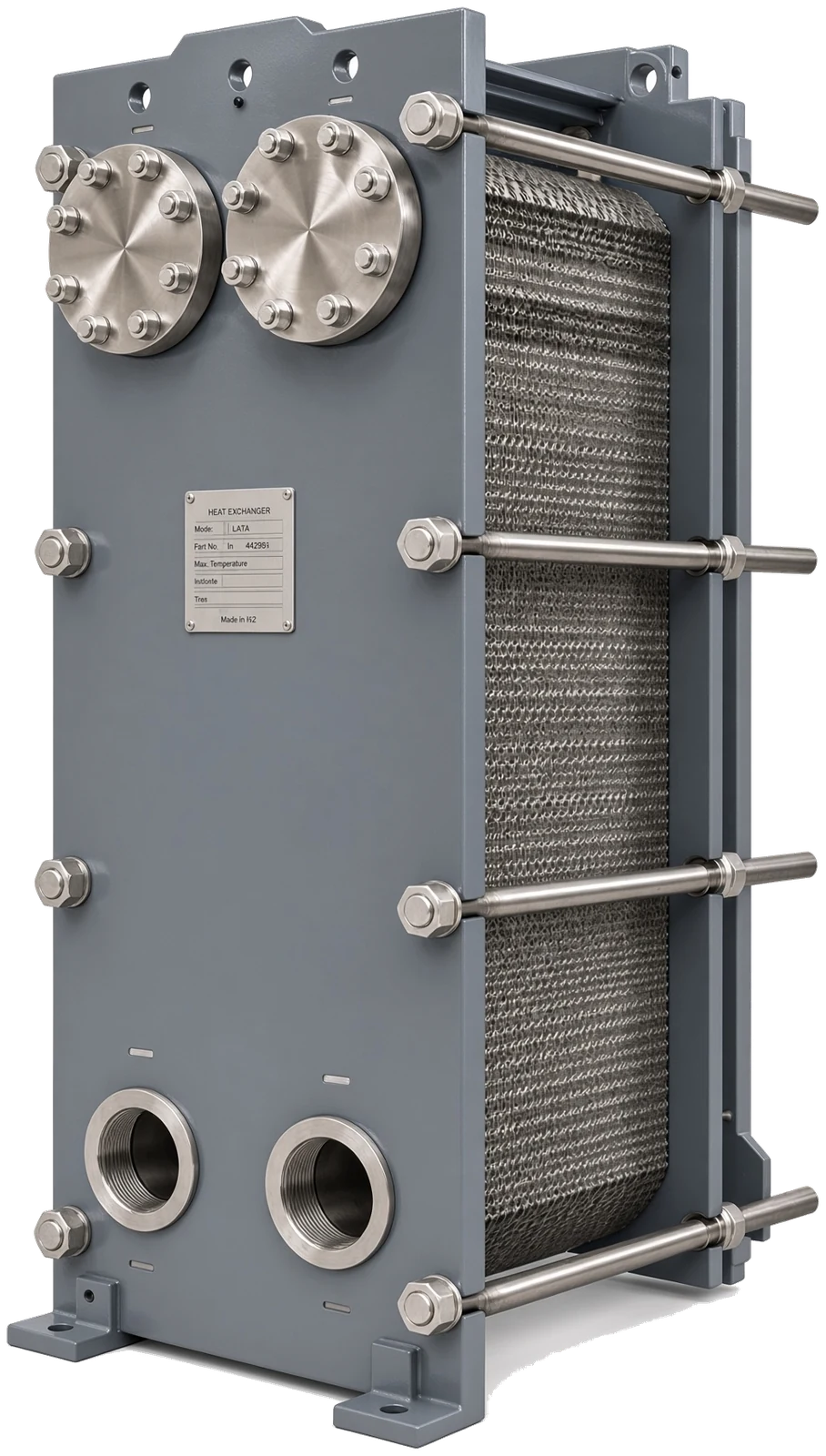
Expandability is built in. A frame ordered with spare length takes additional plates later, and the tie bolts are simply drawn up to the new pack dimension. Tell us about planned load growth when the unit is first rated and the frame will be sized to take it.
Request a Quote



How the Unit Is Put Together
The plates hang from a carrying bar at the top of the frame and are guided by a bar at the bottom, so the pack can be slid apart plate by plate once the pressure plate is backed off. Each plate is pressed with a corrugated pattern that sets the channel gap and the turbulence, and the pattern is chosen for the duty: a steeper chevron for a high heat transfer rate at a higher pressure drop, a shallower one where pressure drop is the constraint.
The gasket sits in a groove around the plate edge and around two of the four ports. Which two alternates from plate to plate, and that alternation is what puts seawater in one set of channels and the cooled fluid in the other. The frame is carbon steel, painted, and the tie bolts run the length of the pack to compress the gaskets to their working dimension, which is marked on the frame as a pack length. On a semi-welded unit every second gasket is replaced by a laser weld and the two plates become one cassette.
Changing Capacity in the Frame
Because capacity comes from the number of plates rather than the size of a shell, a unit can be enlarged after installation. If the vessel picks up an extra generator, a bigger chiller or a new hydraulic consumer on the central cooling loop, the additional load is met by adding plates to the existing frame, provided the frame has the length to take them and the connections can pass the added flow.
That is why frame length is a question at the first rating. A frame ordered with spare capacity costs little more than one ordered tight, and it saves a whole new unit when the load grows. Tell us the duty today and the duty you expect, and we will rate the plate pack for today and the frame for tomorrow.
Replacing an Existing Plate Unit
Most inquiries are for a replacement, and a plate unit is straightforward to match when we have the right data. Send a photo of the nameplate, front and any side plates. Count the plates in the pack. Measure the plate height and width, and the distance between port centers, vertical and horizontal. Note the connection size and where each of the four connections sits on the fixed end, and whether they are flanged or threaded.
Add the duty if you have it, or the fluids, flows and temperatures the unit is seeing now, and tell us what the existing gaskets are if the pack has been opened. With that we confirm the thermal duty, the connections and the frame envelope, and we confirm the replacement with you before anything is built. The general method is on Replacing an Existing Cooler.
What a Rating Is Built From
A new plate unit needs the heat load, or the flow and the temperature change on one side from which we derive it. It needs both fluids named, their flows, their inlet and required outlet temperatures, and the pressure drop each side can stand. Seawater inlet temperature should be the warmest water the vessel will trade in, not the water she was rated in, because the approach temperature is what a plate unit sells. Whether the duty belongs on plates at all is discussed on Plate vs Shell and Tube.
The rating then sets plate size, plate pattern, plate count and gasket material, and from those the frame and the connection sizes. Ratings, plate counts and sizes are per duty, so we do not publish them as a table. Call 1-805-484-2992 with the figures and we will return the selection, and note in the same conversation whether you want spare frame length.
Opened, Not Replaced
A plate unit that fouls is backed off, hosed down and closed again in an afternoon, with the pipework never touched and the plates going back into service.
Operating questions
It depends on the frame, the plate size and the gasket material, so it is set at the rating for each duty rather than quoted as a range. Tell us the working and test pressures your piping system requires and the temperatures on both sides, and the rating will be returned with limits that suit the duty. Call 1-805-484-2992.
If the frame has spare length, yes. Additional plates are hung on the carrying bar in the correct gasket orientation and the tie bolts are drawn up to the new pack length. Send the nameplate, the current plate count and the frame's maximum plate capacity if it is marked, and we will supply the plates and the new pack dimension.
No. Every connection is on the fixed frame plate, so the tie bolts are slackened, the pressure plate is drawn back along the guide bars, and the plates are slid apart for washing. The pipework stays made up throughout. That is the main service advantage over a shell and tube, which needs its bundle withdrawn.
NBR suits oil and moderate water temperatures; EPDM suits hotter water and steam-heated duties but not oil. Refrigerant duties are checked against the specific refrigerant. The choice is made at the rating from the fluid and temperature on the non-seawater side, and it should be repeated exactly when the pack is re-gasketed later.
A nameplate photo, the plate count, the plate height and width, the port center distances, the connection size and position on the fixed end, and the duty or the flows and temperatures you see now. From that we match the thermal duty and the connection envelope and confirm the replacement with you before it is built.