
1-805-484-2992
Quotes - Engineering - SalesCentral Cooling Duty
One Seawater Cooler for the Whole Vessel
A fresh water isolation heat exchanger is the one cooler on the vessel that seawater is allowed to touch. Raw water from the sea chest passes through its tubes or plates and goes back over the side. On the other side of the wall runs a closed loop of treated fresh water, usually with glycol, that is pumped around every other cooling duty on board: main engine jacket water, lube oil, reduction gear, hydraulics, the chiller condenser, the refrigeration plant and the generator sets. Those coolers never see salt water, so they can be plain steel and copper, run without zincs, and last the life of the vessel.
One heat exchanger sees the sea. Everything behind it, engines, gears, hydraulics, chillers and compressors, runs in treated fresh water that never touches salt, silt or a zinc. This page covers how an isolation cooler is arranged, what it is built from and what we need to size or replace one.
The arrangement is called central cooling on ships and fresh water isolation or a keel-cooler alternative on workboats and yachts, and the logic is the same at any size. Corrosion, fouling, silt and marine growth are concentrated in one unit that is built to take them, with titanium or copper-nickel tubes, bronze or 316 bonnets, zinc anodes where dissimilar metals remain, and connections placed so the tube bundle can be pulled and rodded. Everything downstream is a fresh water duty and is selected and serviced as one.
For an existing isolation cooler send a nameplate photograph, the overall length and shell diameter, the connection sizes and which way the bonnets face, and the duties that hang on the fresh water loop. For a new loop send the engine ratings and the other loads. We size the unit and confirm it before it is built.
Request a QuoteCorrosion in One Place Only
Put the sea through one exchanger built to take it and let the rest of the vessel run in clean fresh water; the maintenance list gets shorter every year the boat is in service.

New Loop
What sizes the isolation unit
- Engine ratings and other loop duties
- Seawater flow and warmest inlet
- Fresh water flow and return temperature

Existing Unit
What confirms a replacement
- Nameplate photograph and old part number
- Length, diameter and connection sizes
- Bonnet orientation and seawater inlet end
How an Isolation Loop Is Arranged
The raw water pump draws from the sea chest through a strainer and pushes seawater through the tube side of the isolation exchanger and overboard. A separate fresh water pump circulates the closed loop through the shell side, picks up the cold, and carries it to each duty in turn or in parallel: the jacket water cooler on each main engine, the lube oil and gear coolers, the hydraulic cooler, the air conditioning chiller condenser and the refrigeration condenser. A header tank above the highest point keeps the loop full and gives it room to expand.
- Seawater passes through one exchanger and back over the side
- A closed treated fresh water loop feeds every other cooler on board
- Downstream coolers run in plain steel and copper with no zincs
- Copper-nickel or titanium tubes on the seawater side, bronze or 316 bonnets
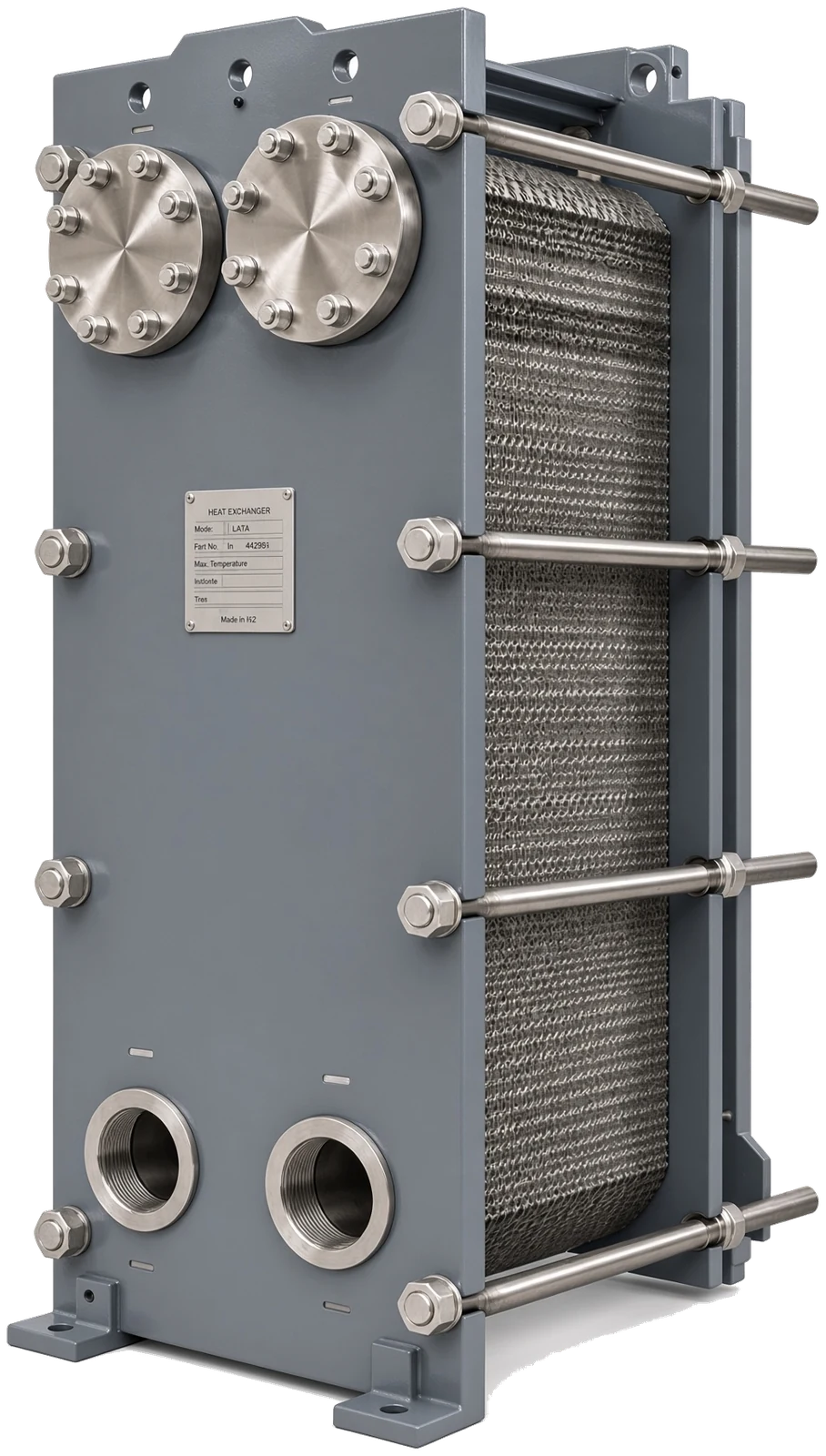
- Titanium gasketed plate units where space is tight or the load is large
- Thermostatic bypass holds the loop temperature in cold water
Choosing the Seawater-Side Material
The isolation exchanger takes every hour of seawater the vessel runs, so its tube material decides the service life of the whole system. Copper-nickel tubes with bronze bonnets and zincs are the proven choice for clean open-ocean water at moderate velocity, and they resist marine growth better than any other material. Where the vessel works in warm harbors, estuaries, silt or chlorinated water, or where the tube velocity has to be high to keep the unit small, titanium tubes remove the corrosion question entirely.
- Sized from the sum of every duty on the fresh water loop
- Send engine ratings, seawater flow and the warmest inlet temperature
- Replacements confirmed from nameplate, dimensions and connections
- The usual route when a keel cooler is fouled or damaged
- Call 1-805-484-2992 for a rating on the isolation unit
Common FAQs
It is the single cooler on a vessel that seawater passes through. Raw water goes through its tubes or plates and overboard, while a closed loop of treated fresh water on the other side carries the cooling to the engines, gears, hydraulics and chillers. Those coolers never see salt water, so they can be plain materials with no zincs.
Yes. Central cooling is the ship-side term for the same arrangement: one or two seawater central coolers and a fresh water loop to every duty. On workboats and yachts it is called an isolation loop or an isolation cooler. The exchanger is selected the same way at any size, from the total loop load and the seawater conditions.
Copper-nickel with bronze bonnets and zincs suits clean open-ocean water at moderate tube velocity and resists marine growth well. Titanium is the answer for warm harbor water, silt, chlorinated intakes, high tube velocity, or a vessel that wants the corrosion question closed for good. Tell us where the boat works and we will say which.
Usually. The isolation exchanger goes in where the raw water now enters the engine room, a fresh water pump and header tank are added, and the existing coolers are re-piped to the loop. The existing marine-material coolers keep working; they simply stop seeing salt water. Send the duties on board and the space available and we will size the unit.
A photograph of the nameplate, the overall length and shell diameter, the connection sizes, which way the bonnets face and which end the seawater enters, and a list of what hangs on the fresh water loop. With that we match the frame, tube count and passes, or select a better tube material, and confirm the replacement before it is built.
Plate and frame earns its place when the summed loop load is large and the engine room is short on straight length. A titanium plate pack gives a close approach in a fraction of the footprint, and capacity can be added later by hanging more plates on the frame as loads grow. The trade-off is sensitivity to debris: plates need a fine strainer and cannot be rodded, while a shell and tube bundle swallows silt and cleans with a brush.
Related

APPLICATIONS • SEAWATER SYSTEMS
Raw Water Cooling
Sea chest, strainer, pump flow and tube velocity on the seawater side
+ Learn More
HEAT EXCHANGERS • PLATE AND FRAME
Plate or Shell and Tube
Where a titanium plate unit wins the central cooling duty and where it does not
+ Learn More
ENGINEERING • MATERIALS
Titanium or Copper-Nickel
The honest comparison for the one exchanger that sees the sea
+ Learn More
