
1-805-484-2992
Quotes - Engineering - SalesCummins NT855 and N14 Coolers
Replacing what nobody has records for
The 855 cubic inch block has been in marine service for decades, and that longevity creates a particular problem. Published marine ratings for the NT855 and N14 run in the region of 250 to 500 horsepower, which is easy enough, but the cooler bolted to the engine may be the third one fitted, sourced from a line that no longer exists, with a nameplate that corroded away two owners ago.
These engines have been working long enough that most of the coolers on them are replacements of replacements. Ratings run roughly 250 to 500 HP, and we routinely quote from a tape measure rather than a part number.
That is normal work here. We quote these from dimensions as often as from part numbers, and the measurements needed are straightforward: shell outside diameter, overall length across the bonnets, connection sizes and thread type, the position and angle of each connection, and the mounting arrangement. With those and the engine rating we can specify a replacement that goes back on the same brackets and the same piping.
Discontinued lines are included in that, ITT Standard units among them. For a Cummins N14 or NT855 jacket water cooler replacement, send the rating, the measurements, photographs from two angles and the water source. The standard marine build is copper-nickel tubes in bronze bonnets with zinc anodes, with titanium available where the water warrants it. Call 1-805-484-2992 or email Sales@HeatX.com.
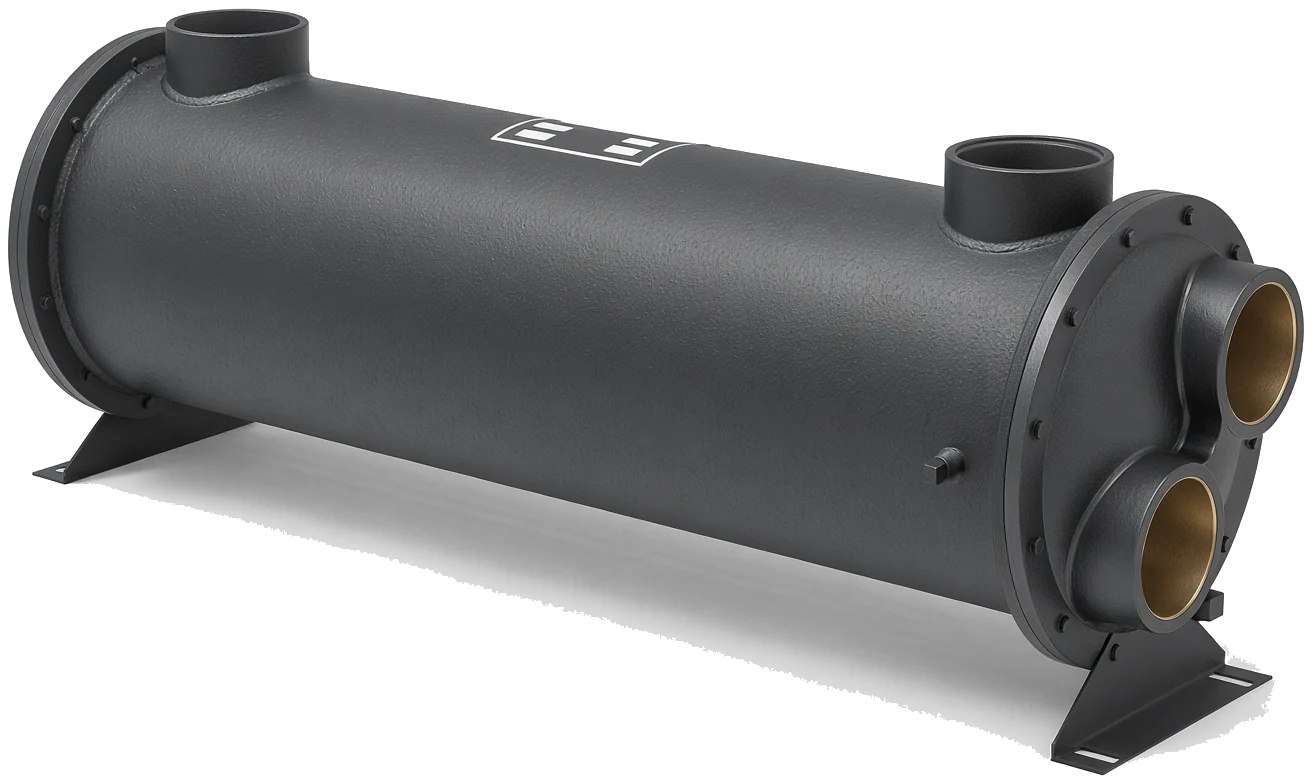
 Replacing a Cooler
 HC Series
 Measured Quotes
 Lube Oil
Quoting From What Is Fitted
Where documentation is gone, six measurements and the engine rating produce a firm selection.
Measure
- Shell outside diameter
- Overall length across bonnets
- Connection size and thread type
- Connection position from bonnet face
- Mounting centers and bracket type
- Free length for bundle withdrawal
Duty Inputs
- Engine rating and duty class
- Heat rejection for the engine rating from the data sheet
- Seawater inlet temperature
- Raw water flow available
- Cleaning interval you can hold
We Return
- Frame size and pass arrangement
- Full part number with option codes
- Connection schedule and dimensions
- Anode part numbers and count
- Price and lead time
| MODEL / RATING | HORSEPOWER | DUTY | TYPICAL SELECTION |
| NT855 marine | About 250 to 350 HP | Continuous propulsion | HC Series lower frames |
| NTA855 marine | About 350 to 450 HP | Propulsion, aftercooled | HC Series mid frames |
| N14 marine | About 350 to 500 HP | Workboat propulsion | HC Series mid frames |
| 855 auxiliary set | About 250 to 400 HP | Generator prime power | AB Series fixed tube |
| Discontinued unit fitted | Any rating in the range | Replacing an obsolete cooler | Quoted from measured dimensions |
| Lube oil duty | Sized on oil load | Lube oil cooling | Lube Oil Cooling |
Replacing A Discontinued Cooler
Including ITT Standard units
Plenty of NT855 and N14 boats carry coolers from lines that stopped being made years ago, ITT Standard among them. There is no cross-reference table that solves this properly, because the original selection was made for a specific duty and envelope that a table cannot capture. What works is treating it as a fresh selection constrained by the existing geometry.
We take the dimensions, work the duty from your rating, and specify a current frame that fits and performs. Where the old unit was oversized or undersized, we will tell you which and let you decide. See ITT Standard Replacement.
Cumulative wear you can see
An older cooler tells you a lot when it comes off. Wall thinning at the tube inlets says the velocity has been high or the water sandy. Plugged anode ports say the zincs stopped being changed a long time ago. Pitting along the bottom of the shell says condensate and salt air worked on the outside while everyone watched the inside.
Photograph the old unit before it goes in the skip, including the bonnet faces and the tube ends. That evidence changes what we reccomend on the replacement, particularly on tube material and anode count. See Troubleshooting.
Related

ENGINEERING • SELECTION
Replacing a Cooler
Matching a discontinued unit from measurements and duty data.
+ Learn More

VESSELS & ENGINES • BY VESSEL
Tugs And Workboats
Older hulls, long hours and coolers with no paperwork
+ Learn MoreBefore you order a cooler for this engine
Yes, this is routine. Send shell diameter, overall length across the bonnets, connection size, thread type and position, mounting centers and the clearance you have to withdraw a bundle, plus the engine rating. From those we specify a current frame that fits the space and meets the duty.
Yes. There is no reliable cross-reference table for discontinued lines, so we treat it as a fresh selection constrained by the existing geometry: your dimensions set the envelope, your rating sets the duty. We will also tell you if the original was oversized or undersized for the engine.
Published marine ratings for the NT855 and N14 family run in the region of 250 to 500 horsepower depending on version and duty class. The jacket water heat rejection for your engine comes from the data sheet for that specific rating, and that figure rather than the block size sets the surface area.
Keep it until the replacement is fitted and running, and photograph it before it goes. The tube inlet condition, the state of the anode ports and any external pitting tell us wether to change tube material or add anodes on the new unit. That evidence is worth more than the part number.
Possibly, but check the piping too. Boats this age usually have raw water runs modified several times, and accumulated reducers, elbows and long hoses cost head the original design did not allow for. Tell us what the run looks like and we will account for the restriction in the selection.
Not automatically. An older boat often carries a cooler chosen for a different engine or a higher rating than the one fitted now, and copying it size for size can leave the raw water moving too slowly through the tubes for silt to stay in suspension. We work the duty from your rating and the envelope from your measurements, tell you whether the old unit was generous, and let you decide between matching it and fitting a correctly sized frame.

