
1-805-484-2992
Quotes - Engineering - SalesEuropean and Japanese Engines
Replacement coolers for imported blocks
An imported engine is not a harder cooling problem, it is a harder parts problem. Model families are wide, marinizing packages vary by builder, and the cooler that failed may have been supplied as part of a package rather than by the engine builder at all. We work the other way around: from the heat rejection on the engine data sheet for your rating, and from the envelope the old unit occupied.
Not every engine room runs American iron. We supply replacement jacket water and oil coolers for Volvo Penta, MAN, MTU, Yanmar, Perkins and Mitsubishi installations, sized on the heat rejection published for the rating you actually have.
The six families on this page cover most of what comes through the door. Volvo Penta D-series across the small and large ranges, MAN D28 inline sixes and V8 and V12 blocks, MTU 2000 and 4000 series, Yanmar 6LY, 6HY and 6AY, Perkins and Sabre marine variants, and Mitsubishi S6R and S12R. Each has its own page with horsepower ranges and the series we normally select.
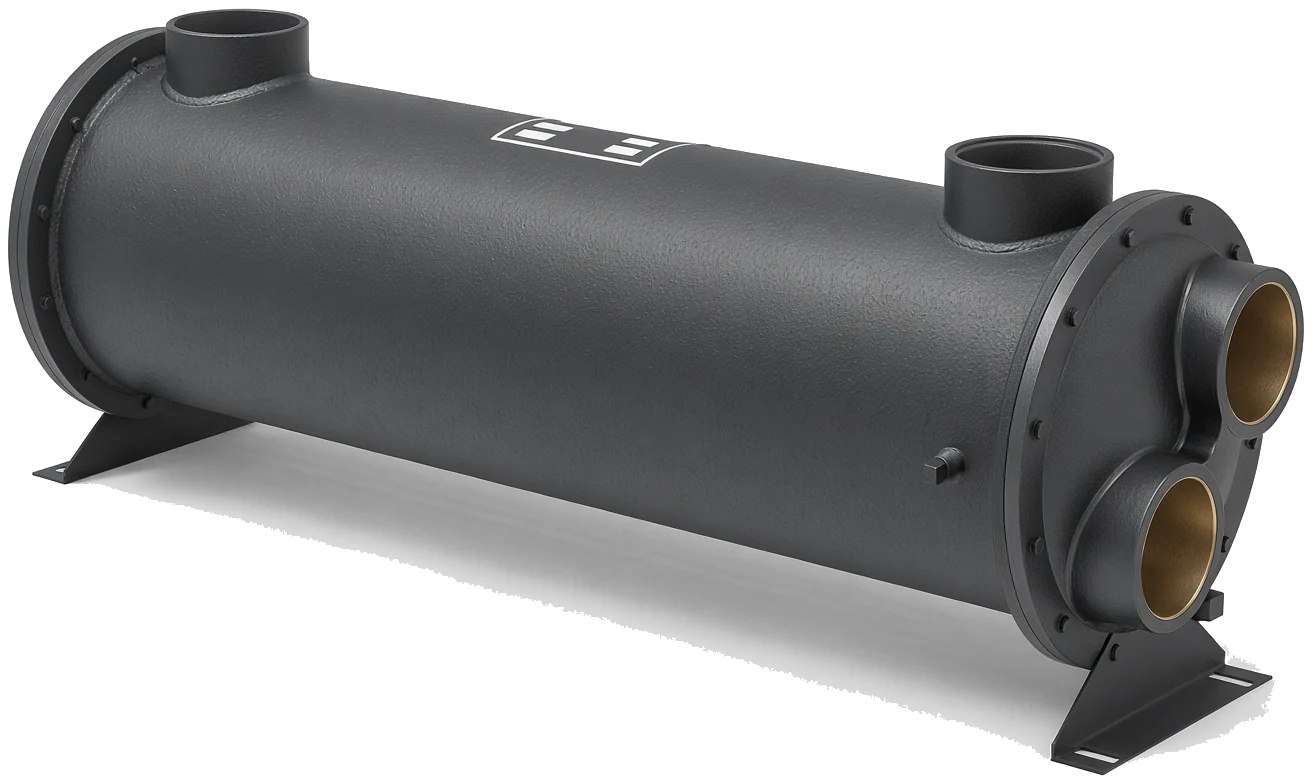
The build is the same regardless of where the engine was cast: seawater on the tube side in copper-nickel or titanium, engine coolant or oil on the shell side, bronze bonnets and replaceable zinc anodes in the raw water end. Metric connections and unusual mounting arrangements are worth a phone call before you order, so ring 1-805-484-2992 with the measurements.
| MODEL / RATING | HORSEPOWER | DUTY | TYPICAL SELECTION |
| Volvo Penta D-series | About 10 to 1,000 hp | Jacket water, gear oil | B Series or HC Series |
| MAN D28, i6, V8, V12 | About 500 to 2,000 hp | Jacket water and lube oil | HC Series, call for rating |
| MTU 2000 and 4000 series | About 600 to 4,000 hp | Jacket water, oil circuits | HC Series or multiple units |
| Yanmar 6LY, 6HY, 6AY | About 250 to 900 hp | Jacket water and lube oil | HC Series with CN tubes |
| Perkins and Sabre marine | About 40 to 450 hp | Jacket water, small gensets | B Series or AB Series |
| Mitsubishi S6R and S12R | About 700 to 2,000 hp | Jacket water, lube oil | HC Series, call for rating |
European
- Volvo Penta D-series
- MAN D28 inline six
- MAN V8 and V12 blocks
- MTU Series 2000
- MTU Series 4000
Japanese
- Yanmar 6LY family
- Yanmar 6HY and 6AY
- Mitsubishi S6R and S6R2
- Mitsubishi S12R
British
- Perkins four cylinder marine
- Perkins six cylinder marine
- Sabre marine variants
- 1300 and 1500 series blocks
Duty, Not Badge
The engine badge decides the heat rejection figure we look up, and after that the selection is the same engineering on every make in the room.
Where the Old Unit Came From
Package coolers and one-off builds
On imported engines the cooler is frequently part of a marinizing package assembled by a yard or a converter rather than a cataloged item. That is why nameplate searches so often come up empty. It also means the original unit may have been selected generously or meanly for the duty, and copying it exactly is not automatically the right answer.
We treat those jobs as two seperate questions. What duty does this engine reject at this rating, and what envelope is available in this engine bay. When the answers agree, the selection is obvious. When they disagree, the honest conversation is about splitting the duty across two units or moving the mounting, and we would rather have it before the order.
High Output Engines
Above the single frame range
The HC Series jacket water selection runs up to roughly 1,250 horsepower on a two pass 1772 frame. Plenty of MTU 4000, MAN V12 and Mitsubishi S12R ratings sit above that, and those installations often already use more than one exchanger, or a central cooler arrangement with a separate low temperature circuit.
For those duties we split the load, quote units in paralell, or price a titanium build where the seawater is warm and the velocity high. There is no single catalog answer at that end of the range. Call 1-805-484-2992 with the model, the rating and the circuit temperatures and we will size it properly rather than guess.
Questions engineers ask
Ratings above roughly 1,250 horsepower go beyond a single HC jacket water selection, so we look at units in parallel, a split duty or a titanium build depending on the circuit. Call 1-805-484-2992 with the model, rating and circuit temperatures and we will size it against the data sheet.
Often. Warm seawater accelerates both fouling and corrosion, and titanium removes the material question entirely on the raw water side. It costs more up front and pays back where a copper-nickel bundle would otherwise be replaced every few seasons. Ratings on titanium builds are set per duty, so call for a rating.
Yes. Those units are usually uncataloged, so we work from the engine heat rejection and the physical envelope rather than trying to trace the original part. Send the engine plate, the old unit dimensions and photographs of the mounting, and we will confirm a replacement that fits the existing installation.
Related

HEAT EXCHANGERS • TITANIUM
Seawater Coolers
Titanium tube builds for warm, dirty or chlorinated raw water
+ Learn More
APPLICATIONS • SEAWATER
Raw Water Cooling
How the seawater side behaves across different berths and routes
+ Learn More
ENGINEERING • SELECTION
Flow and Drop
Setting velocity and pressure drop with the pass arrangement
+ Learn More
