
1-805-484-2992
Quotes - Engineering - SalesReplacing An Existing Cooler
When the only data is the old unit
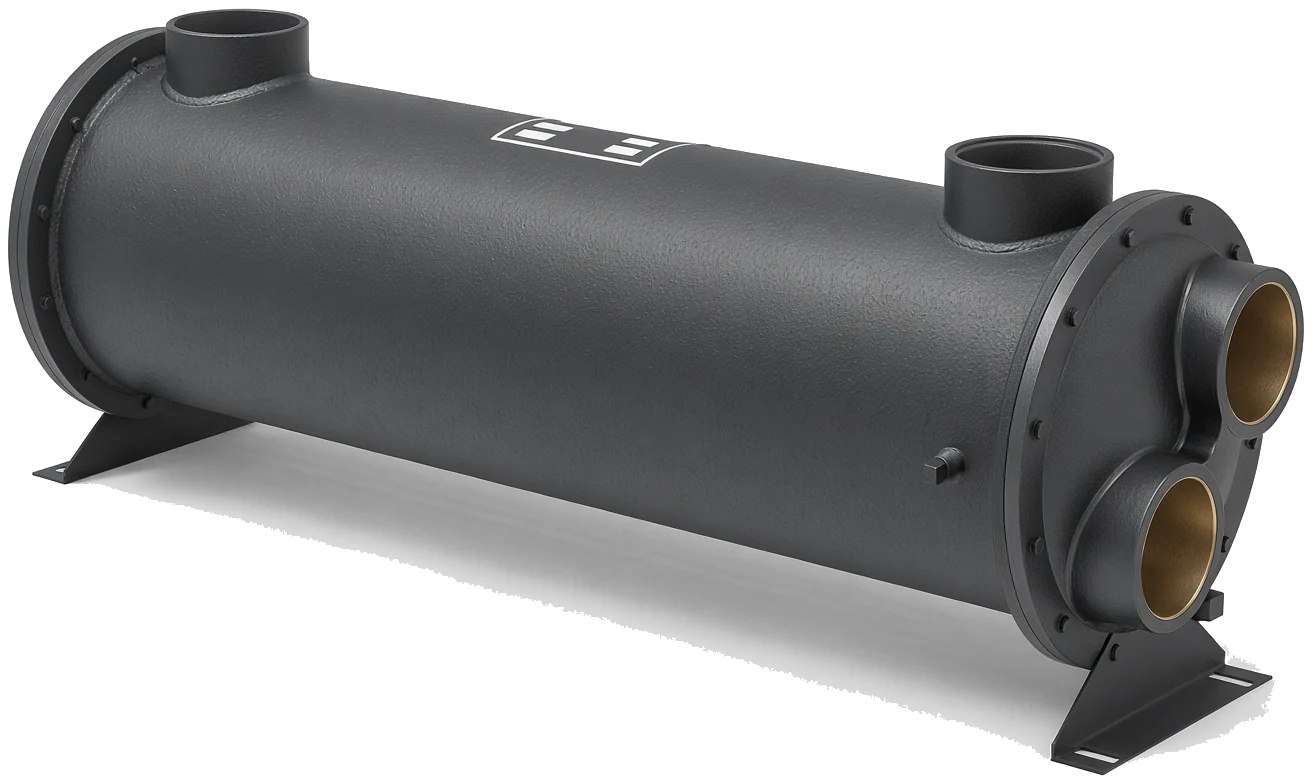
The replacement inquiry we get most often contains no engineering data at all. There is a photograph of something crusted to a bulkhead, a vessel out of the water, and a question about how quickly we can ship. That is a solvable problem, because a shell and tube cooler carries most of its specification in its own geometry. Shell diameter and the tube length between tubesheets fix the surface area closely, the connection sizes indicate the design flows, and the nozzle arrangement reveals the pass configuration.
Most replacements start with a corroded shell on a bracket and a boat waiting on a lift. Six measurements and a handful of photographs are normally enough for us to name a frame and quote it.
So the work is measurement rather than guesswork. We ask for six dimensions and a set of photographs from defined angles, and in the great majority of cases that identifies the frame directly or narrows it to two candidates that a single extra measurement separates. Where the original is a line we recognize, including discontinued ones, the cross-reference does the rest and we can confirm rather than estimate.
The second half of the job is making sure the new unit physically goes where the old one was. Mounting centers, overall length including bonnets, bonnet orientation and the clearance needed to withdraw the bundle for cleaning all matter as much as the thermal duty. A cooler that meets the duty and fouls the exhaust elbow by half an inch is not a replacement, and finding that out on the vessel is the expensive way to learn it.
Measure, Then Match
A replacement has to satisfy three things at once: the heat duty, the connection envelope, and the space it has to live in.
Measure
- Shell outside diameter
- Overall length over bonnets
- Tube length between tubesheets
- Shell nozzle sizes and positions
- Bonnet connection sizes and thread
Photograph
- Nameplate, straight on and close
- Both ends showing the bonnets
- Full side view with a tape in shot
- Mounting brackets and centers
- The installed position before removal
Tell Us
- Engine model and rating served
- Which circuit it cools
- Why it is being replaced
- Any known fouling or leak history
- How much space is available
| DIMENSION | WHY WE NEED IT | HOW TO TAKE IT | TOLERANCE |
| Shell diameter | Fixes the frame family | Across the bare shell, not lagging | To the nearest eighth |
| Tube length | Sets the surface area | Tubesheet face to tubesheet face | To the nearest half inch |
| Overall length | Fit into the space | Over the bonnets, bolts included | To the nearest quarter |
| Shell nozzles | Coolant or oil connections | Size, thread type and position | Exact |
| Bonnet connections | Seawater in and out | Size, thread type and orientation | Exact |
| Mounting centers | Landing on existing brackets | Bolt hole to bolt hole | To the nearest sixteenth |
What The Nameplate Gives You
Read it before you scrape it
If any part of a nameplate survives, photograph it before touching it, because a wire brush takes stamped characters off soft plate faster than it cleans them. Even a partial part number is valuable: a frame digit group, a pass code or a materials suffix each narrow the search considerably, and we can often reconstruct the rest from the physical dimensions.
Our own part numbers follow a readable pattern, so a legible plate on one of our frames tells us the frame size, the pass arrangement and the material option set directly. Call us with the number and we will read it back to you. On unfamiliar or obsolete plates we work from the dimensions instead, which is a slower route to the same place.
Identifying An Unmarked Cooler
Geometry instead of paperwork
Shell diameter and tube length between tubesheets together fix the available surface within a narrow band, and marine frames come in discrete sizes rather than a continuum, so those two numbers usually land on one family. Counting the nozzles and noting their positions then separates the pass arrangements, because a single-pass unit has its water connections at opposite ends and a two or four-pass unit has them at the same end.
Connection sizes are the third clue and a useful cross-check, since a designer sizes them for the intended flow. A one and a quarter inch seawater connection and a four inch shell tell a consistent story; a mismatch between them usually means someone has already adapted the installation, which is worth knowing before we quote.
Duty Sanity Check
Do not replace the same mistake
A surprising number of coolers being replaced were marginal from the day they were installed, and the vessel has simply lived with running warm. If you tell us the engine model and continuous rating along with the dimensions, we will check the frame against the heat rejection and say plainly whether the original looks correctly sized.
Where it does not, you have a choice worth making consciously. Fitting the same size keeps the installation unchanged and keeps the problem. Fitting the next frame up usually costs modest money and a little pipework. The sizing page covers how we run that check.
Questions from the engine room
Usually yes. Marine frames come in discrete sizes, so shell diameter and tube length between tubesheets narrow it to one family, and the nozzle positions and connection sizes separate the pass arrangements. Send those measurements with photographs of both ends and a full side view and we will name a frame.
Shell outside diameter, tube length between tubesheet faces, overall length over the bonnets, the shell nozzle sizes and positions, the bonnet connection sizes and thread type, and the mounting bolt centers. Connections need to be exact; the shell dimensions to the nearest half inch are fine for identification.
That is one of the three things we check, along with the heat duty and the connection envelope. Where the mounting centers have changed between generations we say so before you order and quote the adaptor plate or new brackets, rather than let you find out with the vessel on a lift.
Decide it deliberately rather then by default. Tell us the engine model and rating and we will check whether the original was correctly sized. A cooler that has been running warm for years was often marginal from new, and the next frame up usually costs modest money plus a little pipework.
If the shell wall is sound, the bonnet flange faces are flat and unpitted, and the failure is confined to the tubes, a replacement bundle is cheaper and faster and we supply them for the frames we build. Send the frame size and photographs of the shell interior and flange faces so we can confirm.
Related

ENGINEERING • SERVICE
Bundle Replacement
Pulling and refitting a bundle without damaging the shell
+ Learn More
APPLICATIONS • JACKET WATER
AB Series
Fixed tube frames from 1.4 to 308 square feet of surface
+ Learn More
VESSELS & ENGINES • BY VESSEL
Passenger Vessels
Replacement planning around survey and refit windows
+ Learn More
