1-805-484-2992
Quotes - Engineering - SalesImmersion Plate Product
The Immersion Plate Cooler
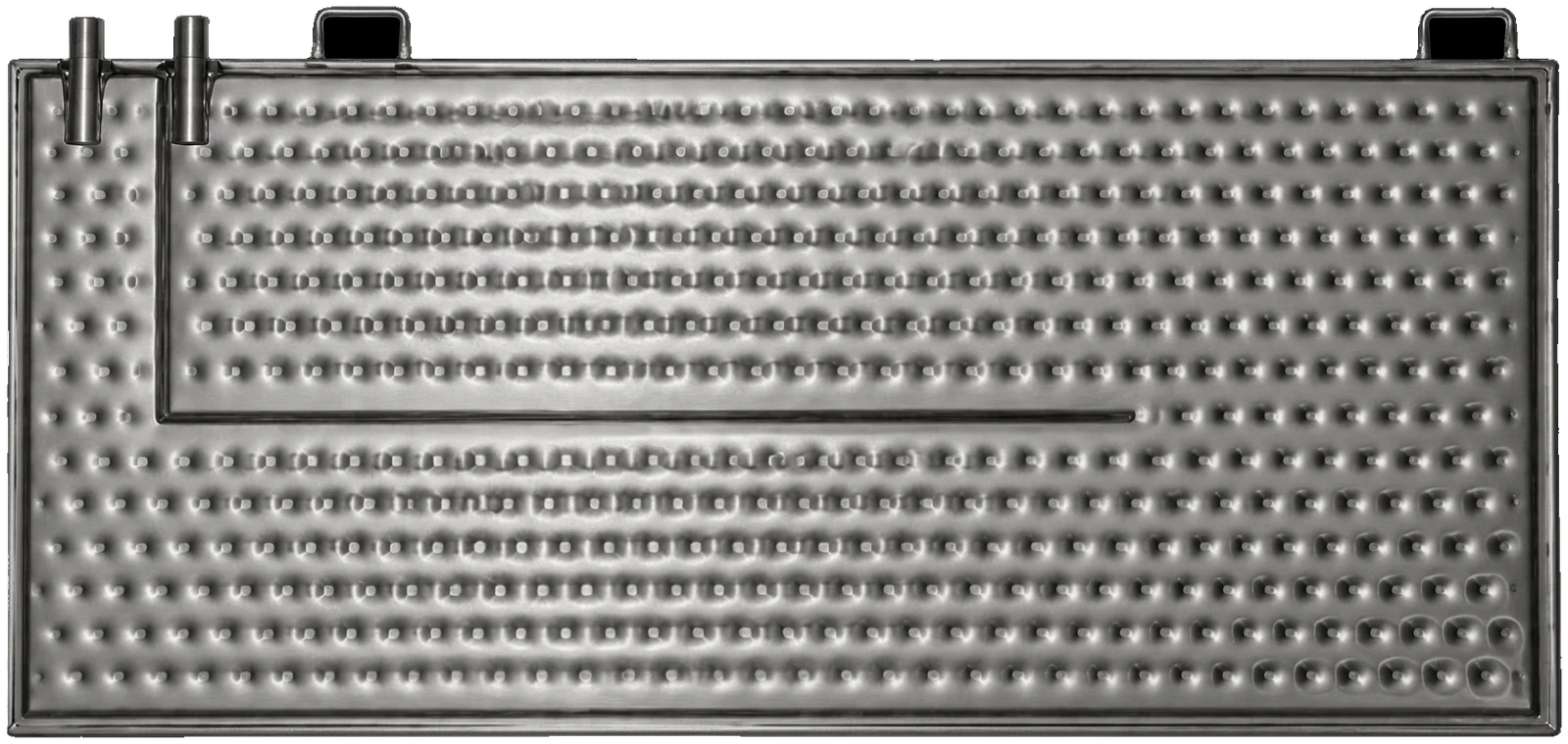
An immersion plate cooler is a free-hanging pillow plate, and it is the working element of most thermal plate installations on a vessel. It starts as two sheets of titanium or stainless steel laid face to face and laser-welded along the perimeter and at a regular grid of spot welds across the face. The welded pair is then inflated with pressure, and the sheets bulge apart between the welds to form a continuous quilted channel. That channel carries refrigerant or chilled coolant, and both outer faces of the plate become heat transfer surface once the plate is immersed in the hold, tank or well.
The plate material follows the fluid it sits in. Seawater, RSW, brine, bait wells and ice slurry get titanium, because cold, salty, oxygen-starved water full of fish and organic matter is exactly where stainless pits at the welds, and a pinhole in a hold plate puts refrigerant into the catch. Fresh water and clean process tanks get stainless steel. The sheets are thin, so the plate is light for its area and responds quickly when the plant starts, and the refrigerant charge inside is small.
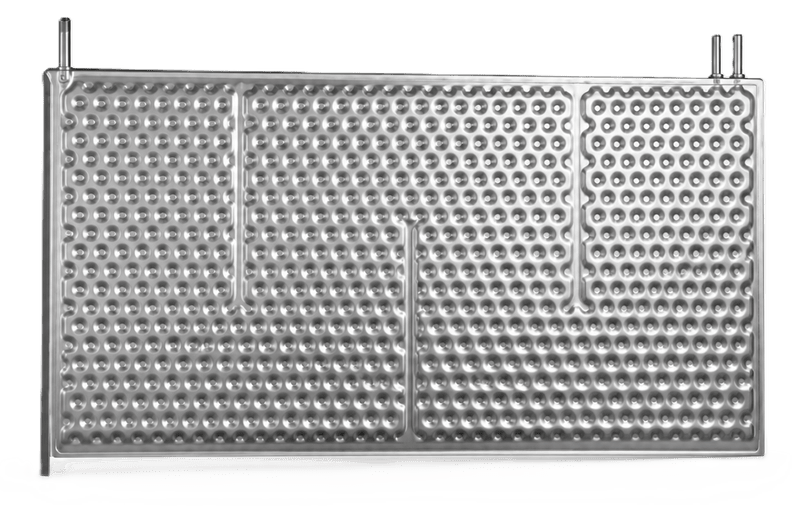
A pillow plate has no gaskets, no tube ends and no mechanical joints inside the tank. What can go wrong is a weld cracked by cargo impact, a face pitted by the wrong material for the water, or a connection strained by pipework. All three are visible on inspection and all three decide what the replacement should be.
Request a Quote


How the Plate Is Built
The perimeter weld seals the two sheets into a closed envelope and the grid of spot welds across the face ties them together at regular intervals. When the envelope is inflated, the sheets balloon between the spots into the pillow pattern that gives the plate its name. The pattern is not decorative: it sets the channel depth, stiffens the plate against handling and cargo loads, and breaks the internal flow into turbulence so the refrigerant or coolant sweeps the whole inside surface.
The finished plate is pressure tested as a sealed vessel before the connection stubs are fitted and tested again after. Because there is one material throughout and every joint is a fusion weld in that material, there is no galvanic couple inside the tank and nothing that relies on a gasket or a thread to stay tight in cold salt water. That is why immersion plates need no anodes where a shell and tube unit in the same water would.
Connections and Piping Into the Tank
Connections are welded stubs on the plate edge, usually at the top so the refrigerant lines run straight to the deckhead and out of the way of cargo. On a direct expansion plate the refrigerant enters through an expansion device and leaves as vapor; on a coolant plate chilled glycol or brine enters one stub and leaves the other. Stub size and position are set when the plate is built, so measure the existing stubs on a replacement and tell us where the pipework has to go.
The plate must not carry the pipework. Refrigerant lines and coolant hoses need their own supports through the tank wall, with a flexible section where vibration or hull movement reaches the tank, because a welded stub strained by a rigid pipe run is the most common leak point on a plate that is otherwise sound. Our Installation and Piping notes cover pipe support and penetrations.
Mounting the Plate in the Tank
A plate works through both faces, so it is mounted on standoffs or brackets that keep it clear of the tank wall and let product circulate behind it. In a fish hold that means wall-mounted plates on standoffs, or plates hung as dividers in the hold where they also stiffen the load. In a bait well or brine tank the plate is fixed where the circulation pump sweeps it. Dead corners with no flow across the plate do not transfer heat and are where ice builds.
Cargo protection matters in a hold. Fish, ice and shovels all reach the plates, and a dented face or a cracked spot weld is the usual result of an unguarded plate. Guards, hold boards or recessed mounting keep the load off the surface without blocking flow across it. Tell us how the existing plates are mounted and what damaged them, and the replacement can be built with the mounting and guarding that the hold actually needs.
Keeping Plates Clean and Ordering Replacements
Cleaning is part of the hold wash-down. Slime, scale and fish residue come off the flat faces with a stiff brush and a hose, and a plate that has been brushed at every wash-down never needs more. Where scale has built up on a neglected plate, an acid descale suited to the plate material clears it; see Cleaning and Descaling. Never chip ice or scale off a plate with a steel tool, as that is how spot welds crack.
To replace a plate, send its height, width and inflated thickness, the stub size and position, the mounting arrangement and the nameplate if there is one, with the refrigerant or coolant in use and what went wrong with it. To size a new set, send the tank or hold dimensions, the product and quantity, the temperature to hold and the time to reach it, and the plant available. Call 1-805-484-2992 or email Sales@HeatX.com and we confirm the plate before it is built.
Thin Metal, Nothing to Foul
A plate that is all working surface, with refrigerant a sheet thickness away from the product and a face that cleans with a brush, is as simple as a heat exchanger gets.
Frequently asked
Two sheets of titanium or stainless steel laser-welded at the edge and at a grid of spots, then inflated so a quilted channel forms between them. Refrigerant or chilled coolant flows in the channel and both outer faces transfer heat to the tank contents. Titanium is used for salt water and brine, stainless for fresh water.
Yes. Many hold and brine plates are direct expansion evaporators, with refrigerant entering through an expansion device and leaving as vapor. Others run chilled glycol or brine from a central plant. Tell us which system you have, the refrigerant or coolant, and the plant capacity, and the plate is built and rated for it.
Usually not. A leak at the stub is most often the pipework straining the weld, from a rigid run or from vibration reaching the tank. Repair or replace the plate and fix the cause: support the lines through the tank wall independently and fit a flexible section at the stub. Send a photograph and we will advise.