1-805-484-2992
Quotes - Engineering - SalesCondensing Duty
Seawater Cooled Condensers
A condenser is where a refrigeration or chiller plant sheds everything it has absorbed. Refrigerant vapor arrives hot from the compressor, gives up its latent heat across the tube wall and leaves as liquid. Seawater goes through the tubes and carries the heat over the side. Get the condenser wrong and head pressure rises, the compressor works harder, capacity falls and the plant eventually trips on high pressure.
Seawater cooled condensers for refrigeration, chillers and distillate duty, with titanium tubes that shrug off chlorination, warm harbor water and the long idle periods that pit other materials.
Titanium tubes suit this duty for a specific reason: condensers spend a lot of their life idle. A fishing vessel's refrigeration plant, a ferry's air conditioning in winter, a yacht laid up for a season, all leave seawater standing in the tubes for weeks. Stagnant seawater under a biofilm is the classic crevice corrosion condition, and it defeats stainless steels and pits copper alloys. Titanium is untroubled by it.
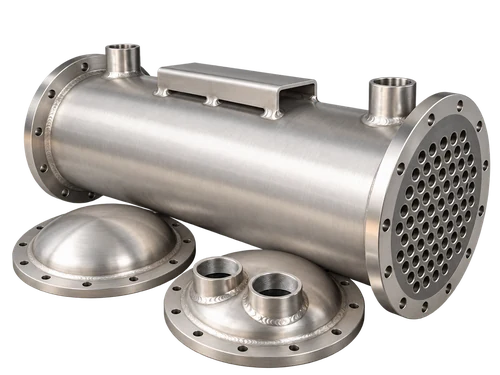
To rate a condenser we need the refrigerant, the heat rejection at the design condition, the condensing temperature you want to hold, and the seawater inlet temperature and flow available. Add the compressor type and whether the plant runs continuously or seasonally.
Request a Quote



Approach Temperature Tells the Story
The difference between the condensing temperature and the seawater outlet temperature is the approach, and it is the single most useful diagnostic on a seawater cooled condenser. A clean condenser holds a consistent approach at a given load. As tubes foul, the approach widens because the same heat has to cross a dirtier wall, and head pressure rises to compensate.
Trending the approach rather than head pressure alone separates fouling from a genuine seawater temperature problem. A condenser in warm summer water shows high head pressure with a normal approach; a fouled condenser shows high head pressure with a wide approach. Those two conditions need completely different responses.
Why Idle Plant Corrodes
When a plant stops, seawater sits still in the tubes. Within days a biofilm establishes, and beneath that film the local chemistry becomes oxygen-depleted and acidic, which is a textbook crevice corrosion cell. Stainless tubes pit under those deposits and copper alloys lose their protective film locally and pit as well. The damage is done while the plant is off.
Titanium is not vulnerable to that cell, which is why it is the right material for any plant with a seasonal or intermittent duty cycle. The other half of the answer is operational: flush the tubes with fresh water before a lay-up, or keep a small circulation running. Both are cheaper than a new bundle.
Chlorination and Biofouling Control
Where a system doses hypochlorite to keep growth out of the seawater circuit, the residual chlorine is a problem for copper alloys and a non-event for titanium. That means a titanium condenser can be protected against biofouling by dosing at whatever level the growth requires, without trading tube life for it.
The practical benefit is that fouling can be managed chemically rather than only mechanically. Tube brushing still has its place at longer intervals, and the strainer discipline does not change. There is more on the trade-offs on Titanium vs Copper-Nickel.
Replacing a Condenser Bundle
Refrigeration condenser shells often outlive several bundles, particularly where the refrigerant side has stayed clean and dry. Where that is the case, a titanium bundle into the existing shell reuses the refrigerant connections, the mountings and the insulation, and it is the point at which upgrading the tube material costs least.
We need the tube count, diameter, length and pass arrangement, the tubesheet bolt pattern, and the shell internal dimensions. Photograph the tubesheet face and both heads. Where the refrigerant side has had a compressor failure and carries acid or debris, say so, because the shell may need attention as well as the bundle.
Idle Time Is the Enemy
Condensers corrode when they are switched off, not when they are running, because stagnant seawater under a biofilm is the perfect crevice cell.
Questions from the engine room
Because the seawater is warmer and the condensing temperature has to sit above it. If the approach between condensing temperature and seawater outlet is normal, the condenser is clean and the plant is simply short of margin at peak water temperature. If the approach has widened, the tubes are fouled and cleaning will recover it.
Yes, that is one of the strongest cases for it. Corrosion in a condenser happens mostly while the plant is off and seawater stands in the tubes under a biofilm. Titanium is immune to the crevice conditions that develop there. A plant that runs six months and sits six months is exactly where copper alloys lose.
Yes, at whatever residual the biofouling requires. Titanium is unaffected by chlorinated seawater, which is one of its main advantages over copper alloys in this duty. Strainer maintenance and periodic mechanical cleaning still apply, since chlorination controls biological growth rather than silt and debris.
Clean first and measure. Brush and rod the tubes, then check whether the approach temperature returns to what it was when the plant was new. If it does, it was fouling. If it does not, the tubes have lost wall or are partly blocked with something that will not come out, and a bundle renewal is the honest answer.
Usually non-condensable gas in the refrigerant circuit, which occupies condenser surface and raises pressure without a corresponding temperature. Purge and then find the leak or the source, because air in a refrigeration system also brings moisture. The condenser itself is rarely the fault when the pressure is erratic rather than steadily high.
Usually the bundle stays and the rating moves. A different refrigerant condenses at a different pressure and gives up a different amount of heat per pound, so the same tube surface will hold a different condensing temperature against the same seawater. Tell us the new refrigerant and compressor duty and we will re-rate the existing unit; where the new condensing pressure exceeds what the shell was built for, that is the point at which a new shell is needed rather than the tubes.