
1-805-484-2992
Quotes - Engineering - SalesCoolers For Caterpillar Marine Diesels
3400 series, 3500 series and the C-Series
Caterpillar engines are the backbone of the North American workboat fleet, and the coolers hung on them get old at their own pace. A 3406 that has run twenty seasons on a seiner will have been through more than one jacket water cooler, and the last one may have been a shop-built unit with no nameplate left on it. Every model page below gives the horsepower band, the duty split between jacket water and oil, and the frame family that normally answers it.
Jacket water and lube oil coolers for the Caterpillar engines that keep working boats moving. Pick your model for horsepower bands, the series that normally answers the duty, and what to send us to confirm a replacement.
The sizing route is the same on every one of them. The engine model and rating narrow the band, the jacket water heat rejection figure from the engine data sheet for that specific rating sets the required surface, and the seawater inlet temperature and available raw water flow settle the pass arrangement. We do not guess at heat rejection and we do not publish it as a fixed number, because it moves with rating, aftercooling arrangement and duty class.
For a Caterpillar jacket water cooler replacement, send the engine serial and rating, a photo of the nameplate on the existing cooler, the connection sizes and thread type, and the seawater source. Bronze bonnets, copper-nickel tubes and zinc anodes are the standard marine option set; titanium tubes are available where the raw water is warm or dirty. Call 1-805-484-2992 or email Sales@HeatX.com.
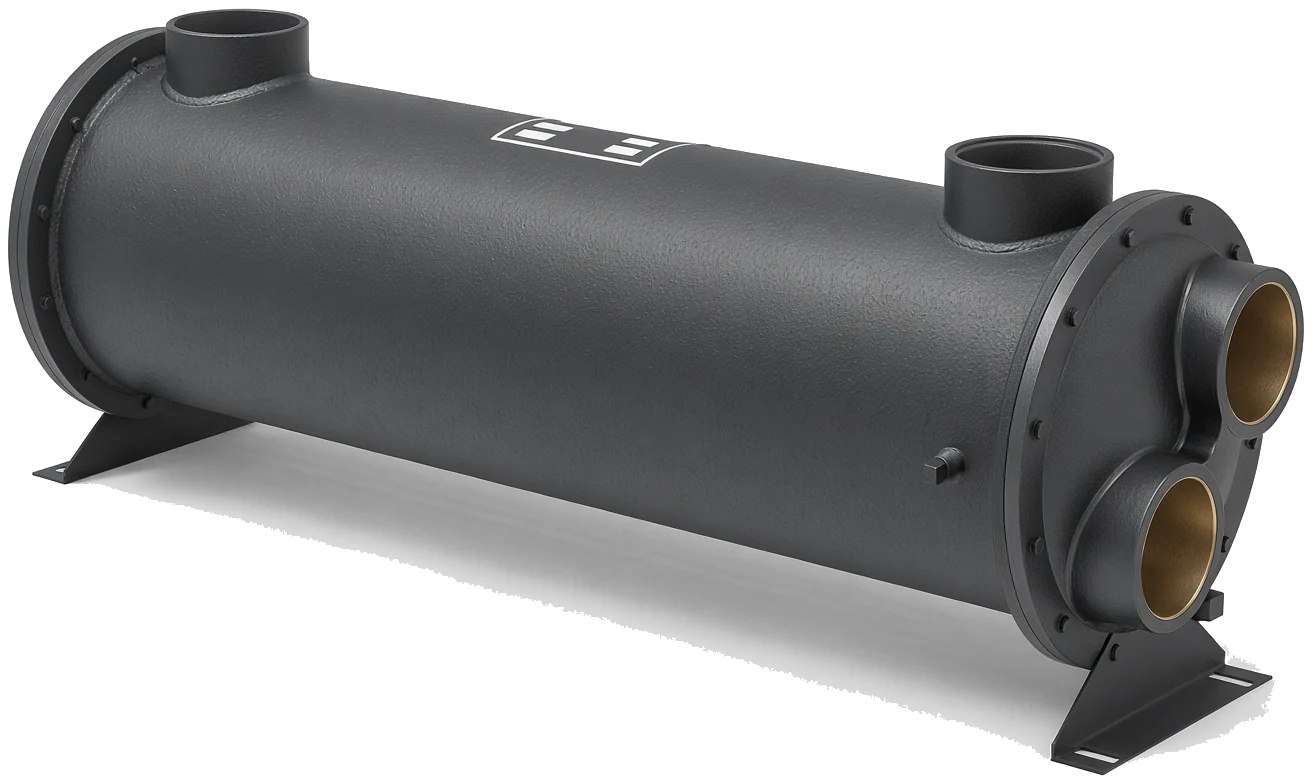
| MODEL / RATING | HORSEPOWER | DUTY | TYPICAL SELECTION |
| CAT 3406 | About 350 to 800 HP | Propulsion and auxiliary | HC Series jacket water, lube oil cooler |
| CAT 3408 | About 400 to 900 HP | Propulsion, V8 | HC Series jacket water |
| CAT 3412 | About 600 to 1400 HP | High output propulsion | HC Series, call for rating above the range |
| CAT 3508 | About 800 to 1200 HP | Propulsion and prime power | HC Series larger frames |
| CAT 3512 | About 1200 to 1800 HP | Main propulsion | Large HC frames, call for rating |
| CAT C-Series | About 225 to 1900 HP | C7 through C32 | B Series or HC by rating |
Send Us
- Engine model and serial
- Rated horsepower and RPM
- Nameplate from the old cooler
- Connection sizes and thread
- Seawater or lake water
Standard Build
- Tubes: 90/10 copper-nickel
- Bonnets: bronze
- Anodes: zinc, both bonnets
- Connections: NPT or SAE
- Titanium tubes optional
Also Supplied
- Replacement tube bundles
- Bonnets and gasket sets
- Spare zinc anodes
- Lube oil coolers
- Gearbox oil coolers
One Model, Many Ratings
A 3406 is not one duty but a family of them, so we size from your specific rating and the heat rejection on that engine data sheet.
The 3400 Family In Marine Service
3406, 3408 and 3412 cooling loads
The 3406, 3408 and 3412 cover a wide band of workboat and yacht propulsion, and within each model the ratings span several hundred horsepower across generations. That spread is the reason a single cataloged cooler cannot be quoted from a model name alone. Two 3406 installations on the same dock can have jacket water loads far enough apart to need different shell lengths.
What is consistent is the arrangement: raw water through copper-nickel tubes, engine coolant through the shell, zincs in the bonnets. Once the heat rejection figure is in hand from the engine data sheet for the actual rating, the frame selection is straightforward and usually lands somewhere in the HC range.
The 3500 Family And Larger Duties
3508 and 3512 propulsion and prime power
The 3508 and 3512 push into the upper end of what a single shell and tube frame will carry. The published jacket water selection band runs to roughly 1250 HP on the largest two-pass HC frame, so an engine rated above that either needs the biggest frame at a favorable seawater temperature or a different arrangement entirely.
That is a conversation, not a catalog lookup. Tell us the rating, the seawater inlet temperature you design to and the raw water flow you can supply, and we will tell you wether one unit covers it. Call 1-805-484-2992 and we will work it against the data sheet with you.
Questions we answer every week
No. Marine 3406 ratings run accross a wide band through the B, C and E generations, and the jacket water heat rejection moves with the rating. We size from your specific rating and the heat rejection figure on that engine data sheet, then confirm the frame and pass arrangement back to you before anything is built.
Yes, routinely. Send shell diameter, overall length, connection sizes and positions, and mounting center distances, along with the engine model and rating. Between the geometry and the duty we can specify a replacement that goes back in the same space with the same piping. Photographs from two angles help.
Yes. Reduction gear and lube oil coolers are sized on heat load, oil grade and allowable pressure drop rather than horsepower alone. Send the oil flow, the inlet temperature you need to hold and the pressure drop you can accept, and we will select a frame against those numbers.
Consider it if the boat works in warm, sandy or polluted water, sits in a berth for long periods, or has a history of tube pitting. Copper-nickel remains the standard build and serves well in clean, cooler seawater at sensible tube velocities. We will advise on your water source when you call.
Inspect them at every scheduled service and replace when roughly half consumed. Interval varies with water chemistry, temperature and how much the vessel runs, so the first few inspections set your own schedule. Carry spares aboard; anodes are the cheapest protection the cooler has and running without them costs tubes.
Related

ENGINES • CUMMINS
Cummins Engines
The same selection approach across the Cummins marine range
+ Learn More
APPLICATIONS • HC SERIES
HC Series
The frame family that answers most Caterpillar jacket water duties
+ Learn More
VESSELS & ENGINES • BY VESSEL
Tugs And Workboats
Duty cycles that decide how hard a cooler is worked
+ Learn More
