1-805-484-2992
Quotes - Engineering - SalesRepeat Parts
Plates and Gaskets in Service
In a titanium plate unit the plates are not the wearing part; the gaskets are. Titanium does not pit or corrode in seawater, so a plate leaves service for mechanical reasons: a crack at a corrugation from years of pressure cycling, a port damaged in handling, or a gasket groove deformed by an over-compressed pack. The elastomer, on the other hand, ages from the day it is fitted. Heat hardens it, oil swells NBR, chemicals attack it, and every opening of the pack costs it some of its compression set.
The parts a plate unit consumes over its life: gasket sets by material and fixing type, individual titanium plates for the ones that fail inspection, and full plate packs when the whole stack has reached the end of its service.
So the parts we supply for units in service fall into three groups. Gasket sets, which are the routine item and should be on hand before the pack is opened. Individual replacement titanium plates, for the few that fail inspection during a re-gasket. And full plate packs, plates and gaskets together, for a unit whose plate stack has been damaged, mixed up, or is simply old enough that piecemeal replacement no longer makes sense against the cost of a new pack in the existing frame.
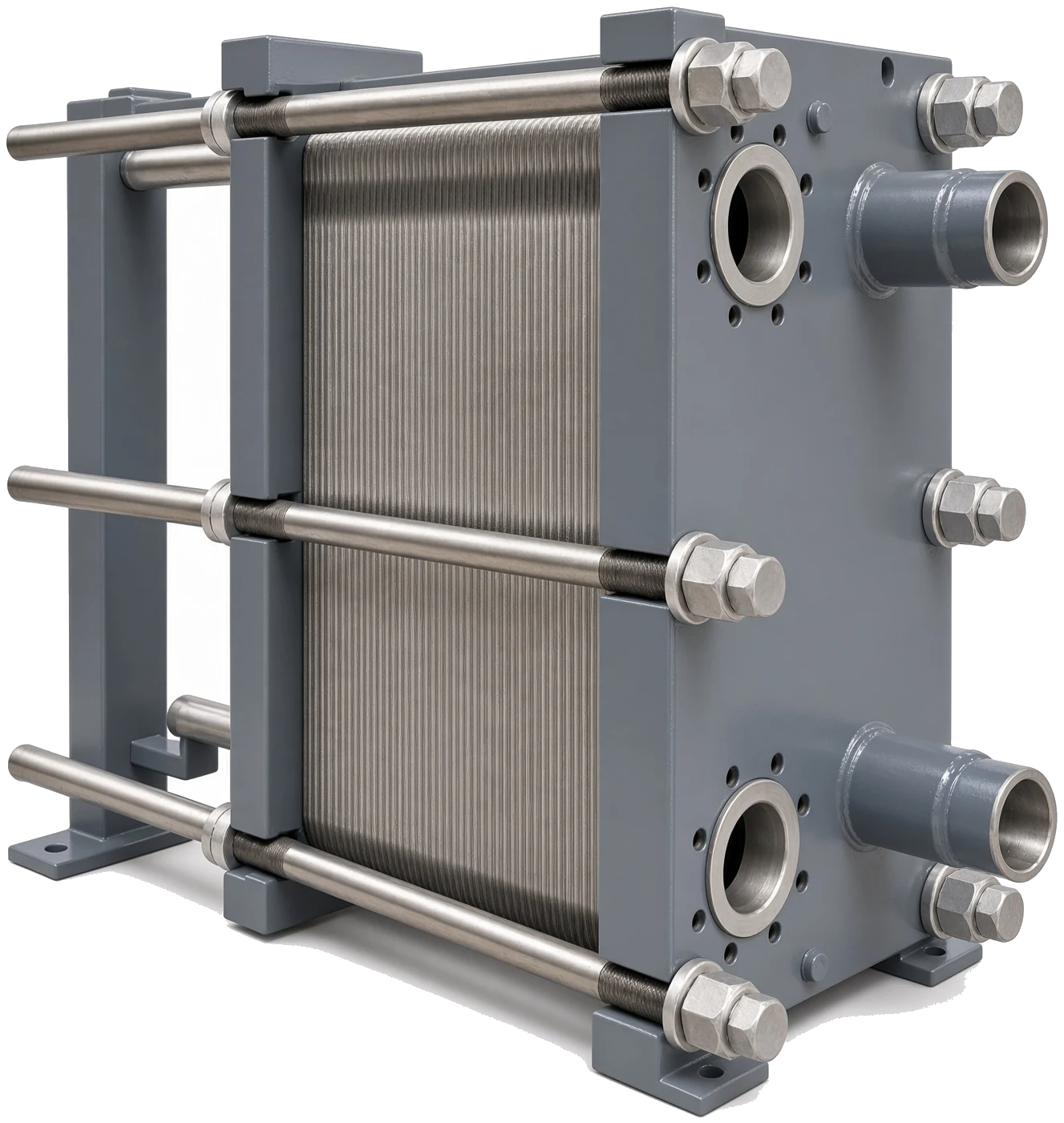
Glued gaskets are bonded into the groove and need the old adhesive cleaned out before the new one goes on. Clip-on gaskets locate with tabs under the plate edge, need no adhesive and can be changed on board. Tell us which type you have and we will supply the matching set.
Request a Quote


Choosing the Gasket Material
NBR, nitrile, is the gasket for oil duties and for water at moderate temperatures. It resists mineral oil, which EPDM does not, and it is the usual fit on lube oil coolers and on central coolers running at ordinary fresh-water temperatures. Its weakness is heat: run it hot for long enough and it hardens, takes a permanent set and stops sealing.
EPDM is the gasket for hot water and for duties where the other side runs warmer than nitrile likes. It has a higher temperature limit and better resistance to aging in hot water, but it swells in contact with mineral oil and must not be used on an oil duty. Refrigerant duties are checked individually. The material on the existing gaskets is usually marked on the gasket or on the nameplate; if it is not, tell us the fluid and temperature on the non-seawater side and we will select it.
Glued or Clip-On
Older and some larger packs use glued gaskets, bonded into the plate groove with an adhesive that has to be cleaned out completely before the new gasket goes in. That is bench work: the plates are stripped, the groove is cleaned to bare metal, the new gasket is glued and the plates are stacked under weight to cure. It is done properly ashore or in a well set up workshop, not on a running vessel.
Clip-on gaskets locate with molded tabs that hook under the plate edge and need no adhesive. They can be changed on board with the pack open, one plate at a time, and the plates go straight back into the frame. If your unit has clip-on gaskets, a gasket set on board and a spare day in port is a complete re-gasket. Send a close photo of a gasket at the plate edge and we will confirm which fixing you have.
Re-Gasket or Replace the Pack
A pack with sound titanium plates and tired gaskets is re-gasketed. The plates are cleaned, inspected against a light for cracks and for deformed grooves, the failed ones are replaced individually, and a full new gasket set goes on. That is the normal life cycle and the cost is a gasket set, a few plates and the labor to fit them. On a semi-welded unit the plates are laser-welded in pairs into cassettes, so only the gasketed channel is renewed and the set is half the count of a fully gasketed pack.
The arithmetic changes when many plates are damaged, when plates from different sources have been mixed over past repairs so the pack no longer seals evenly, or when a glued pack is due for stripping and there is no workshop available. Then a full plate pack, plates with gaskets fitted and stacked in the correct sequence, drops into the existing frame in a day. We confirm plate size, pattern and count from the nameplate and a plate photo before it is built.
Cleaning in Place or Opening the Pack
Scale and biological fouling on the seawater side can be removed with a circulated cleaning solution through the connections, with the pack closed and the pipework isolated. That suits routine descaling on a schedule and it costs no gaskets, because the pack is never opened. Titanium plates tolerate the acid cleaners used for scale; the gaskets set the limit on chemistry and temperature, so follow the guidance on Cleaning and Descaling.
Silt, weed, shell and anything that has packed the channels solid needs the pack opened and the plates hosed and brushed. Opening the pack means new gaskets, or at least the honest expectation of them, so plan the two jobs together: clean in place between openings, open the pack on the gasket interval, and inspect the plates while they are out. Other wearing parts across the range are on Replacement Parts.
Gaskets Before the Pack Opens
Opening a plate pack without new gaskets on board is a bet that old elastomer will reseal, and it is a bet the vessel usually loses at the first pressure test.
What to know before sizing
Photograph the nameplate, count the plates, and photograph one plate on both faces and a close view of the gasket at the plate edge. That shows us the plate size, the pattern, the port layout and whether the gasket is glued or clip-on. Add the fluid and temperature on the non-seawater side and we confirm material and set.
No. EPDM swells in mineral oil, loses its shape and stops sealing, sometimes quickly. Oil duties take NBR. EPDM belongs on hot water duties where nitrile would harden. If the existing gaskets are the wrong material for the fluid, which we see on units that have been re-gasketed from mixed stock, tell us and we will correct it.
Yes, as a rule. Gaskets in a pack have aged together and compressed together, and a new gasket beside old ones will sit at a different height and leave the old ones under-compressed. Replacing a single gasket to stop a leak is a temporary fix at best. Order a full set and change them all while the pack is open.
It depends on temperature, fluid and how often the pack is opened, so the interval is set by inspection rather than a calendar. Hardened, cracked or flattened gaskets found when the pack is opened for cleaning mean the interval has arrived. Many vessels combine the two and re-gasket on every second or third opening.
Often. Send the nameplate, the plate count, the plate dimensions and port centers, and a clear photo of a plate and its gasket. We confirm whether we can match the plate and gasket, quote the pack, and confirm the parts with you before they are built. If the plate can not be matched we say so and quote a replacement unit instead.
To the closed pack dimension on the nameplate, measured between the frame plates, and no further. New gaskets seal at that figure, and pulling the bolts past it to cure a weep crushes the elastomer, deforms the gasket grooves in the titanium plates and shortens the life of the set you just fitted. A weep at the correct dimension means a plate is out of sequence or a gasket is misplaced, so open it and look rather than tighten.