
1-805-484-2992
Quotes - Engineering - SalesEngine Lubricant
Holding Oil Temperature
A diesel engine uses its lube oil as a coolant whether the designer intended it or not. Oil sprayed at piston undersides, pumped through main and rod bearings and fed to turbocharger journals comes back carrying heat, and on many engines the oil circuit takes a meaningful fraction of total rejected heat. A marine lube oil cooler removes that heat, normally into raw seawater or into the jacket water circuit, and keeps the oil inside a band where its viscosity still supports the loads.
Lube oil does more than lubricate. On a marine diesel it carries a large share of the heat out of the pistons and bearings, and holding its temperature is what keeps the oil film where the designer put it.
Too hot and two things happen at once. Viscosity drops, the film between journal and bearing thins, and metal-to-metal contact becomes possible under peak load. At the same time oxidation accelerates sharply with temperature, additive packages deplete faster, and oil that should have gone three hundred hours is finished in half that. Too cold is a real problem as well: cold thick oil starves bearings on start and, on engines without a thermal bypass, drives the pressure drop across the cooler far above what the circuit was drawn for.
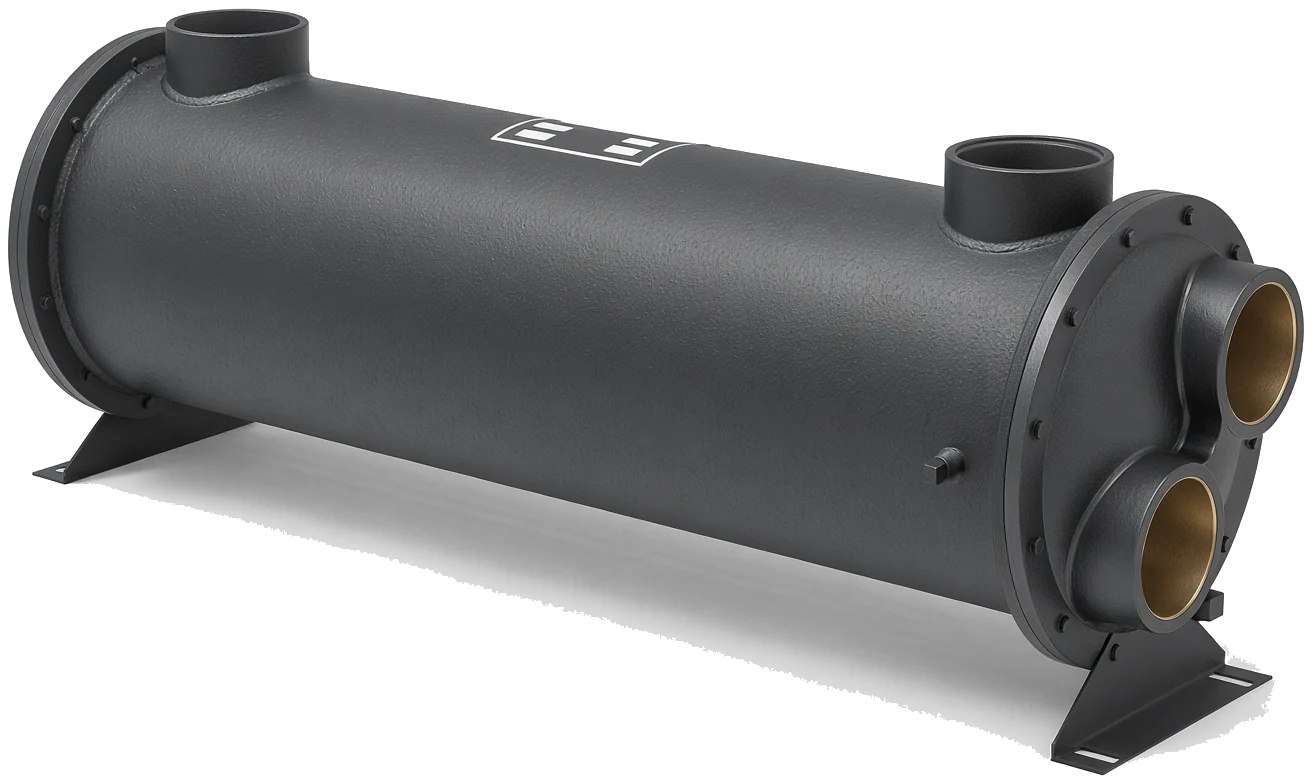
The classic symptom of a failed lube oil cooler is oil in the expansion tank or a milky film on the dipstick. Oil pressure normally exceeds coolant pressure, so a cracked tube pushes oil into the water. Pressure test before you condemn a head gasket.
Request a QuoteOil Is a Coolant
On a hard-worked marine diesel the lube circuit removes heat the jacket water never sees, which is why an undersized oil cooler shortens bearing life long before it trips a gauge.

Confirm the Leak
Prove it before you order
- Pressure test the oil side cold
- Look for oil in the expansion tank
- Check the water side for emulsion

Oil Condition
What the sample tells you
- Water content in the sample
- Viscosity outside grade limits
- Oxidation and additive depletion
Where the Heat Comes From
Piston cooling jets, main and connecting rod bearings, camshaft and valve train, and the turbocharger bearing housing all put heat into the oil. On engines with oil-cooled pistons the share is substantial, and on a heavily rated marine engine it rises with load faster than the jacket water figure does.
- Lube oil removes heat the jacket circuit never sees
- Hot oil thins the film and accelerates oxidation
- Cold oil drives pressure drop far above design
- Oil on shell side with baffles, seawater in tubes
- Copper-nickel tubes and zincs on seawater builds
- Frames from B-401 up through the HC range
Seawater or Jacket Water Cooled
Many marine engines cool lube oil against raw seawater. That gives the coldest available sink and the smallest cooler, at the cost of putting salt water into another exchanger with its own tube ends and anodes to look after. Copper-nickel tubes with zincs in bronze bonnets is the standard build for it.
- Oil pressure exceeds coolant, so leaks go oil to water
- Milky dipstick means water has crossed the other way
- Thermostatic bypass valves protect against cold starts
- Heat to oil is published separately on the data sheet
- Extra surface often fits the original envelope
Material questions
Engine builders publish a band, commonly with an upper limit somewhere near 210 to 240 degrees Fahrenheit at the gallery depending on the engine. Work to the figure for your engine rather than a rule of thumb, and treat a steady climb over seasons as evidence the cooler is losing surface.
Isolate the cooler and pressure test the oil side with the water side open. If it holds, look elsewhere. Oil in the coolant with no combustion gas present points at the cooler, because oil pressure exceeds coolant pressure and pushes oil across a cracked tube.
Many engines are arranged that way from new, and it works well. The oil runs warmer so the cooler needs more surface, but all seawater exposure is concentrated in one exchanger you can service and re-zinc. Do not change arrangement without checking the engine builder's oil temperature limits.
If raw seawater passes through it, yes, exactly as with a jacket water cooler. The anodes sit in the bonnets and protect the tubesheet and tube ends. Check them at every haul-out. If the cooler runs on jacket water instead, anodes are not required in it.
Sometimes. Individual tubes can be plugged, which costs a small amount of capacity, and a full tube bundle replacement is available on removable-bundle frames. If more than a few tubes have gone the rest are usually close behind, and a complete unit is the better value.
Only on an engine without a thermostatic bypass. Where a bypass valve is fitted it routes oil around the cooler until the gallery is up to temperature, so added surface simply buys margin for a hot summer and a fouled tube side. Without one, a seawater cooled unit sized well above the duty can hold light-load oil below band and push cold pressure drop past the relief setting. Tell us which arrangement the engine has and we size accordingly.
Related

APPLICATIONS • OIL COOLING
Gear Cooling
Reduction gear oil, its band and why it runs warmer.
+ Learn More
ENGINES • CATERPILLAR
CAT 3406
Jacket water and oil cooler replacements for the 3406 family.
+ Learn More
ENGINEERING • SERVICE
Bundle Swap
When a new tube bundle beats a complete replacement unit.
+ Learn More
