
1-805-484-2992
Quotes - Engineering - SalesMarine Gear
Cooling the Gearbox
A reduction gear looks like a passive lump of iron and behaves like a heat source. Tooth mesh losses, bearing friction, oil churning at speed and, most of all, slip during clutch engagement all put heat into a relatively small oil charge. On a boat that maneuveres frequently, a tug making up to a barge or a ferry doing thirty turns a day, clutch heat dominates and the gear oil cooler is working harder than the duty plate suggests.
A marine gear generates heat in its bearings, its tooth mesh and above all in its clutch. Hold the oil in band and the gear runs for decades; let it climb and you find out what gear oil costs in bearing terms.
Gear oil also has a narrower comfort band than engine oil. Too cold and it is thick enough to slow engagement and load the pump. Too hot and the film in the tooth contact thins to where scuffing and micropitting begin, seals harden, and the oil oxidizes into the varnish that eventually blocks a control valve. Gear builders publish a maximum sump temperature and it is worth treating as a hard number, not a guideline.
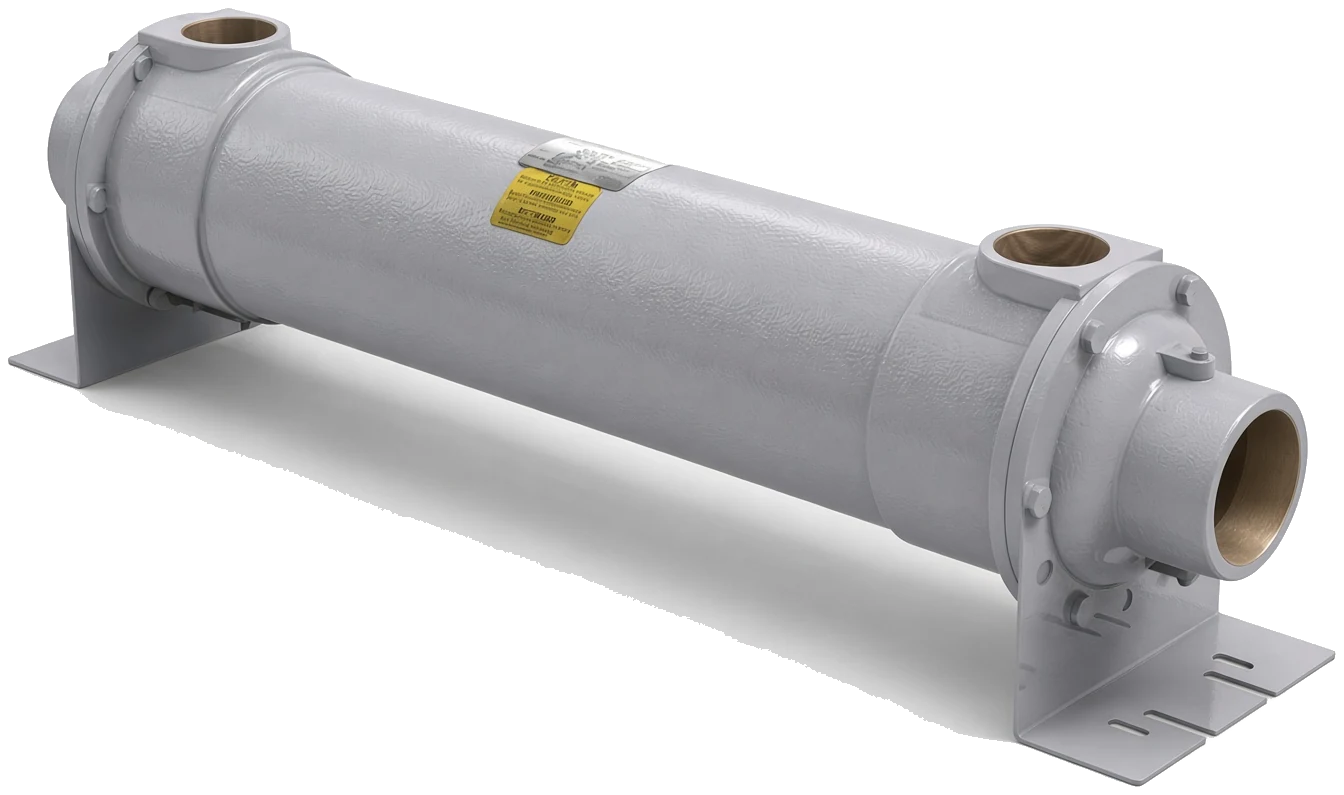
Gear oil temperature that climbs during maneuvering and settles at cruise is telling you clutch heat is the load. That pattern changes the sizing, because the cooler has to absorb a peak, not a steady state. Mention it when you call.
Request a QuoteManeuvering Is the Peak
Gear oil temperature usually peaks not at full power but during repeated clutch engagements, so the cooler must be sized for the harbor, not the passage.

Log the Temperature
Build a picture before ordering
- Sump temperature during maneuvering
- Sump temperature settled at cruise
- Seawater temperature at the same time

Check Clearance
Room to service the cooler
- Space to pull each bonnet
- Access to both anode plugs
- Room for hose or pipe removal
Where Gear Heat Comes From
Every clutch engagement accelerates a shaft, a coupling and a propeller from rest, and the energy that does not end up as rotation ends up as heat in the clutch plates and then in the oil. A single engagement is trivial; a hundred of them in a working day at a barge or a berth is not, and it is the reason two identical gears in identical boats can want different coolers.
- Clutch engagement is the dominant heat source
- Gear oil temperature often peaks in harbor, not at sea
- Sump temperature limits protect the tooth contact film
- Overheated gear oil varnishes and drops its additives
- Gear oil on the baffled shell, seawater in the tubes
- One or two pass to keep oil side drop reasonable
The Temperature Limit Is Real
Gear builders publish a maximum sump temperture, and it exists because the tooth contact film thins as the oil warms. Once the film fails, scuffing and micropitting start on the loaded flanks and the damage does not reverse. Bearings suffer the same loss of film, and lip seals at the output shaft harden and start weeping.
- Envelope and service clearance often decide the frame
- Bonnet orientation can be set to suit the piping
- Water in a gear oil sample means a failed tube
- Slow engagement can be a temperature symptom
- Duty description matters as much as horsepower
Questions from the yard
Work to the maximum sump temperature the gear builder publishes for your model. Many marine gears set that ceiling somewhere near 180 to 200 degrees Fahrenheit. What matters more than the exact number is wether you are approaching it during maneuvering, because that is when the clutch is making heat.
Because clutch slip during engagement generates far more heat than steady mesh and bearing losses at cruise. Repeated ahead and astern engagements at a berth or on a tow load the cooler harder than a passage does, which is why we size for the maneuvering peak.
Usually yes, if the cooler is seawater cooled. Gear oil pressure is often lower than the raw water pressure at that point, so a failed tube lets water into the oil rather than the reverse. Isolate and pressure test the cooler, and change the oil completely once it is fixed.
Often, if the space allows. Extra surface is thermally free and buys margin against fouling and hot summer water. The limits are the oil side pressure drop the lube pump can accept and the room needed to pull a bonnet for anode service. Send dimensions and we will look.
Related

APPLICATIONS • OIL COOLING
Lube Oil
Engine lubricant cooling and the temperature band it needs.
+ Learn More
VESSELS & ENGINES • BY VESSEL
Ferries
High engagement counts and why gear cooling matters there.
+ Learn More
ENGINEERING • MATERIALS
Bronze and Brass
Why bonnets and tubesheets use the alloys they do.
+ Learn More
