
1-805-484-2992
Quotes - Engineering - SalesCummins 6BT and QSB Coolers
Small frames, tight spaces
These are the engines in the boats that cannot afford a week alongside. The 6BT and its QSB successors sit in published marine ratings of roughly 130 to 425 horsepower, powering launches, small trawlers, pilot boats and a great many generator sets. The coolers are correspondingly small, which sounds easier and often is not: connections are small, the space around them is minimal, and a half inch of extra length can be the difference between fitting and not.
The 6BT and QSB sit at roughly 130 to 425 HP, in launches, small trawlers and generator sets. Small frames, small connections, and a replacement that has to land on hoses nobody wants to reroute.
The duty is a straightforward one. Seawater passes through copper-nickel tubes, engine coolant through the shell, and zinc anodes in the bonnets take the corrosion. The heat rejection comes from the engine data sheet for your rating, and at these loads the frame usually falls inside the smaller shell diameters. What we spend time on is the geometry, because the difference between a right and wrong answer here is almost always dimensional.
For a Cummins 6BT or QSB raw water cooler replacement, send the model and rating, the old part number or nameplate photo, the connection sizes and thread type, the shell diameter and overall length, and the water source. Copper-nickel tubes, bronze bonnets and zincs is the standard marine build, with titanium available for warm or dirty water. Call 1-805-484-2992 or email Sales@HeatX.com.
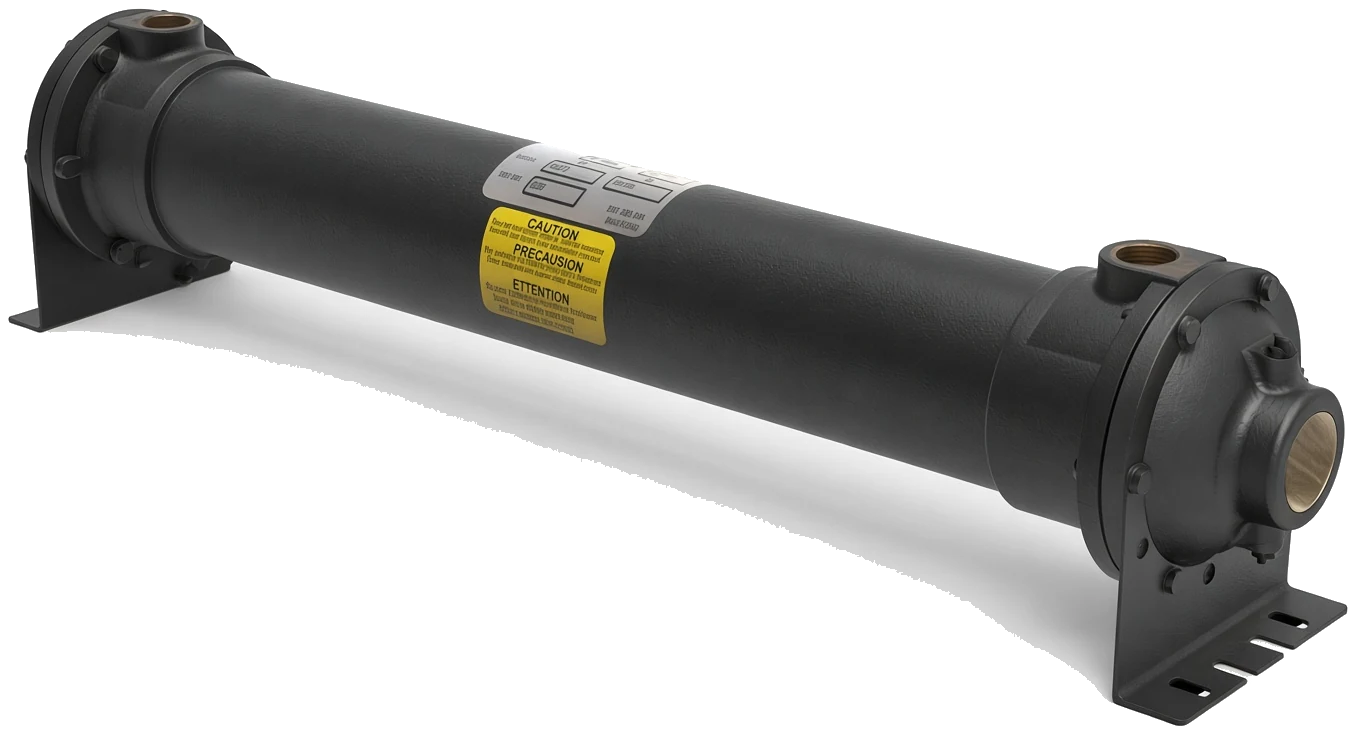
 B Series
 Genset Cooling
 Zinc Anodes
 Bonnets And Gaskets
Getting A Small Cooler Right
At these frame sizes the dimensional detail decides the job, so we take it before quoting.
Duty Inputs
- Model and rated horsepower
- Heat rejection for the rated output from the data sheet
- Seawater inlet temperature
- Raw water pump flow
- Propulsion or generator duty
Dimensions
- Shell outside diameter
- Overall length across bonnets
- Connection size and thread type
- Connection positions and angle
- Mounting bracket or foot pattern
Duty Profile
- Seawater on the tube side
- Coolant on the shell side
- Four pass common at low flow
- Copper-nickel tubes as standard
- Zinc anodes in both bonnets
| MODEL / RATING | HORSEPOWER | DUTY | TYPICAL SELECTION |
| 6BT 5.9 marine | About 130 to 210 HP | Light propulsion | B Series small frames |
| 6BTA 5.9 marine | About 210 to 315 HP | Propulsion | B Series mid frames |
| QSB 5.9 marine | About 230 to 380 HP | Propulsion | B Series or small HC |
| QSB 6.7 marine | About 250 to 425 HP | Propulsion | HC Series lower frames |
| 6B and QSB generator sets | About 130 to 250 HP | Auxiliary power | AB Series or B Series |
Why Small Coolers Are Fussy
The geometry does the deciding
On a large engine there is usually room to accept a slightly different unit. On a 6BT in a small hull there is not. The cooler was fitted where it could be fitted, the hoses were cut to length, and the bracket was drilled once. A replacement that is a little longer, or has its connections rotated, turns into a piping job nobody quoted for.
So we take the dimensions properly. Shell diameter, overall length, connection sizes and thread, the position and angle of each connection, and the mounting pattern. With those we can hold the envelope while still meeting the duty, usually by adjusting the pass arrangement rather than the length.
Access is the usual problem
A large share of 6B and QSB installations are generator sets, and on those the cooler is often mounted behind or under the set where nobody expected to service it. The zinc anodes are the immediate casualty, because a port you cannot reach is a port that never gets opened, and the tubes then take the corrosion instead.
When you send details, tell us how the unit is mounted and what you can actually reach. Where anode access is impossible in place we can sometimes reorient the bonnets so it is not. See Generator Set Cooling.
Related


APPLICATIONS • ENGINE COOLING
Jacket Water Cooling
Raw water coolers for engine jacket water, sized by rating.
+ Learn MoreFitting and connection questions
Most 6BTA duties land in the smaller shell frames, but the exact frame depends on the rating and on the space and connections you have. Send the rated horsepower, the shell diameter and length you can accommodate, and the hose sizes, and we will select a unit that fits the existing installation.
Sometimes physically, but not reliably by duty. QSB ratings generally run higher than the equivalent 6BT, so the heat rejection differs. Check the rating rather than the family, and send the dimensions of what is fitted so we can confirm both the duty and the envelope before quoting.
Usually low tube velocity. A small raw water pump feeding a two pass arrangement leaves the water moving slowly enough for silt to settle in the bores, which fouls the surface and creates local corrosion conditions. Four passes recover the velocity, at the cost of some pressure drop.
You can, and it will cost you tubes. An anode port that cannot be opened is one that never gets serviced, and the copper-nickel then takes the corrosion. Tell us how the unit mounts and what you can reach, and we will orient the bonnets so the anodes are accessible in place.

