
1-805-484-2992
Quotes - Engineering - SalesBronze And Brass
The structural metals in the wet end
Everyone specifies the tube alloy and almost nobody thinks about the bonnet, which is where a surprising number of marine coolers actually fail. The bonnets take the full seawater flow, turn it through the pass arrangement at the highest turbulence in the unit, hold the zinc anodes, and get unbolted and rebolted every time the tubes are cleaned. Getting the casting material wrong costs anodes, costs gasket faces, and eventually costs tube ends when the anodes can no longer keep up.
The bonnets and the tubesheet take the whole seawater flow, carry the anodes and get unbolted every time the cooler is cleaned. On a marine build they are bronze and brass, and both choices are deliberate.
Cast bronze is the marine answer. It sits close enough to copper-nickel on the galvanic series that the tube ends are not driven anodic by their own end covers, it tolerates standing seawater far better than iron, and it survives repeated flange work without the face pitting away. On our frames it is the BR code on the B and HC Series and the B code on the AB Series, and it is part of what makes those the marine option sets rather than the general industrial build.
Brass does the tubesheet work. The tube-to-tubesheet joint is the most electrochemically sensitive feature in the whole cooler, because it is a rolled mechanical joint between two alloys sitting in the electrolyte, and brass keeps that pairing benign with copper-nickel tubes. Brass also appears as a shell material on the B Series. Its one weakness, dezincification in stagnant chloride water, is real and worth recognizing, and it is one of the reasons layup practice matters.
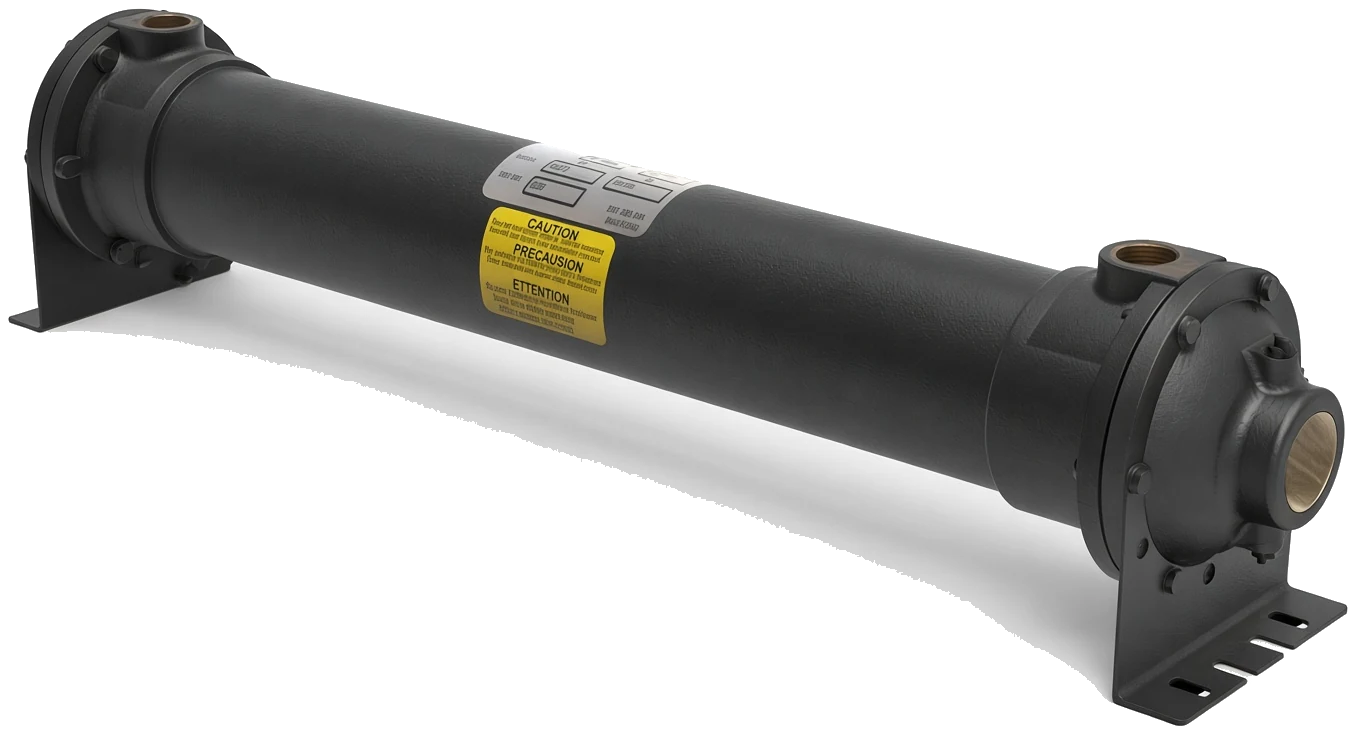
Bonnets Fail Too
A bonnet is not just a cover; it is the most turbulent part of the water path and the electrical anchor for everything protecting your tubes.
Cast Bronze
- Marine standard bonnet material
- Close to copper-nickel galvanically
- Tolerates standing seawater
- Tapped for zinc anode plugs
- BR or B option codes
Brass
- Standard tubesheet material
- Benign with copper-nickel tubes
- Shell option on B Series
- Machines cleanly for rolled joints
- Vulnerable to dezincification
Alternatives
- Cast iron for closed fresh water
- 316 stainless bonnets on HC frames
- 316 tubesheets where specified
- Steel shells on B and HC
- Call for anything else
| COMPONENT | MARINE CHOICE | ALTERNATIVE | WHY IT MATTERS |
| Bonnets | Cast bronze | Cast iron or 316 | Iron consumes anodes fast in seawater |
| Tubesheet | Brass | 316 stainless | Rolled joint sits in the electrolyte |
| Shell | Brass or steel | 316 stainless | Not wetted by seawater on our layout |
| Anode plug | Bronze with zinc pencil | None on fresh water builds | Electrical path must stay clean |
| Gaskets | Marine grade sheet | As original | Renew on every reassembly |
Why Not Cast Iron In Seawater
The cheapest bonnet is the most expensive
Cast iron bonnets are standard on general industrial coolers and entirely appropriate on closed fresh water circuits. Put one in raw seawater and it becomes a large area of active metal wetted by the electrolyte, corroding steadily itself and drawing heavily on any zinc in the system. Anodes that used to last six months disappear in weeks.
The consequence is not just anode cost. Once the zinc is gone the current has to come from somewhere else, and the next most active feature is the tube-to-tubesheet joint. An iron-bonneted seawater cooler with neglected anodes typically shows tube-end attack rather than mid-tube wastage, and that pattern is often the first clue to the real cause.
Dezincification And Layup
What pink brass is telling you
Brass in stagnant chloride water can lose zinc selectively, leaving a weakened, porous, pinkish copper structure that still looks like brass until it is loaded. It happens where water sits still, warm and low in oxygen, which describes a laid-up vessel with a full seawater circuit far better than it describes a boat in service.
The defenses are simple and mostly operational. Flush the seawater side with fresh water and drain what will drain before a long layup, fit fresh anodes before the boat sits rather than after, and inspect tubesheet faces and bonnet interiors on recommissioning. See Corrosion Control for the wider layup guidance.
The Bonnet As An Electrical Component
Anode ports, threads and contact
A zinc anode only works if current can flow from it through the bonnet casting and into the rest of the wetted assembly. That path runs through the plug threads, so a port fouled with paint, sealant or corrosion product reduces protection even with a brand new zinc fitted. Clean threads to bare metal and keep thread sealant off the electrical seating face.
It follows that anode wastage is a diagnostic reading. An anode that comes out looking untouched after months is not connected. An anode reduced to a stub in weeks means the circuit is drawing hard, and the usual suspects are iron in the water path, steel piping bolted to bronze, or a stray current fault. Both cases are covered on the anode page.
What to know before sizing
We would not build it that way. Cast iron corrodes steadily in seawater and consumes zinc anodes several times faster than bronze, and once the zinc is gone the corrosion current attacks the tube ends instead. The saving on the casting is lost in anodes and then in a bundle. Cast iron belongs on closed fresh water duty.
It is selective loss of zinc from brass in stagnant chloride water, leaving a porous pink copper structure that has lost most of its strength. It is a layup problem more than a service problem. Flush with fresh water, drain what you can before the vessel sits, and inspect tubesheet faces and bonnet interiors on recommissioning.
You still want a marine-appropriate casting, because the bonnet is wetted by seawater regardless of tube material. Titanium is very noble, so pairing it with an active casting increases rather than decreases the galvanic driving force on the bonnet. Tell us the arrangement and we will specify the casting and anode set together.
Look at three things: whether the flange face is still flat enough to seal on a new gasket, whether the anode boss threads are intact, and whether the internal turn shows erosion grooving. Any of those failing means a new casting. We hold bonnets and gasket sets for the frames we supply.
No. A bonnet gasket has already taken its compression set and will not seal reliably on a second assembly, and a weeping bonnet joint on a seawater cooler puts salt water in to the machinery space. Gasket sets are inexpensive service items and we supply them with bonnets or on their own.
Related

HEAT EXCHANGERS • CASTINGS
Bonnets
Replacement bonnets and gasket sets for installed frames
+ Learn More

VESSELS & ENGINES • BY VESSEL
Tugs and Workboats
Bonnet and anode service on hard-working commercial hulls
+ Learn More
