
1-805-484-2992
Quotes - Engineering - SalesManeuvering Systems
Two Awkward Duty Cycles
A bow thruster and a fin stabilizer put almost opposite demands on a hydraulic cooler. The thruster runs for thirty seconds at close to full pump power, several times in a docking, then sits idle for hours. The reservoir absorbs the first few bursts; on a windy day with a crosscurrent and four attempts at the berth, it does not. A stabilizer power pack does the reverse: it runs continuously through a passage, and at anchor with zero-speed stabilization active it runs all night while the engines that used to help cool things are shut down.
Thrusters and stabilizers are the two systems most often fitted without enough cooling. One works in short violent bursts, the other works all night at anchor, and both punish a reservoir that was expected to absorb the heat.
Neither of those is a comfortable fit for cooling that relies on reservoir surface and engine room air. Thruster packs overheat in a busy harbor and trip on temperature exactly when the boat needs them. Stabilizer packs quietly run at 190 degrees for eight hours, cook the oil, harden the seals in the fin actuators, and get blamed on the actuator when the oil analysis would have told the story.
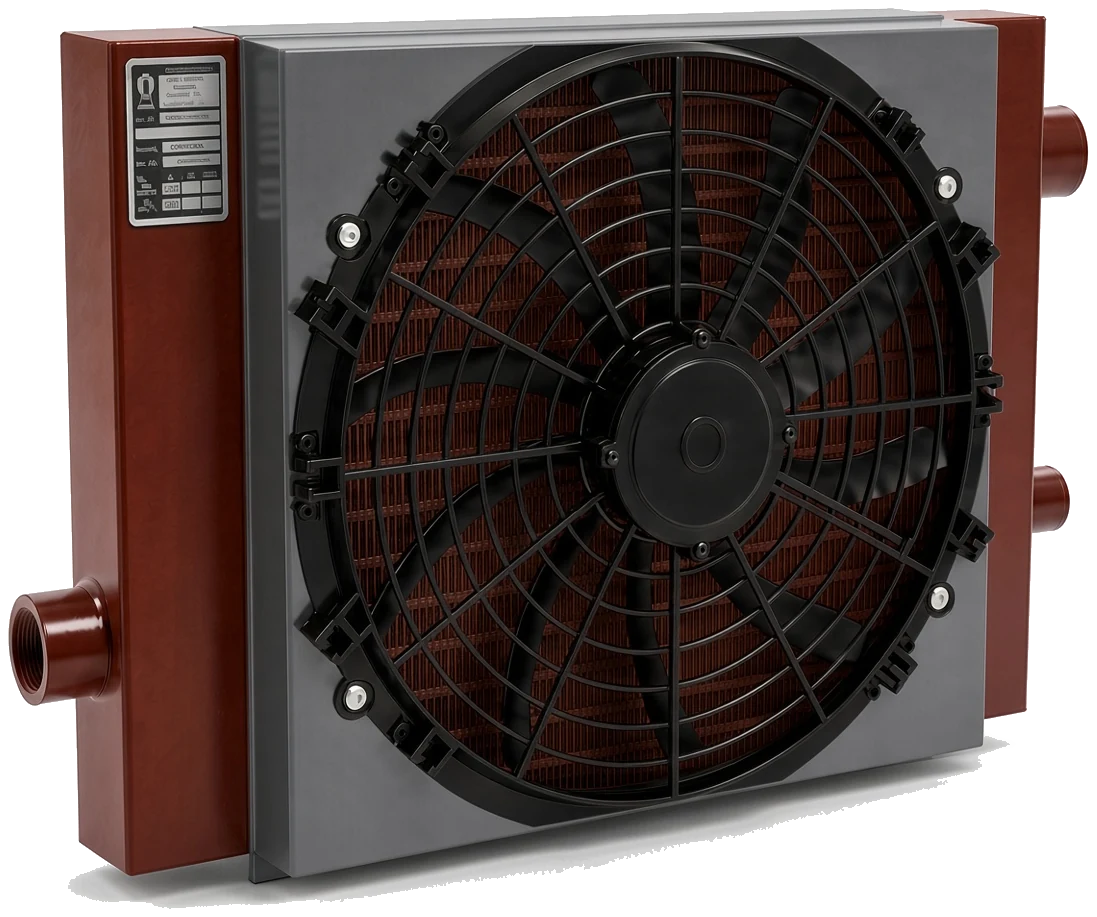
Zero-speed stabilization is the duty that catches people out. With the vessel stopped and the main engines off, the only heat sink is what you have fitted deliberately. Size for a full night at anchor, not for a two hour passage.
Request a QuoteAt Anchor Is the Case
Zero speed stabilization runs the hydraulic pack hardest with the engines stopped, which removes every incidental heat sink the installation was quietly relying on.

Describe the Duty
What we need to size it
- Burst length and how many in a row
- Hours of zero speed operation
- Pump flow and working pressure

Compartment Check
Can it be air cooled here
- Air path to a cooler space
- Ventilation openings and grilles
- Fan drive power available
Sizing for a Burst Duty
For a thruster the honest question is not average heat but how many consecutive bursts the system has to survive. The oil charge and reservoir mass absorb the first engagements; after that the temperature climbs almost linearly with cumulative running time. Operators experience this as a thruster that works fine in calm weather and quits on the day they need it.
- Thrusters heat oil in short bursts near full power
- Consecutive docking attempts are the real design case
- Stabilizers run continuously, hardest at zero speed
- At anchor the engines provide no incidental cooling
- Forepeak packs rarely justify a new through-hull
- Air cooled cores need a genuine air path, not a corner
Zero Speed Stabilization
Zero-speed stabilizers move the fins continuously to damp roll while the vessel is stopped. The pump runs, the fins work against the water, and every bit of that energy becomes oil temperature. Meanwhile the main engines are shutdown, so the engine room is not being ventilated as it is underway and there is no raw water flow unless a pump has been started for the purpose.
- Heresite protects cores in damp salty compartments
- Fan drives available in 12 V, 24 V and AC
- Hydraulic fan drive runs off the circuit it cools
- Overheated oil hardens actuator and cylinder seals
- Oil analysis usually predicts the failure in advance
Questions from the engine room
Almost always hydraulic oil temperature, or an electrical protection responding to it. The reservoir absorbs the first bursts and then the temperature climbs with cumulative running time. If the thruster works in calm conditions and quits after several attempts in wind, the cooling is the limit, not the thruster.
Generally yes. Zero-speed operation runs the hydraulic pack continuously with the main engines stopped, removing the incidental cooling the installation relied on underway. Size for a full night at anchor and make sure the cooling flow, whether a raw water pump or a fan, runs whenever the pack does.
You can, but it means a long suction line, a strainer in a compartment nobody visits, and a through-hull well forward. Most owners are better served by an air cooled bar-and-plate unit with a Heresite coated core and a DC or hydraulic fan, provided the compartment has a usable air path.
The oil itself tolerates more than the seals do. Sustained operation above about 180 degrees Fahrenheit shortens seal and hose life measurably, and above 200 degrees you are cooking the additive package and varnishing valve spools. Fin actuator seal weeping is often the first visible sign.
Only if they share a genuinely common hydraulic circuit and reservoir, which some combined maneuvering packs do. Where they are separate systems, keep the coolers separate; the duty cycles are so different that a single selection will be wrong for one of them.
Related

VESSELS & ENGINES • BY VESSEL
Yachts
Where stabilizers and thrusters both run hardest at anchor.
+ Learn More
HEAT EXCHANGERS • AIR COOLED
Air Cooled
The coated bar and plate range with three fan drive options.
+ Learn More
ENGINEERING • SELECTION
Flow and Drop
Return line pressure limits on a hydraulic cooler selection.
+ Learn More
