
1-805-484-2992
Quotes - Engineering - SalesCoolers for Detroit Two-Strokes
From the 6-71 to the 16V149
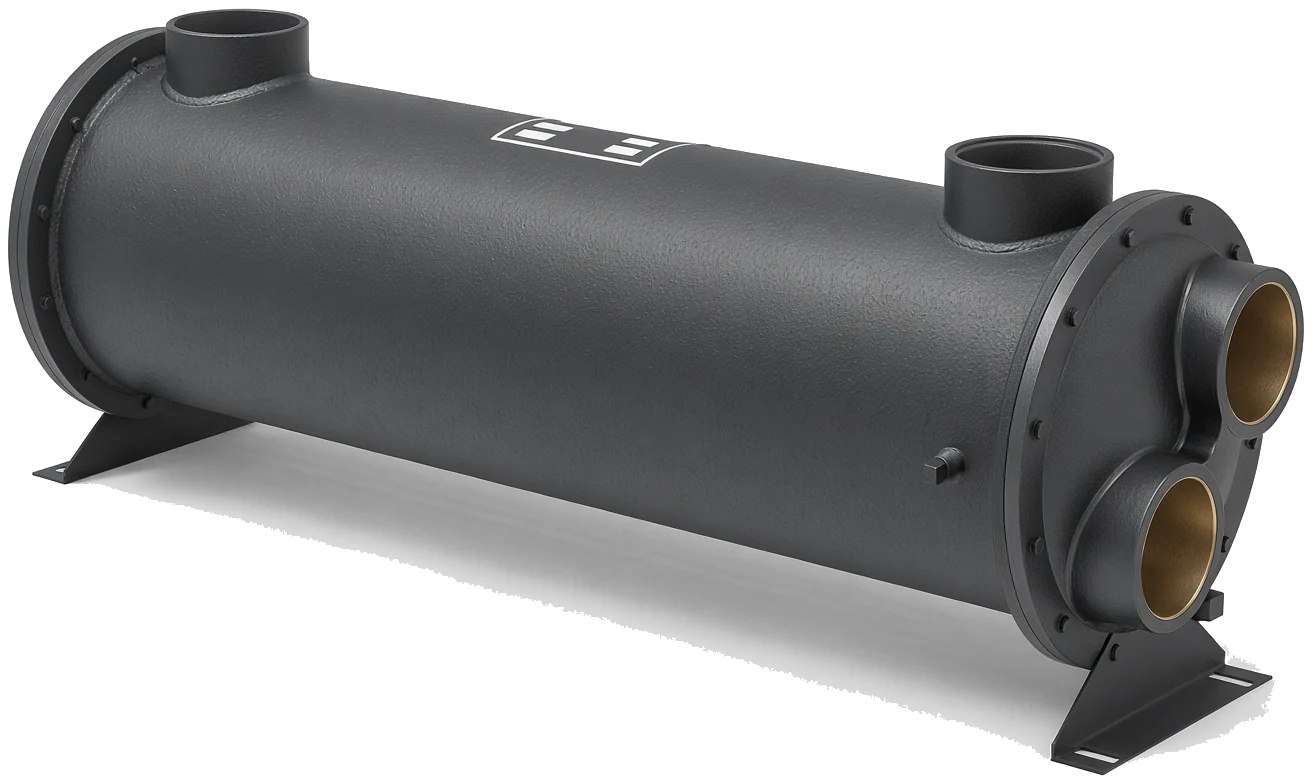
A Detroit Diesel heat exchanger is almost always a replacement job. The engines outlive their coolers by decades, and the shell that came with the boat has usually been rebuilt, re-tubed or bodged with a plug or two before it reaches us. We supply new shell and tube jacket water coolers and lube oil coolers built to the duty the engine actually rejects, with bronze bonnets, copper-nickel tubes and zinc anodes in the raw water end.
Detroit two-strokes are still working boats every day, and the coolers hung on them are usually older than the last repower. We build the replacement jacket water cooler and lube oil cooler to the duty on your data sheet, in bronze and copper-nickel.
Detroit ratings move a long way inside one model number. The same 8V71 block appears naturally aspirated, turbocharged and turbocharged aftercooled, and the injector size and rated speed decide where in the range it sits. That matters because the cooler is sized on heat rejection, not on displacement. Tell us the model, the rated horsepower and the rated RPM and we work from the heat rejection published on the engine data sheet for that specific rating.
Every model family on this page runs to a page of its own with horsepower ranges, the series we normally select and what we need from you to confirm the replacement. If your engine is not listed, or the nameplate on the old cooler is unreadable, call 1-805-484-2992 with the engine model and a photograph of the unit and we will work it out from the connections and the envelope.
| MODEL / RATING | HORSEPOWER | DUTY | TYPICAL SELECTION |
| Detroit 6-71 and 8V71 | About 165 to 450 hp | Jacket water and lube oil | HC Series or B Series |
| Detroit 12V71 and 16V71 | About 400 to 925 hp | Jacket water, gear oil | HC Series plus gear oil cooler |
| Detroit 8V92 and 12V92 | About 400 to 1,050 hp | Jacket water and lube oil | HC Series plus lube oil cooler |
| Detroit Series 60 | About 350 to 825 hp | Jacket water, aftercooling | HC Series with CN tubes |
| Detroit 149 Series | About 700 to 2,000 hp | Jacket water, lube oil | HC Series, call for rating |
Two-Stroke
- 6-71 and 8V71 inline and vee
- 12V71 and 16V71 heavy duty
- 8V92 and 12V92 higher speed
- 8V, 12V and 16V149
- Naturally aspirated through TIB
Four-Stroke
- Series 60 at 11.1 liter
- Series 60 at 12.7 liter
- Series 60 at 14.0 liter
- Marine and auxiliary ratings
Duties
- Jacket water to seawater
- Lube oil to seawater
- Marine gear oil cooling
- Auxiliary and genset cooling
- Hydraulic deck circuits
Sized on Heat Rejection
Two engines with the same model number can reject very different heat, so we size on the rating stamped on your engine rather than on the family name.
Why Detroit Coolers Fail Early
Raw water, zincs and standing time
The tube side sees raw seawater at whatever velocity the raw water pump and the piping give it. Too slow and silt and shell debris settle in the tubes; too fast and the inlet ends thin out. Both show up as a rising jacket water temperature that the crew first blames on the thermostat. A bundle that has been rodded three times has less wall left than the gauge suggests.
The second cause is zincs nobody has pulled. An anode that has wasted away stops protecting the tubesheet and the bonnet, and the corrosion moves to the next most active metal in the assembly. On a boat that sits between seasons, the standing seawater in a hot shell does more damage in three idle months than a season of running. Pull the zincs on a schedule and write the date on the shell.
What We Need to Quote
Five things off the engine and the old unit
Engine model and rated horsepower with rated RPM, a photograph of the old cooler nameplate, the old part number if it is still legible, the inlet and outlet connection sizes at both ends, and where the seawater comes from. That last one decides material: harbor water with sand in it, warm tropical water and Arctic intake water are three different jobs even at the same heat load.
If the nameplate is gone, measure the shell diameter, the overall length between bonnet faces, the connection sizes and the mounting centers, and send photographs of both bonnets. We can normally identify the frame size from that, including discontinued ITT Standard units, and confirm a replacement that lands on the existing brackets and piping.
Frequently asked
Yes. Age of the engine is not the obstacle, the missing paperwork is. Send the engine model, rated horsepower and rated RPM plus measurements of the old shell, and we select a current frame size that matches the duty and fits the existing brackets. Zincs, bronze bonnets and copper-nickel tubes are the standard marine build.
It comes off the engine data sheet for your specific rating, not from the model family. A naturally aspirated 8V71 and a turbocharged aftercooled one carry very different jacket water and lube oil heat. Give us the model, horsepower and rated speed and we work to the published figure for that rating.
In many cases yes, if the shell is sound and the frame is one we can bundle. Where the shell is thinned, pitted around the bonnet face or has been welded, a complete unit is the better buy. Send photographs of the shell ends and the tubesheet and we will tell you which way to go.
They are replacement heat exchangers selected to the duty your engine rejects, supplied by HeatX. We size them from the heat rejection on the engine data sheet and build them to marine specification with copper-nickel tubes, bronze bonnets and zincs. Call 1-805-484-2992 if you need the selection confirmed in writing.
Related

APPLICATIONS • JACKET WATER
HC Series
The workhorse frame for Detroit jacket water duty, 614 through 1772
+ Learn More
VESSELS & ENGINES • BY VESSEL
Tugs and Workboats
Cooling duty on boats that run hard and berth in dirty water
+ Learn More
ENGINEERING • SELECTION
Replacing a Cooler
How we identify an unmarked unit from measurements and photographs
+ Learn More
