
1-805-484-2992
Quotes - Engineering - SalesStainless And Stagnation
Why 316 disappoints on a moored boat
Stainless steel in seawater is the material decision that catches out more people than any other on a vessel. The confusion is understandable, because 316 genuinely performs well in fast-moving aerated seawater and the published corrosion rates look excellent. What those figures do not describe is what happens the moment the pump stops. Chlorides concentrate in any crevice, oxygen is consumed and not replaced, the passive film cannot repair itself locally, and the attack becomes autocatalytic and fast.
316 stainless looks perfect in a flowing seawater test and fails in a laid-up vessel. The reason is that its passive film needs oxygen and movement, and a shut-down cooler gives it neither.
The mechanism is worth understanding because it explains the pattern of failure. Pitting starts under a deposit, a gasket edge, a scale flake or the tiny annular gap where a tube enters a tubesheet. Inside that shielded volume the chemistry turns acidic and aggressive while the metal a millimeter away stays bright and apparently perfect. The result is a pinhole through a wall that shows no general thinning at all, which is why a stainless tube can leak while looking new.
So we do not build raw seawater tube bundles in 316. For tube service in seawater the answer is copper-nickel, which resists chloride by growing a different kind of film that does not depend on flow, or titanium, which is simply immune. 316 remains a perfectly sensible material elsewhere on the same cooler: shells and tubesheets on the HC frames, closed fresh water and glycol circuits, and duty where the fluid moves continuously and is not chloride-bearing.
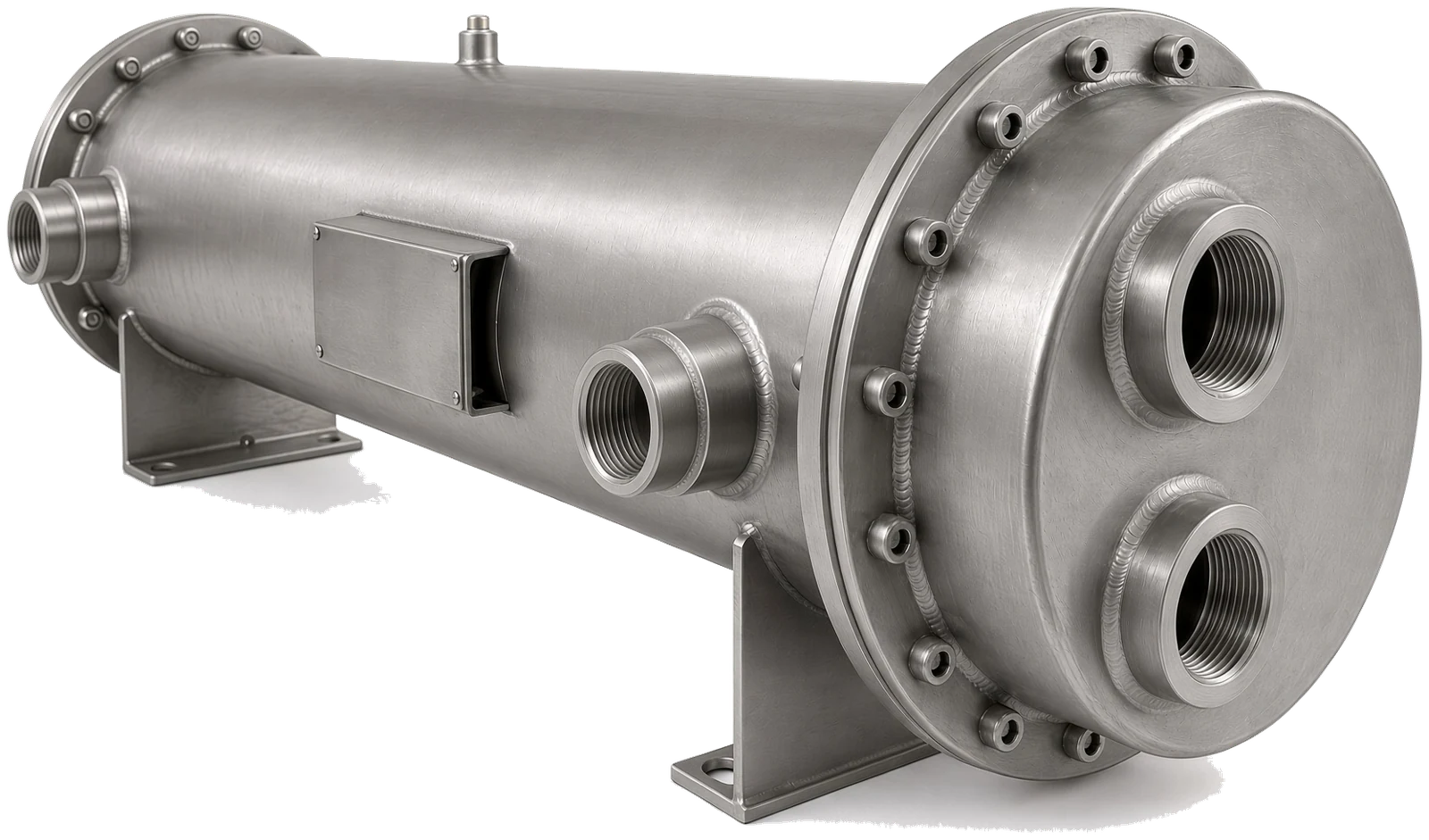
Flow Keeps It Passive
Stainless steel in seawater is protected by moving oxygenated water, and every vessel shuts down, so the design condition is stagnation.
Where 316 Works
- Shells on HC Series frames
- Tubesheets where specified
- Closed coolant and glycol loops
- Continuously flowing clean water
- Structural brackets and fasteners
Where It Fails
- Raw seawater tube bundles
- Anything left standing full
- Under scale or biological deposit
- Tube-to-tubesheet crevices
- Warm chloride-bearing water
Failure Signs
- Pinholes with no general wastage
- Rust staining from a single point
- Dark pits under lifted deposit
- Leaks after a layup period
- Attack at gasket edges
| CONDITION | 316 BEHAVIOR | COPPER-NICKEL | TITANIUM |
| Flowing aerated seawater | Good | Good | Immune |
| Stagnant seawater | Pits and perforates | Fair with anodes | Immune |
| Under deposits or scale | Crevice attack | Slowed but resistant | Immune |
| Warm chloride water | Pitting risk rises sharply | Use 70/30 grade | Immune |
| Closed glycol loop | Excellent | Unnecessary | Unnecessary |
The Passive Film And Its Conditions
Why oxygen and movement matter
Stainless steel is not inherently unreactive. It is protected by a very thin chromium oxide layer that repairs itself when damaged, and repair needs dissolved oxygen at the metal surface. In moving aerated water that supply is continuous and the film keeps up with chloride attack easily.
Shield a patch of surface under a deposit and the local oxygen is used up. The film cannot repair, chloride migrates in, the trapped solution acidifies, and metal dissolution accelerates because the corrosion products themselves make the enviroment more aggressive. That self-reinforcing loop is why stainless pitting is fast once it starts, in contrast to the slow general attack people expect from corrosion.
Why It Bites Marine Users
Every vessel provides the failure condition
Industrial seawater plant often runs continuously, and stainless can be made to work there with care. A vessel does not. It runs for hours, then sits for days or months with the seawater circuit full and still, warm from the machinery space, with whatever silt and organic matter came in through the strainer settling onto the tube bores.
That is the worst possible condition for 316 and a survivable one for copper-nickel with maintained zinc anodes. It is also why a stainless cooler can pass a sea trial, complete a season, and then leak during recommissioning after winter layup. The failure was set up during the idle period, not during operation.
Where We Do Specify 316
Shells, tubesheets and closed loops
On the HC Series the shell can be steel or 316, the tubesheet steel or 316, and the bonnets cast iron, bronze or 316. Because we always put seawater on the tube side, the shell and its internals see engine coolant or oil, and there 316 is a strong material with real advantages in strength and cleanliness.
316 is also the sensible choice on closed fresh water and glycol circuits, on brackets and fasteners in the machinery space, and on any duty where flow is continuous and chlorides are absent. The rule to remember is not that stainless is bad but that stainless plus still seawater is bad.
Installation and service questions
The published performence assumes flowing aerated water, which keeps the passive film repaired. Marine service does not provide that. Once flow stops, oxygen under deposits is consumed, chlorides concentrate, and localized pitting or crevice attack proceeds quickly. The alloy is not defective; the service condition is different from the test condition.
Higher alloyed grades resist chlorides considerably better than 316, but they carry cost close to the point where titanium becomes the sensible comparison, and they still foul biologically. For marine cooler tubes we specify copper-nickel or titanium and use 316 for shells, tubesheets and closed circuits.
Cathodic protection helps, but it does not reliably stop crevice attack in shielded volumes where the protecting current cannot reach, which is precisely where stainless fails. Anodes are essential on copper alloy coolers because they protect accessible surfaces and tube-end joints. They are not a substitute for choosing the right tube alloy.
Because the damage was done while it sat. Seawater left standing under fouling deposits creates the low-oxygen high-chloride pocket that drives pitting, and months of that will put a pinhole through a tube that looked perfect at haul-out. Flushing with fresh water and draining before layup makes a large difference.
On the shell side and the structure. Because we always run seawater through the tubes, 316 shells and tubesheets on the HC frames see engine coolant or oil and perform excellently there. It is also correct for closed glycol loops, brackets and fasteners. The seawater passages get copper-nickel or titanium.
The annular gap where a tube passes through the tubesheet is a ready-made crevice. Seawater in that gap is cut off from the oxygen the passive film needs, chlorides build up inside it, and the attack runs through the wall while the open bore a short distance away stays bright. The same geometry exists at every gasket edge, which is why a stainless bonnet joint can weep after a layup with no visible corrosion anywhere else.
Related

APPLICATIONS • JACKET WATER
HC Series
Frames offering 316 shells with copper-nickel or titanium tubes
+ Learn More
ENGINEERING • CORROSION
Galvanic Corrosion
How stainless behaves when coupled to bronze and steel
+ Learn More
VESSELS & ENGINES • BY VESSEL
Yachts
Intermittent duty and long idle periods on pleasure hulls
+ Learn More
