
1-805-484-2992
Quotes - Engineering - SalesGalvanic Corrosion
The circuit is bigger than the cooler
Galvanic corrosion needs three things and a seawater cooling system supplies all of them without being asked. Two different metals, an electrolyte joining them, and an electrical connection between them. Seawater is an excellent electrolyte, the piping bolts everything together electrically, and a typical raw water circuit contains bronze valves, a steel or plastic strainer body, a bronze or stainless pump, rubber hose with a wire helix, and a cooler made of at least three alloys itself.
Bolt two different alloys together in seawater and you have built a battery. The cooler is only one component in that circuit, and the piping either side often decides which part of it corrodes.
The metal that suffers is the more electrochemically active of the pair, and how fast it suffers depends far more on the area ratio than on how far apart the two metals sit in the galvanic series. A small steel fitting connected to a large bronze and copper-nickel cooler is in serious trouble; the same steel as a large pipe run with one small bronze fitting on it will barely notice. Getting the area relationship right is often more useful than avoiding the pairing altogether.
Inside the cooler we manage this by keeping the wetted alloys close together: copper-nickel tubes rolled into a brass tubesheet under cast bronze bonnets, with zinc anodes as the deliberate weakest link. That leaves the piping as the variable, and it is where most avoidable damage originates. This page covers the pairings we see causing problems on real vessels and what to do about each.
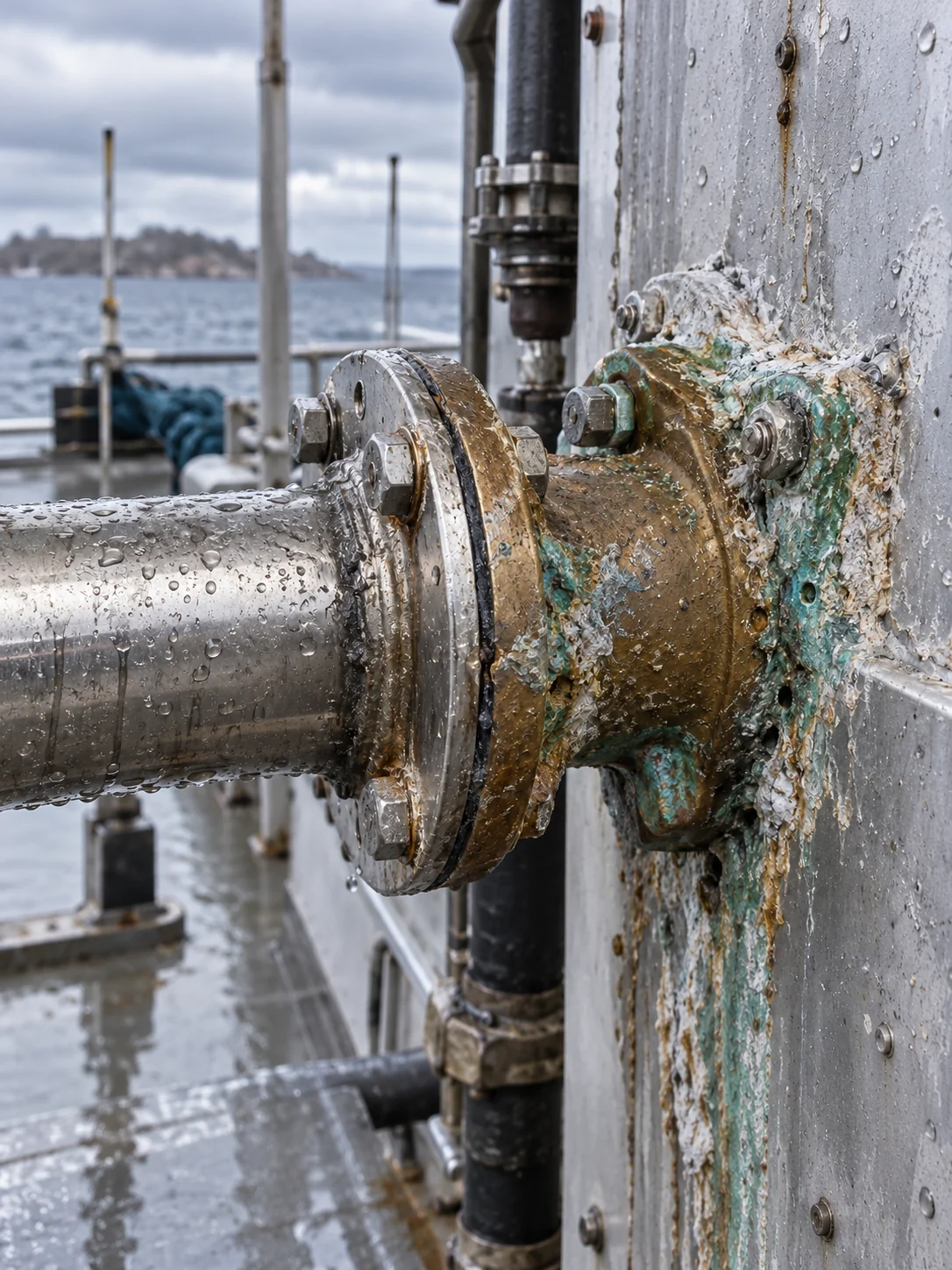
Area Beats Nobility
A small active fitting serving a large noble surface will be eaten quickly, and reversing the areas turns the same pairing into a non-event.
Good Pairings
- Bronze fitting to bronze bonnet
- Copper-nickel tubes to brass tubesheet
- Bronze valve to copper-nickel pipe
- Zinc anode to everything else
- Non-metallic hose between components
Bad Pairings
- Small steel adaptor to bronze bonnet
- Cast iron bonnet on a seawater cooler
- Titanium against an active casting
- Aluminum anywhere in seawater piping
- Stainless fastener in a crevice
Breaking The Cell
- Isolating unions at transitions
- Non-conductive hose sections
- Get the area ratio the right way round
- Zinc anodes in both bonnets
- Sound bonding, no stray current
| PAIRING | WHAT CORRODES | SEVERITY | REMEDY |
| Steel adaptor to bronze cooler | The steel fitting, rapidly | High | Bronze fitting or isolating union |
| Cast iron bonnet with CuNi tubes | The bonnet, then the tube ends | High | Bronze bonnets on seawater duty |
| Titanium tubes, bronze bonnet | The bonnet | Moderate | Anodes sized for the couple |
| Aluminum in seawater piping | The aluminum, very fast | Severe | Remove aluminum from the circuit |
| Bronze valve to bronze bonnet | Essentially nothing | Low | Preferred arrangement |
| Stainless bolt in bronze flange | Crevice under the head | Moderate | Correct fastener and bedding |
Why Area Ratio Dominates
The same pairing, two different outcomes
The current in a galvanic cell has to leave the anodic metal through its wetted surface. Concentrate that whole current into a small area and the local corrosion rate is enormous; spread it over a large area and the rate per square inch is trivial. This is the single most useful idea in practical galvanic control and it explains failures that the galvanic series alone does not.
It is why a small mild steel nipple screwed into a bronze bonnet fails in a season while a long steel pipe run with bronze end fittings lasts for years. It is also why zinc anodes work: the zinc is deliberately made the small active component, and it is cheap and replaceable, so all the concentrated attack lands where you want it.
The Pairings We See Most
Common faults in real engine rooms
Steel adaptors on seawater lines are the most frequent avoidable fault, usually fitted because that is what was in the drawer. Cast iron bonnets on a seawater cooler are the second, and they show up first as impossible anode consumption. Aluminum in a seawater circuit is rare but catastrophic when it happens, because aluminum is far more active than anything else present.
Stainless fasteners are a subtler case. The bolt itself is noble and survives, but the shielded crevice under the head or in the threads is exactly the condition where stainless pits, and a bolt that fails in a bonnet flange can be an expensive surprise. Match fasteners to the casting and bed them properly rather than assuming stainless is always the upgrade.
Breaking Or Managing The Circuit
Isolation, substitution and sacrifice
Three approaches work. Substitute so the pairing goes away, which for seawater piping usually means bronze on bronze at the cooler connections. Isolate so no current can flow, using isolating unions or a length of non-conductive hose between two dissimilar metal components. Or sacrifice, by fitting zinc anodes so the current has a cheap, deliberate exit.
In practice a good installation uses all three. Bronze connections at the cooler, non-metallic hose where the piping changes material, and maintained anodes in both bonnets. Note that isolation only works if it is complete; a bonding wire across an isolating union restores the electrical path and undoes the whole exercise.
Sizing questions
Aluminum with anything else is the worst combination and should not appear in a seawater circuit at all. Small mild steel fittings bolted directly to bronze or copper-nickel components are the next worst and fail quickly. Bronze to bronze at the cooler connections is the arrangement to aim for.
Because the whole galvanic current must leave the active metal through its own wetted surface. A small anodic area concentrates that current and corrodes fast, while a large anodic area spreads it thin and barely suffers. The same two metals can therefore be a disaster or a non-issue depending on which is larger.
They work when the isolation is complete. Any paralell path restores the circuit, and the usual culprit is a bonding conductor running accross the union for electrical safety reasons. If a bonding wire is required, plan on sacrificial protection instead of isolation and size the anodes for the couple you have.
Titanium is very noble, so pairing it with bronze increases the driving force on the casting rather than the tubes. In practice this is manageable with appropriate anodes and it does not stop us fitting titanium tubes in bronze-bonneted frames. Tell us the arrangement and we will specify the anode set with it.
Look at how widespread it is. Galvanic damage concentrates at a specific joint or component where two alloys meet. Stray current damage is general, and the giveaway is anodes disappearing everywhere at once, at the cooler, the shaft and the rudder. That points at shore power, bonding or wiring rather than metallurgy.
Bond it the way the rest of the seawater hardware is bonded, but check what that wire connects to. A bonding strap that spans an isolating union or a length of non-conductive hose reconnects the two metals you just separated, and the union becomes decoration. Bonding also ties the cooler to the shaft and rudder anodes, so if those are wasting fast the cooler zincs will be too, and the fault is electrical rather than in the cooler.
Related

ENGINEERING • CORROSION
Velocity Limits
The other mechanical cause of early tube failure
+ Learn More
HEAT EXCHANGERS • PARTS
Bonnets
Bronze castings that keep the internal galvanic gap small
+ Learn More
APPLICATIONS • SEAWATER
Raw Water Cooling
Laying out the seawater circuit around the cooler
+ Learn More
