
1-805-484-2992
Quotes - Engineering - SalesWhere Material Choice Actually Matters
Seawater is the only heat sink a vessel has, and it is also the most aggressive fluid on board. It carries chlorides at around 19,000 parts per million, dissolved oxygen, sand, silt, marine organisms that would rather live in your tubes, and sometimes chlorine from a treatment system. Every exchanger on the boat has one side facing that, and how well the design handles it decides whether the unit lasts three years or twenty.
Everything on a boat is ultimately cooled by the sea, and the seawater side is where the corrosion, the fouling and the material decisions live. These pages cover the circuits that touch salt water directly.
Read this page before buying any cooler on this one, because most overheating complaints begin upstream of the exchanger. Raw water cooling treats intake, seacock, strainer, impeller pump and hose as a single circuit whose delivered flow at working RPM is the number that matters. A worn impeller or a collapsing suction hose gives the same gauge reading as an undersized unit, and a bucket-and-stopwatch flow check settles the argument in twenty minutes. The page also weighs a direct arrangement, seawater in every cooler, against central cooling, and shows how pass count holds tube velocity inside the alloy's safe window.
Freshwater generation is the one seawater duty where the fluid is hotter and saltier than the sea itself. A flash evaporator boils seawater under vacuum using jacket water heat and discharges concentrated brine; a reverse osmosis plant still passes concentrated feed through its cooling and energy recovery exchangers. Elevated temperature plus high chloride plus velocity is the exact combination that strips the protective film from copper alloys, so titanium evaporators and condenser sections are the standard build rather than an option. Ratings depend on brine concentration and operating vacuum, so these units are quoted per duty, not from a table.
A hold that takes longer to pull down each season is a condenser problem, and this page explains how to prove it. Refrigeration condensing temperature is seawater temperature plus the approach the condenser achieves, so lost surface shows up as rising head pressure, more compressor hours and more fuel long before anything leaks. The diagnostic is a logged gap between condensing pressure and seawater inlet temperature. Condensers run higher tube velocity than jacket coolers and scale on their hottest surfaces, which is why titanium condensers are specified for warm, fast or chlorinated water while small cold-water plants stay on copper-nickel.
Air conditioning is sized for the stopped vessel, which makes its condenser different from every refrigeration plant that runs underway. A chiller works hardest at anchor in a warm, still harbor with the main engines off and a genset carrying the load, so its condenser is selected for the warmest water the boat will ever sit in, not for cruising conditions. The symptom is warm cabins rather than an alarm, and the condenser water pump, strainer and through-hull are checked before the condenser is blamed. Copper-nickel serves temperate cruising boats; titanium is the choice for tropical, silty or chlorinated berths.
If you want to stop maintaining five or six seawater coolers and look after one instead, this is the architecture. A fresh water isolation exchanger takes the sea through a single unit built for it, with copper-nickel or titanium tubes and bronze or 316 bonnets, and circulates a closed treated loop to every other duty aboard. Engines, gears, hydraulics and condensers then run in clean fresh water with no zincs. The page covers how the loop is arranged, what sizes or confirms a unit, and where a titanium gasketed plate unit suits a tight space or a large load.
Boats that live on rivers and in harbors need a different metal, not a shorter cleaning interval. Variable salinity, silt at the inlet ends, warm sulfide-rich summer water and nearby chlorination keep the protective film copper-nickel depends on from ever stabilizing, so a bundle that should last a decade pits through in two or three years. The brackish water unit is the same shell-and-tube frame, most often the HC Series with the T option, built with titanium tubes and tubesheet on the identical footprint and connections. It is the page for a replacement that keeps failing on the same schedule.
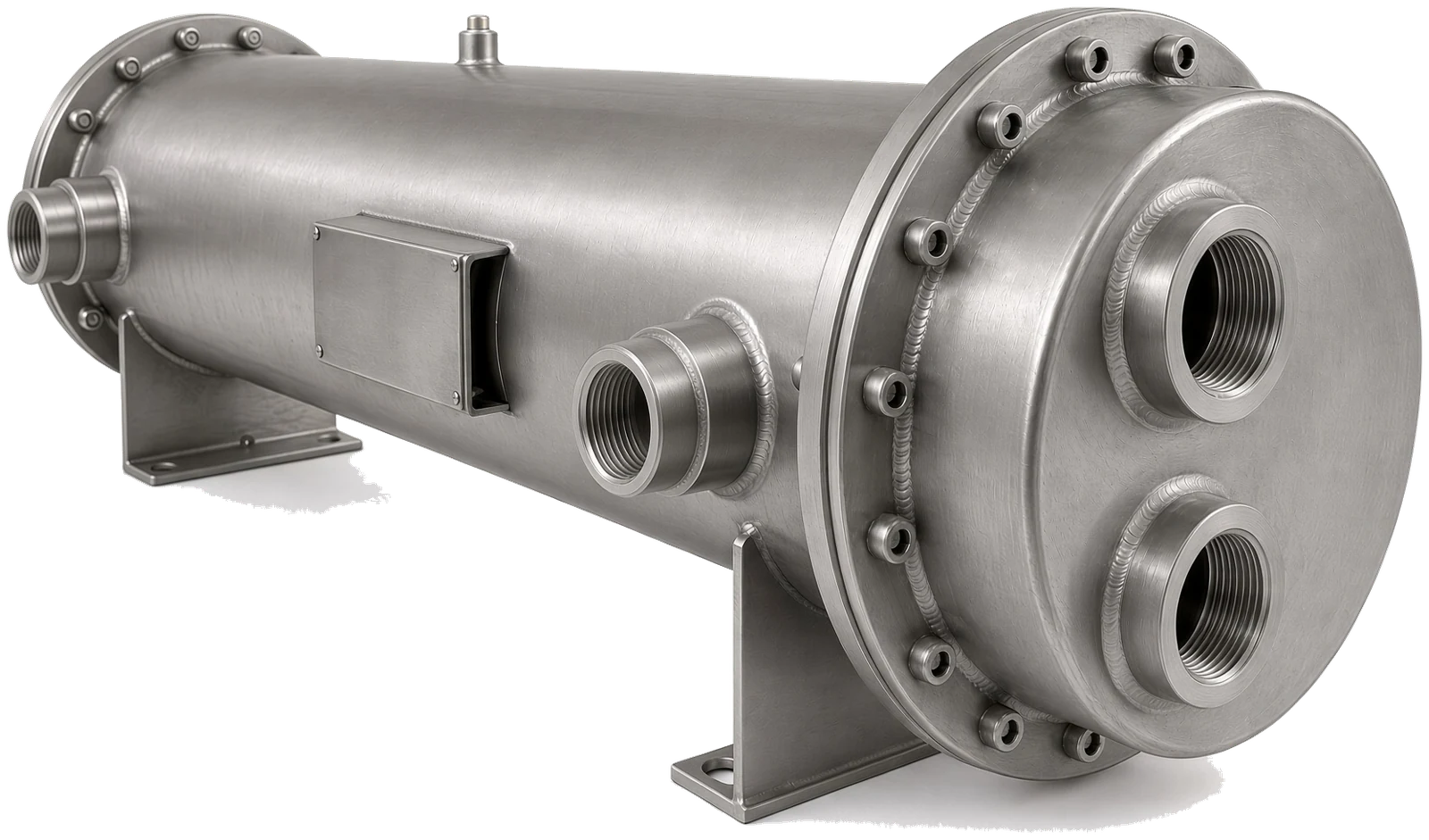
Putting seawater inside straight tubes means every surface it touches can be reached with a rod and a brush from the bonnet end. It also confines the corrosion problem: only the tubes, the tubesheet face and the bonnets have to be built for salt water, while the shell can be steel and the shell-side fluid can be whatever the duty needs.
Below roughly three feet per second, seawater drops its sediment and gives marine organisms somewhere comfortable to settle, so low-velocity tubes silt and foul. Above the upper limit for the alloy, the flow strips the protective film off copper-nickel faster than it can reform, and the tube thins from the inside starting at the inlet end.
Chlorination, elevated temperature, high velocity and concentrated brine are the four conditions that defeat copper alloys. Titanium is unaffected by any of them at the concentrations found in marine service, which is why evaporators, watermaker exchangers and many condensers are built with titanium tubes as a matter of course rather than as an upgrade.
Two numbers govern seawater side design more than any other: velocity, which must be high enough to keep tubes swept but low enough to avoid erosion of the protective film, and temperature, which sets how much duty is available at all.
The Seawater Circuit




Velocity Cuts Both Ways
Too slow and the tubes silt up and grow things; too fast and the protective film erodes off the copper-nickel, so the usable window is narrower than most selections assume.
Where Titanium Wins
Chlorination, elevated temperature, high velocity and concentrated brine are the four conditions that defeat copper alloys. Titanium is unaffected by any of them at the concentrations found in marine service, which is why evaporators, watermaker exchangers and many condensers are built with titanium tubes as a matter of course rather than as an upgrade.
Keeping the Circuit Working
Most seawater side problems begin upstream of the exchanger. An undersized or badly located strainer that nobody cleans, a worn impeller, a collapsed suction hose or a growth-restricted intake all reduce flow, and reduced flow both cuts duty and drops velocity into the silting range. Fix the circuit before you buy surface.
Downstream of that, the anodes are the maintenance item that matters. Pull them at every haul-out, replace anything past half consumed, and treat unusually fast consumption as a diagnostic rather than an inconvenience. The anode page covers sizing and intervals.
Four Specific Conditions
Titanium is a T option on the shell-and-tube frames we supply, and titanium evaporators and condensers are rated per duty, so call us for a rating on those. What titanium does not fix is fouling, sizing errors or a bad raw water pump; those remain your problems and ours.
There are duties where copper-nickel is not enough. Evaporators and watermaker heat exchangers concentrate brine at elevated temperature. Refrigeration and chiller condensers run seawater fast and warm, and often in harbor water at its worst. Chlorinated systems attack the protective film copper alloys depend on. Those are the cases where a marine seawater heat exchanger with titanium tubes stops being an indulgence and becomes the cheaper answer over the life of the vessel.
Seawater Systems

HEAT EXCHANGERS • TITANIUM
Titanium Range
Titanium tube options, evaporators and condensers for seawater.
+ Learn More
ENGINEERING • CORROSION
Velocity Limits
The window between silting and film erosion in seawater tubes.
+ Learn More
APPLICATIONS • ENGINE COOLING
Jacket Water
The engine circuit that the seawater side ultimately serves.
+ Learn More
