
1-805-484-2992
Quotes - Engineering - SalesDuty and Documentation
Availability Is the Metric
Offshore support, patrol, fire and rescue vessels are bought and judged on availability. A charter day lost, a station left uncovered or a callout missed carries a cost nothing about the equipment can offset, and that changes how cooling is specified. Margin is bought deliberately, spares are held on board rather than ordered on failure, and the construction and material records are expected to be in the file before anyone asks for them.
These vessels are measured on availability. Cooling that fails takes a boat off station, and the paperwork behind the replacement matters almost as much as the replacement itself.
The duty itself is demanding. Offshore support vessels run high hours at varying load with dynamic positioning working the thrusters continuously. Patrol craft do long slow watches punctuated by full power runs. Fire boats sit idle for months and then run pumps at full output with everything else running too. Government vessels frequently operate wherever they are sent, which means the seawater temperature and quality assumptions have to be conservative rather than local.
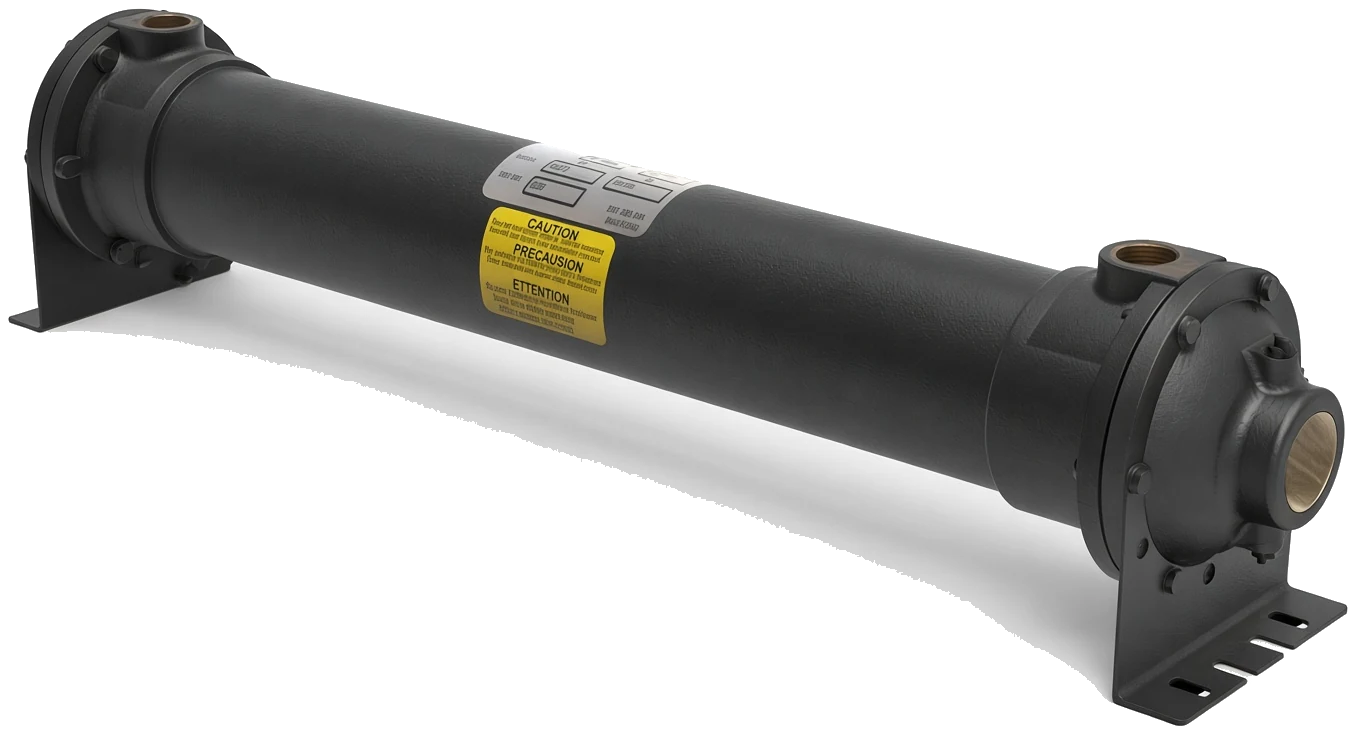
Tell us at inquiry if the unit needs ASME construction, certified material records or witnessed pressure tests. Those requirements change lead time and cost, and they cannot be added to a unit that has already been built.
Request a QuoteSpecify the Paperwork Early
Code construction and certified material records are decisions made before a shell is cut, never afterward, so they belong in the inquiry rather than the delivery note.

Inquiry Content
State the requirements up front
- ASME construction needed or not
- Material certification required
- Witnessed pressure test needed

Deployment Spares
What sails with the vessel
- Complete unit on critical duties
- Bundles and gaskets for the rest
- Two anode sets per exchanger
Where Titanium Earns Its Place
Copper-nickel relies on a protective film, and chlorine interferes with it. Vessels with seawater chlorination systems, or berthed near a treatment discharge, put their coolers in exactly the condition that thins copper alloy tubes from the inside. Warm tropical water and sulfide bearing harbor water add to the problem, and long periods alongside at low velocity remove the flushing that would otherwise help.
- Availability targets justify deliberate surface margin
- Chlorination is the clearest case for titanium tubes
- Dynamic positioning makes thruster cooling continuous
- Deployment means conservative water assumptions
- ASME construction available on AB Series frames
- Material and test records supplied when specified
Dynamic Positioning Load
A vessel holding station on DP runs its thrusters continuously, and the hydraulic or electrical losses in that system end up as heat somewhere. On hydraulically driven units the oil cooler is a continuously loaded item rather than an occasional one, and selections made for a maneuvering duty are undersized for a week on station.
- Documentation is specified before a shell is cut
- Complete spare units beat bundles at sea
- Vessel file records turn failure into a shipment
- Copper-nickel still correct on many duties
- Evaporator and condenser duty favors titanium
Before you request a quote
Yes. AB Series shell and tube units are available with ASME code construction, supplied with the stamp, data report and associated documentation. Specify it in the inquiry, because code construction affects lead time and price and cannot be applied to a unit that has already been built.
Where seawater is chlorinated, unusually warm, sulfide bearing, or where velocity is high as in condenser and evaporator duty. Also where a vessel has already lost copper alloy tubes and the cause cannot be removed. For ordinary open-water cooling with maintained anodes, copper-nickel remains the better value.
Pressure test records and certified material records for tubes and tubesheets are available on request for standard construction, and full code documentation comes with ASME units. Tell us the requirement at inquiry so it is built into the order rather than chased afterward.
Titanium itself does not need protecting, but the rest of the assembly may. Where titanium tubes sit in bronze bonnets with a steel or stainless tubesheet, the galvanic relationships change and anode arrangements are specified per build. Ask us for the arrangement on your particular unit.
On critical duties, yes. A tube bundle swap needs a workshop, clear space and time, none of which a vessel offshore reliably has. A complete unit can be changed in place with hand tools. On secondary duties, bundles, gaskets and anodes are sufficient.
Related

HEAT EXCHANGERS • TITANIUM
Evaporators
Titanium evaporators for freshwater generation on deployment.
+ Learn More
APPLICATIONS • SEAWATER
Raw Water
Central seawater cooling and the material decisions in it.
+ Learn More
ENGINEERING • MATERIALS
Titanium vs CN
Where the extra cost is justified and where it is not.
+ Learn More
