
1-805-484-2992
Quotes - Engineering - SalesTitanium Or Copper-Nickel
Immunity against cost, stated plainly
Titanium wins the corrosion argument outright, and there is no point pretending otherwise. In seawater at any concentration, at any temperature a marine system produces, with or without chlorine dosing, titanium is effectively immune. It does not pit, it does not crevice-corrode under deposits, it does not care whether the water is moving, and it has no practical erosion velocity limit. A titanium tube bundle will outlive the vessel it is fitted to. If corrosion resistance were the only criterion, every marine cooler would be titanium and this page would be one sentence long.
Titanium does not corrode in seawater. Copper-nickel does, slowly, and costs a fraction as much. Choosing between them is an economic decision with a small number of technical cases where the money is not the deciding factor.
It is not the only criterion. Titanium tubing costs several times copper-nickel, and the difference lands on a part that on most vessels does not fail from corrosion in the first place. The great majority of copper-nickel bundles we replace failed from inlet erosion, from neglected zinc anodes, or from being undersized and run hot for years. Fixing those three things buys more service life per dollar than upgrading the alloy, and titanium fixes none of them by itself.
Copper-nickel also does one useful thing titanium cannot. Copper suppresses biological growth inside the tube bores. A titanium bundle in raw seawater will block with slime, mussel spat and barnacle set on a schedule set by the water rather than the metal, so it needs mechanical cleaning more often than the copper-nickel unit it replaced. On a vessel with limited yard time that is a real operating cost, and it is the reason we do not recommend titanium reflexively for ordinary jacket water duty.
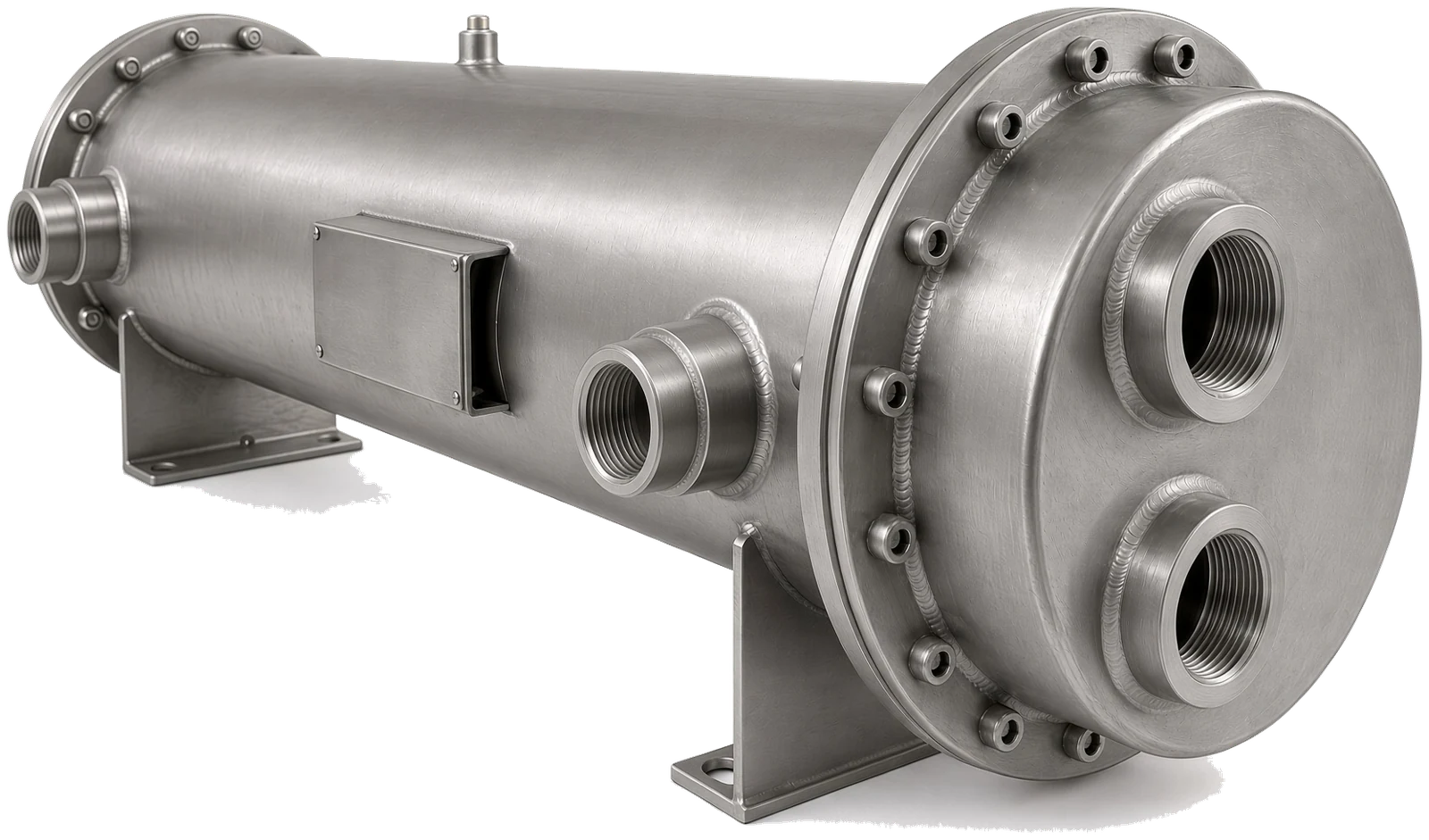
Buy The Immunity You Need
Titanium is the right answer when the water would destroy copper-nickel, and an expensive answer to a problem you do not have when it would not.
Titanium Wins
- Chlorinated or dosed seawater
- Evaporator and condenser duty
- Sandy or silt-laden intakes
- Long stagnant layup periods
- High tube velocity installations
CuNi Wins
- Ordinary raw seawater cooling
- Cost-driven replacement work
- Fouling-sensitive duty
- Cataloged frames and lead times
- Anode-protected engine circuits
Neither Fixes
- An undersized cooler
- A missing zinc anode
- Excessive tube velocity
- A blocked seawater strainer
- Air trapped in the shell
| PROPERTY | TITANIUM | 90/10 COPPER-NICKEL | PRACTICAL EFFECT |
| Seawater corrosion | Immune | Resists via oxide film | Titanium survives chlorine and stagnation |
| Erosion velocity | No practical limit | Defined threshold | Pass count matters for CuNi only |
| Biofouling | Fouls readily | Suppressed by copper | CuNi needs cleaning less often |
| Thermal conductivity | Lower | Higher | Titanium needs more surface for the same duty |
| Relative tube cost | Several times higher | Baseline | CuNi wins on ordinary duty |
| Availability on frames | T option, call for rating | Cataloged CN and CNT codes | CuNi ships on normal lead time |
Where Titanium Is The Right Buy
Four conditions that end the argument
Chlorination is the first. Any system dosing hypochlorite for growth control will destroy the protective film copper-nickel relies on, and the tube then corrodes freely. The second is evaporator and watermaker service, where seawater is heated and concentrated and often left standing between production runs. The third is a silty or sandy intake, where suspended solids scour the film off mechanically no matter what the chemistry says.
The fourth is intermittent duty with long idle periods, which describes a great many yachts and standby generator sets. Copper-nickel maintains its film best under flow; titanium is indifferent. Our titanium evaporators and condensers exist because those duties genuinely require the material rather than because titanium sells well.
Where Copper-Nickel Remains The Answer
Ordinary seawater and ordinary money
A jacket water cooler on a workboat, taking clean seawater through a strainer at a sensible tube velocity, with maintained zinc anodes in bronze bonnets, is a solved problem in 90/10 copper-nickel. Those coolers run ten to twenty years and come out for tube fouling rather than corrosion. Spending several times the tube cost to protect against a failure mode that was not going to occur is not engineering, it is insurance against the wrong risk.
The commercial reality reinforces it. The B Series and HC Series marine builds are cataloged option sets, so the copper-nickel cooler is a stock-configuration item at a known price. That matters when a vessel is on a lift waiting for a part.
The Two Costs Titanium Adds
Conductivity and fouling, not just price
Titanium conducts heat less well than copper-nickel, and although tube wall resistance is a modest part of the total in a water-to-water exchanger, it is not nothing. For the same duty and the same flows a titanium unit generally needs a little more surface, which can mean a longer frame or an extra pass, and that has it's own cost and space implications on a crowded installation.
Fouling is the larger operating penalty. A titanium bundle in raw seawater will accumulate biological growth that a copper-nickel bundle in the same water largely refuses, so the cleaning interval shortens. Budget for rodding as routine work rather than as evidence of a problem, and make sure the installation leaves access to pull the bonnets.
Material questions
For practical purposes yes. Titanium carries a stable oxide that does not break down in chloride solution at seawater concentrations or at the temperatures marine systems reach, and it resists crevice attack and stagnation that defeat other alloys. That is why it dominates evaporator, condenser and chlorinated seawater service.
Because on ordinary strained seawater with maintained anodes, copper-nickel already lasts as long as anyone needs and costs a fraction as much. It also fouls far less, so cleaning intervals are longer. Paying for immunity you will not use is a poor trade when the same money would buy a properly sized cooler.
Yes, and it is the main operating penalty. Copper leaches slowly from copper-nickel and discourages growth in the tube bores. Titanium is biologically neutral, so barnacle set, mussel spat and slime accumulate at whatever rate the water dictates. Plan on more frequent mechanical cleaning and leave access to pull the bonnets.
The tube material is several times the price of copper-nickel and the finished unit reflects that, plus any extra surface needed for the lower conductivity. Rather than quote a multiplier in the abstract, send us the duty and we will price the copper-nickel and titanium selections side by side.
Related

HEAT EXCHANGERS • TITANIUM
Seawater Coolers
Titanium shell and tube units for aggressive raw water
+ Learn More
APPLICATIONS • SEAWATER
Watermakers
Evaporator duty where titanium is normally the only option
+ Learn More
ENGINEERING • MATERIALS
Stainless Limits
Why 316 is not the middle ground between these two
+ Learn More
