
1-805-484-2992
Quotes - Engineering - SalesSea to Overboard
The Raw Water Chain
A marine raw water cooling circuit is a chain, and its capacity is set by the weakest link, not by the exchanger. Water enters through a grating and a sea chest, passes a seacock, a strainer, a pump with an elastomer impeller, some length of reinforced hose, the exchanger tubes, and leaves through the exhaust or an overboard fitting. Growth on the grating, a strainer full of weed, a five-season impeller, a hose that has gone soft on the suction side: each of these reduces flow, and reduced flow looks precisely like a cooler that is too small.
The raw water circuit is the part of the cooling system nobody designs and everybody blames. Intake to strainer to pump to exchanger to overboard, and a fault anywhere in that chain looks exactly like an undersized cooler.
That matters commercially because operators buy exchangers to solve problems the circuit caused. We would rather sell you the right unit once, so the first questions we ask are about the circuit: what pump, what flow at working RPM, when was the impeller last changed, how big is the strainer and how often does it need clearing. If the answer to any of those is uncomfortable, fix that first and the temperature complaint often disappears.
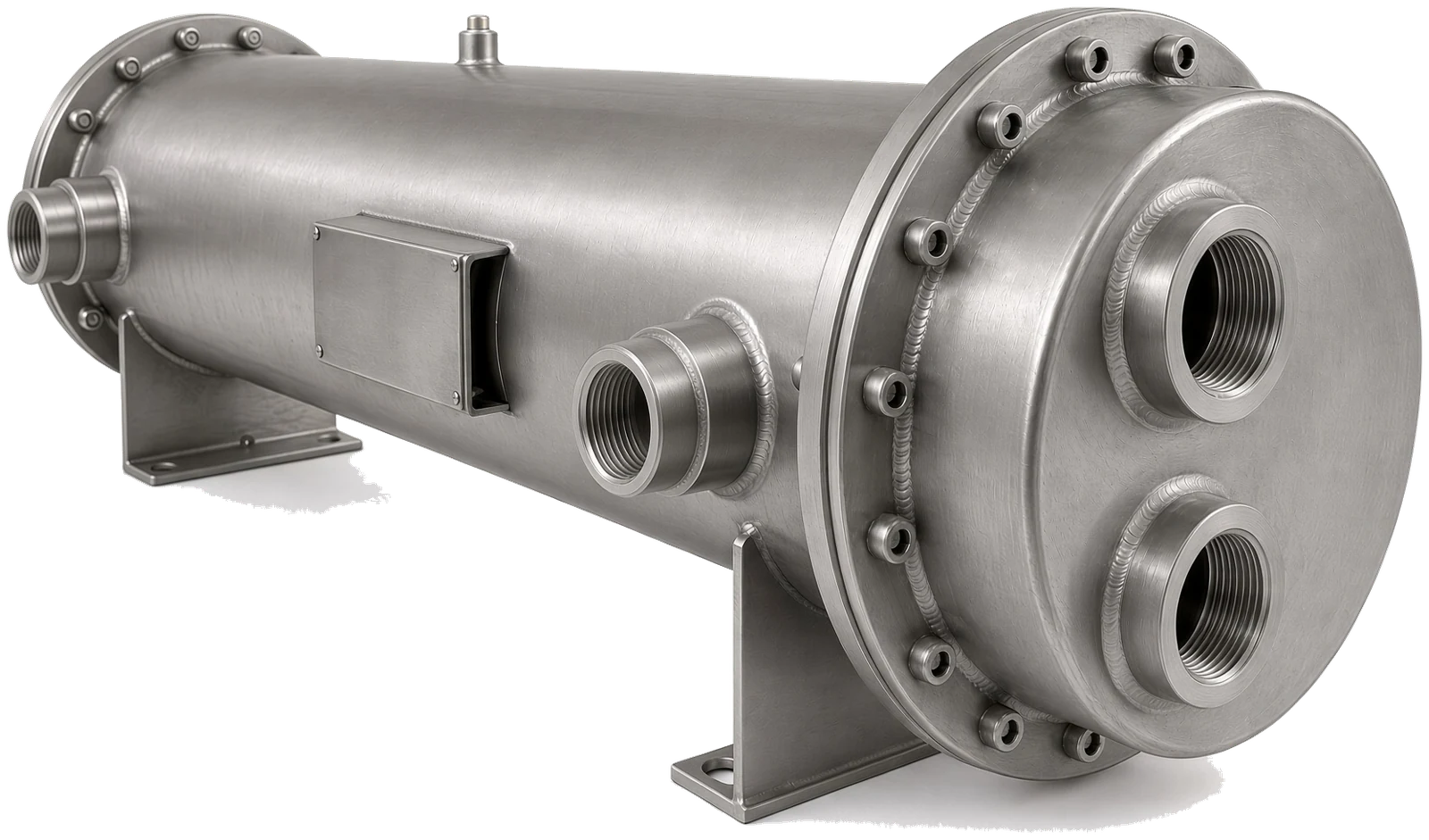
The most useful measurement you can bring us is not a temperature, it is a flow. Raw water flow at working RPM tells us whether the existing selection ever had a chance, and it takes a bucket and a stopwatch on many boats.
Request a QuoteFix the Chain First
An exchanger cannot transfer heat into water that never reaches it, so a flow check costs nothing and settles most cooling arguments before an order is placed.

Flow Check
Twenty minutes with a bucket
- Measure flow at working RPM
- Repeat at idle or trolling RPM
- Compare against selection needs

Circuit Upgrade
Cheaper than a bigger cooler
- Larger, accessible strainer
- New impeller and wear plate
- Reinforced non-collapsing suction hose
Central Cooling Versus Direct
In a direct arrangement every cooler on the boat has seawater in its tubes: jacket water, lube oil, gear oil, refrigeration, air conditioning. That means anodes to check and tubes to rod in five or six places, and five or six chances of a seawater leak into something expensive.
- Circuit capacity is set by its weakest link
- Growth, weed and worn impellers all steal flow
- Low flow mimics an undersized exchanger exactly
- Central cooling concentrates seawater into one unit
- Pass count sets tube velocity within the safe window
- Pressure drop checked against real pump delivery
Measuring What the Pump Delivers
Belt or gear-driven raw water pumps deliver flow proportional to engine speed, which means the flow at trolling or idle is a fraction of the flow at cruise. A selection that assumed cruise flow will be short at low RPM, and that is exactly when many boats run hottest.
- Belt driven pump flow falls with engine speed
- Strainers should pass flow when half full of weed
- Above-waterline strainers can be cleared safely
- Titanium tubes where the system is chlorinated
- A flow measurement settles most cooling arguments
Service life questions
It comes out of the thermal selection: the flow required to carry the heat at your seawater temperature, at a velocity that keeps tubes swept without eroding them. We state it with the selection. The important step is confirming your pump actually delivers it at the RPM the boat works at.
On a boat with repeated corrosion or leak problems across several coolers, usually yes. It concentrates all seawater exposure into one accessible exchanger and lets everything else run on treated fresh water. The cost is a circulating pump, more piping and one more circuit to vent and maintain.
Almost certainly the strainer, and it is probably too small or badly located. If clearing the basket restores temperature, the exchanger is fine. Fit a larger strainer, mounted above the waterline where the crew can open it easily, and the problem stops recurring.
Annually on a working boat, and always before a season on a boat that has been laid up, because elastomer impellers take a set and loose vanes with age. Keep a spare and the wear plate aboard. A tired impeller silently costs flow long before it fails outright.
It does if the system is chlorinated, the water is warm, or you are running high tube velocity. Titanium is unaffected by any of those. For a temperate boat with clean water and maintained anodes, copper-nickel does the same job for less money, and we will say so.
Order decides which duty gets the coldest water. Every exchanger upstream warms the seawater for everything after it, so the duty needing the tightest approach, usually the aftercooler or an oil cooler, sits first and the jacket water cooler goes last before the exhaust elbow. Pressure drops add up along the chain as well. When one unit in a series is replaced, tell us its position so the rating uses its real inlet temperature rather than sea temperature.
Related

APPLICATIONS • ENGINE COOLING
Charge Air
The other circuit commonly cooled directly by seawater.
+ Learn More
HEAT EXCHANGERS • TITANIUM
Seawater Coolers
Titanium tube coolers for chlorinated and high velocity duty.
+ Learn More
ENGINEERING • SERVICE
Troubleshooting
Working through a high temperature complaint in order.
+ Learn More
