1-805-484-2992
Quotes - Engineering - SalesDimple Jacket Product
The Dimple Jacket Panel
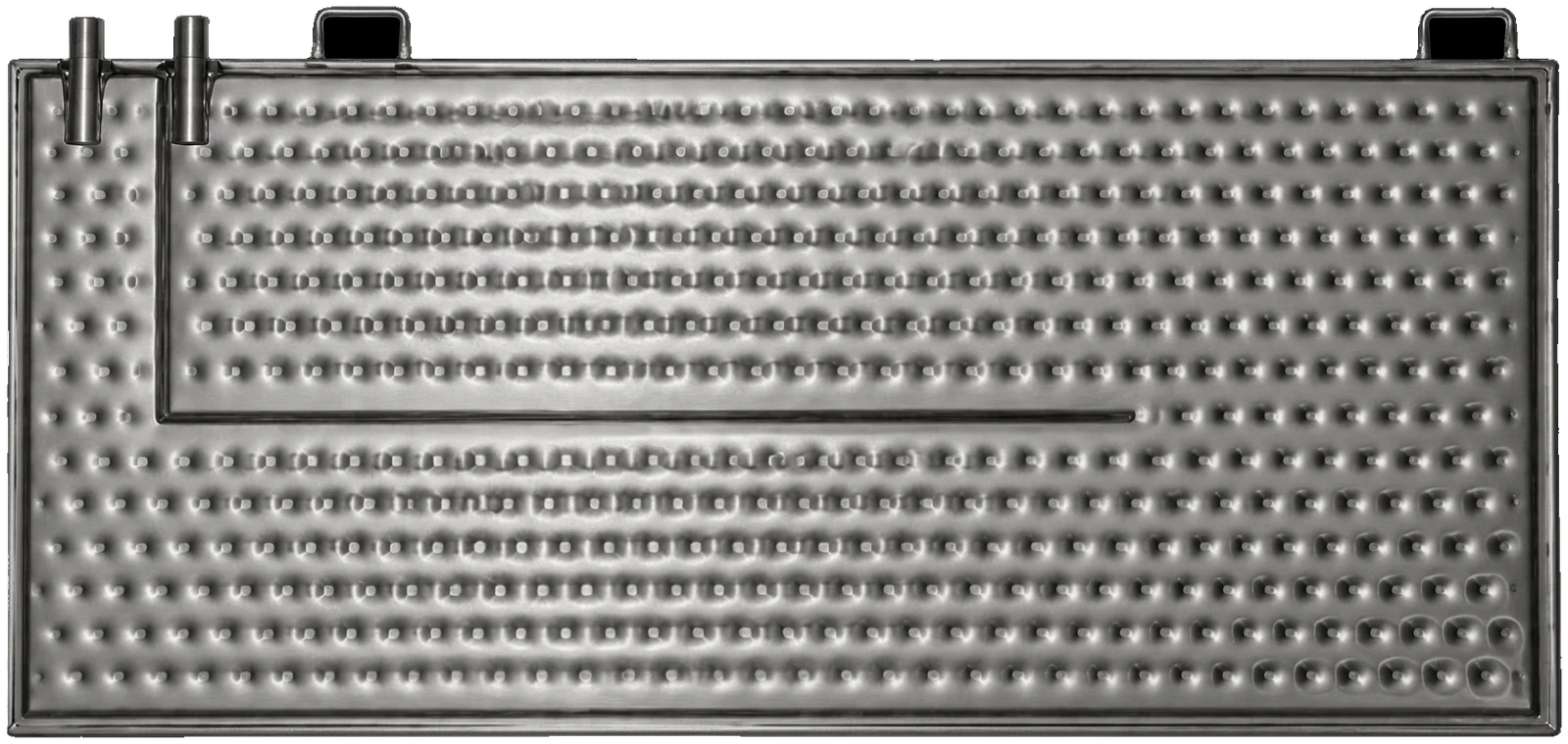
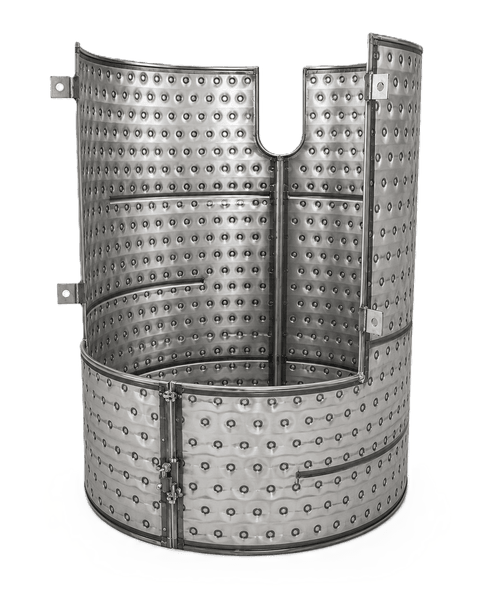
A dimple jacket is the thermal plate that stays out of the tank. It is built from two sheets of titanium or stainless steel laser-welded together around the perimeter and at a grid of spots across the face, then inflated so the outer sheet bulges into the quilted dimple pattern while the inner sheet stays flat. That flat face is welded, bonded or clamped to the outside of the tank wall, hold bulkhead or hull plating, and the channel between the sheets carries refrigerant or chilled coolant. The tank wall becomes the heat transfer surface and the product inside never touches the jacket.
That is the whole reason to choose a jacket over a free-hanging immersion plate. A fish hold with jacketed walls is a smooth box with nothing to work around when loading, unloading or washing down; there are no plates to bend, no brackets to catch a shovel, and no connections inside the hold to leak. The jacket cannot foul because it is never wetted by the product, and the only cleaning it needs is the wash-down the hold gets anyway. Where the jacket is welded directly to the wall it is part of the tank for the life of the vessel.
For a new jacket set we need the tank or hold drawings, the wall material and thickness, the product and quantity, the target temperature and pull-down time, and the refrigerant or coolant available. For a replacement panel, the dimensions, connection positions and nameplate of the existing jacket settle most of it. We confirm before anything is built.
Request a Quote

How a Dimple Jacket Is Built
The panel starts as two sheets laid face to face and laser-welded along the perimeter and at a regular grid of spot welds across the whole area. Inflating the welded pair with pressure pushes the outer sheet away from the inner one everywhere except at the welds, so the outer sheet takes on the quilted dimple pattern and a continuous channel forms between the sheets. Because the inner sheet is backed by the tank wall during forming, or is made thicker, it stays flat; that is what makes a jacket different from a double-embossed immersion plate.
Inlet and outlet stubs are welded into the panel edge, positioned to suit the pipe run outside the tank. The channel is shallow, so the refrigerant charge is small and the panel responds quickly to a change in load, and the dimples turn the internal flow turbulent so a thin sheet transfers heat at a rate a smooth pipe coil on the wall would not. The finished panel is one welded piece with no gaskets, no mechanical joints and no tube ends, and it carries the same pressure rating as the sheets and welds it is made from.
Fitting the Jacket to the Tank
On a titanium or stainless tank the jacket is welded straight to the wall, edge and grid, so the wall and the inner sheet are one and heat passes with nothing in between. On an aluminum fish hold, or a steel bulkhead, the jacket is clamped or stud-mounted against the wall with a thermal compound filling the gap, which keeps the dissimilar metals apart while still giving a good conduction path. Either way the panel sits on the outside, and the outside is then insulated over the jacket so the cold goes into the hold and not into the engine room.
Panels are laid out to cover the wall area the duty needs, most often the sides and the forward bulkhead of a hold, and are piped in series or parallel outside the tank. Because every connection is outside, a leak is found and fixed from the machinery side without emptying the hold. The layout is decided with the tank drawings in front of us; send them and we will mark up where the panels go, how they are piped, and where the refrigerant or coolant enters and leaves.
Jacket or Immersion Plate
The jacket wins where the hold has to stay a clean box: fish holds that are shoveled out, cargo and process tanks that are washed and inspected, and any tank where a plate inside would be in the way or at risk of damage. It also wins on fouling, since the product never touches it, and on a new build, where welding jackets to the hold before it is closed in costs little. Its limit is surface area, which is set by the wall the tank has; a small tank with a large load may not have enough wall.
The immersion plate wins on surface per panel, since both faces work, and on retrofit, since it hangs on brackets without hot work on the shell and can be fitted to a hold already in service. Where the wall area is short a hold will carry jackets on the walls and immersion plates in the space as well. Our tank cooling page goes through the duties one by one; for a specific hold, send the drawings and we will say which form, or which mix, carries the load.
Ordering a New or Replacement Jacket
A new jacket set is sized from the tank or hold dimensions and wall material, the product and how much of it is loaded at a time, the temperature it has to reach and how quickly, and the refrigerant or chilled coolant the plant supplies. From that we work the surface needed, lay out the panels on the walls available, and confirm the panel count, connection positions and pressure rating before anything is cut. If the wall area is short we say so and propose immersion plates to make up the difference.
A replacement panel is confirmed from the existing jacket: its height, width and the position and size of its connections, the wall it is fixed to and how, the refrigerant or coolant in use and the nameplate if there is one. A photograph of the panel and its stubs, and of the tank wall around it, answers most of the questions. We match the panel, or improve on it where the original was undersized or the wrong material, and we confirm it with you before it is built. Call 1-805-484-2992 or email Sales@HeatX.com.
The Wall Does the Work
Fix the cooling channel to the outside of the tank and the whole wall becomes the heat exchanger, with nothing in the product to foul, bend or leak.
Fitting a replacement
A thermal plate embossed on one side only. Two sheets are laser-welded on a grid and inflated so the outer sheet dimples while the inner sheet stays flat; the flat side is fixed to the outside of a tank wall and refrigerant or coolant runs in the channel between. The tank wall becomes the cooling surface and nothing sits in the product.
Yes. The jacket is clamped or stud-mounted against the aluminum wall with a thermal compound in the gap, which keeps the titanium or stainless jacket and the aluminum apart while still carrying the heat. It is not welded to aluminum. On a titanium or stainless tank the jacket is welded straight to the wall.
The jacket keeps the hold a clean box and cannot foul, and is the natural choice on a new build. The immersion plate gives more surface per panel and fits an existing hold without hot work. Where wall area is short, holds carry both. Send the hold drawings and the load and we will say which, or which mix.
The same way as any other tank, with nothing extra. The jacket is on the outside and never touches the product, so the inside of the hold is a smooth wall that is washed down as normal. The only service on the jacket side is checking the stubs and pipework outside the tank, which is done from the machinery side.
The tank or hold drawings with wall material and thickness, what goes in the tank and how much at a time, the temperture it has to reach and how quickly, and the refrigerant or chilled coolant the plant supplies. From that we lay out the panels, confirm the count and connection positions, and tell you if immersion plates are needed as well.