
1-805-484-2992
Quotes - Engineering - SalesCopper-Nickel In Seawater
Why the marine default is 90/10
Copper-nickel is the alloy the marine cooling industry settled on for good engineering reasons, not habit. In seawater it forms a thin, adherent cuprous oxide film within days of first wetting, and that film is what stands between the chloride and the metal for the rest of the tube's life. Unlike a passive film on stainless, it does not depend on dissolved oxygen reaching every crevice, which is exactly why copper-nickel survives the intermittent duty a vessel imposes and 316 stainless does not.
Copper-nickel carries almost every marine cooler we ship because it grows a protective film in chloride water and resists the growth that would otherwise close the tubes. Here is what each grade will and will not tolerate.
The second property matters just as much on a working boat. Copper ions leaching slowly from the surface keep barnacle, mussel and slime growth from establishing inside the tube bores. A titanium tube in the same raw seawater service is metallurgically untouchable and will still block with growth, so it needs mechanical cleaning far more often. On a fishing vessel that runs seasonally and lies alongside between trips, that difference decides the maintenance schedule.
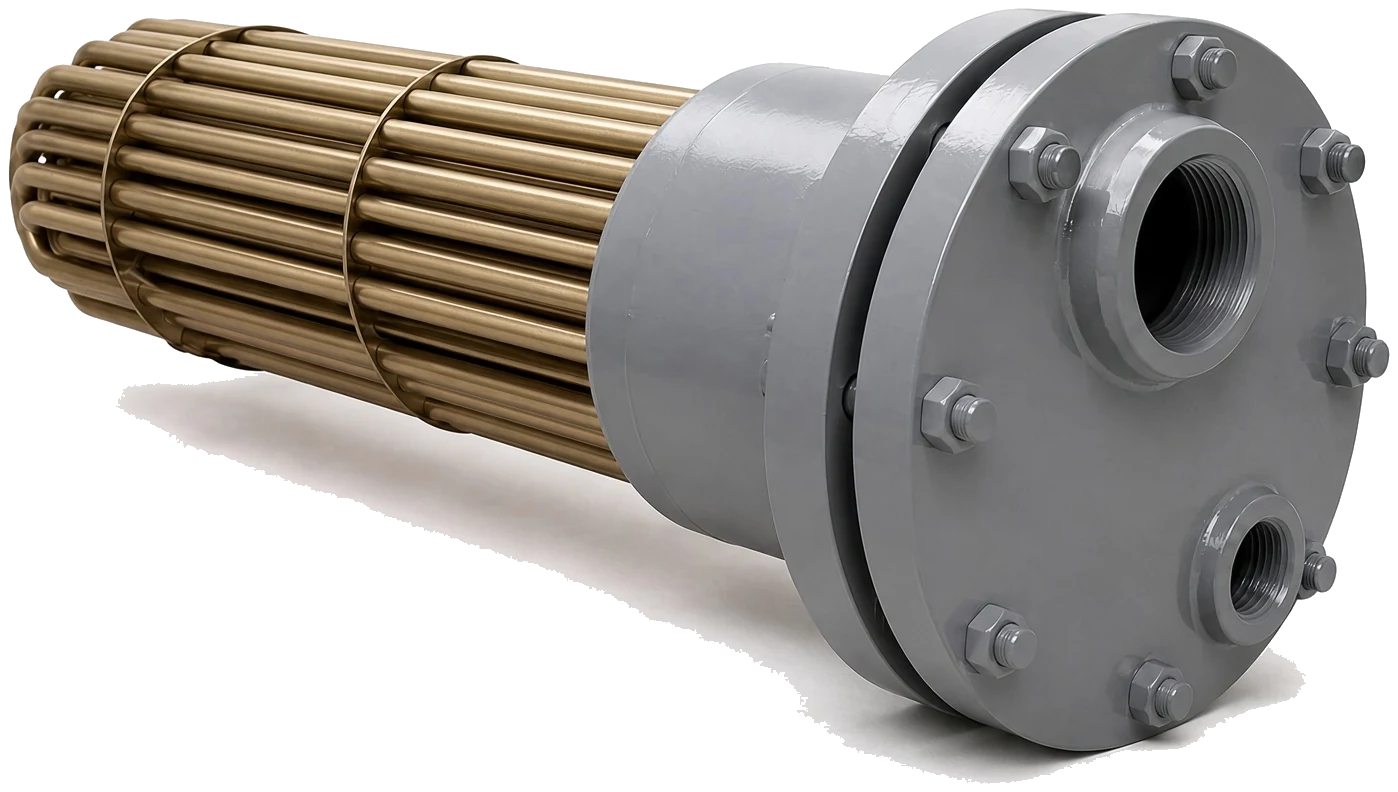
Two grades cover marine work. The 90/10 grade, nominally ten percent nickel with small iron and manganese additions, is the standard copper-nickel heat exchanger tube and the CN option on the frames we build. The 70/30 grade carries thirty percent nickel and more iron, and buys a meaningfully higher allowable seawater velocity plus better resistance in warm, sulfide-bearing or polluted harbor water. It costs more, so we recommend it where the service earns it.
The Film Is Everything
Copper-nickel does not resist seawater by being noble; it resists by growing a film, and everything that damages the film shortens the tube.
90/10 CuNi
- Standard marine tube alloy
- CN code on B and HC frames
- CNT code on AB frames
- Good film in clean seawater
- Best value for jacket water duty
70/30 CuNi
- Higher allowable velocity
- Better in warm polluted water
- More tolerant of sulfides
- Higher strength, thinner wall possible
- Cost premium over 90/10
Against It
- Chlorine or hypochlorite dosing
- Sand and silt in suspension
- Long stagnant periods
- Ammonia in the shell-side fluid
- Sulfide-polluted mud berths
| CONDITION | 90/10 | 70/30 | MOVE TO TITANIUM |
| Clean flowing seawater | Standard choice | Unnecessary premium | Not required |
| Warm tropical water | Acceptable with margin | Preferred | Only if also chlorinated |
| Sulfide-polluted harbor | Marginal | Better | Where the berth is permanent |
| High tube velocity | At the limit | More headroom | No practical limit |
| Chlorinated water | Not recommended | Not recommended | Correct answer |
| Long idle periods | Fair with anodes | Fair with anodes | Best answer |
What The Iron Addition Does
Small percentages with large consequences
Marine copper-nickel is not simply copper and nickel. Both grades carry deliberate iron and manganese additions, and the iron is the part that matters for erosion. It stabilizes the oxide film and raises the velocity at which the water strips it faster than the metal can rebuild it. This is why a nominally identical alloy from an unspecified source can behave worse in service than a proper heat exchanger grade tube.
It is also why the tube specification on a marine cooler is worth stating rather than assuming. We build the marine option sets with heat exchanger grade copper-nickel to the tube gauges the frames are designed around, so the rolled joint at the tubesheet and the pressure rating of the finished unit are both known quantities rather than approximations.
Velocity, Not Water Chemistry
The most common cause of a short tube life
Most copper-nickel bundles that fail early were not defeated by chemistry. They were run too fast. Above the alloy's erosion threshold the film is removed hydraulically at the tube inlet, where entry turbulence is worst, and the tube thins from the inside in a recognizable horseshoe pattern within the first few inches.
Velocity is set by the seawater flow divided by the flow area of a single pass, which makes pass count a life-expectancy decision as much as a thermal one. If a bundle has failed with inlet grooving, replacing it with an identical unit will produce an identical failure. The velocity page covers how we set it.
Copper-Nickel And The Rest Of The Cooler
Tubesheets, bonnets and anodes
The tube alloy has to sit next to something. On the marine build the tubes are rolled into a brass tubesheet and covered by cast bronze bonnets, which keeps the galvanic gap across the wetted assembly small and gives the zinc anode an easy job. Cast iron bonnets on a seawater cooler will drive the anodes hard and, once the zinc is gone, drive the tube ends.
Zinc anodes are not optional on a raw water cooler even with the best alloy choices. They protect the tube-to-tubesheet joints, which are the most electrochemically sensitive feature in the unit, and their wastage rate tells you how hard the whole circuit is working. See bronze and brass for the structural side.
Replacement questions
The nickel content, and with it the strength, the allowable seawater velocity and the tolerance of warm polluted water. The 90/10 grade is the marine standard and suits ordinary raw seawater duty. The 70/30 grade costs more and is the right specification where velocity is high or the water is warm and sulfide-bearing.
Far less than stainless or titanium. The copper content leaches slowly and discourages barnacle, mussel and slime growth from establishing in the tube bores, so cleaning intervals stretch out. Hard mineral scale still forms over years, and silty water still deposits mud, so mechanical rodding remains part of routine service.
We would not specify it. Continuous chlorine or hypochlorite dosing breaks down the protective oxide film that copper-nickel depends on, and the tube then corrodes at a rate the alloy was never intended to survive. That is one of the clearest cases for titanium tubes or a full titanium exchanger.
Related

APPLICATIONS • JACKET WATER
AB Series
Fixed tube coolers in the CNT copper-nickel marine option set
+ Learn More
APPLICATIONS • ENGINE COOLING
Jacket Water Cooling
Where the copper-nickel tube bundle sits in the engine circuit
+ Learn More
HEAT EXCHANGERS • BUNDLES
Tube Bundles
Replacement copper-nickel bundles for installed frames
+ Learn More
