
1-805-484-2992
Quotes - Engineering - SalesOlder Blocks, New Coolers
Four and six cylinder marine ratings
A Perkins marine heat exchanger inquiry usually starts with a unit that has no readable markings. These engines have been marinized by many different builders over many decades, so the cooler is frequently a package part or a yard fabrication rather than a cataloged item. The good news is that the duties are modest: four cylinder blocks broadly in the 40 to 85 horsepower band, Sabre marine variants roughly 90 to 250, and the larger six cylinder blocks up to around 450.
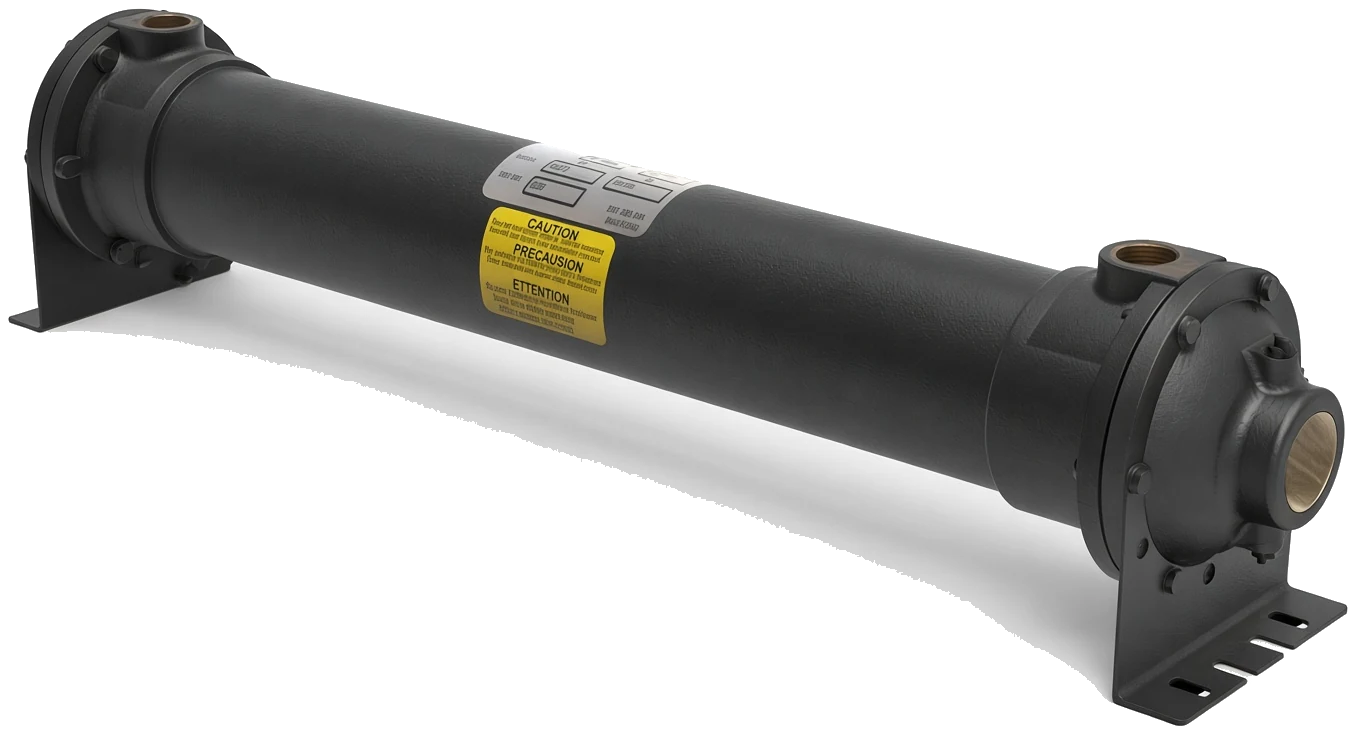
At those ratings a compact frame satisfies the duty comfortably, which means the whole job is identification and fit. We work from shell diameter, length between bonnet faces, connection sizes and thread form, mounting arrangement and bonnet style, together with the engine rating. From those we select a current frame that lands in the same space and carries the same load.
The build is the standard marine option set at small scale: copper-nickel tubes carrying seawater on the tube side, coolant on the shell side, bronze bonnets and brass tubesheet with zinc pencil anodes. BSP connections are common on these engines and adapters are listed on the quotation. Call 1-805-484-2992 with the measurements or send photographs to Sales@HeatX.com.
 Small Frames
 No Nameplate
 Replacing a Cooler
 Pencil Anodes
Identifying an Unmarked Unit
With five measurements and a few photographs we can normally place the frame.
Duty Inputs
- Engine block and rated output
- Rated RPM if known
- Shell diameter and overall length
- Connection sizes and thread form
- Mounting centers and bonnet style
What We Supply
- Compact B and AB Series frames
- Bronze bonnets and gaskets
- Copper-nickel tubes, brass tubesheet
- Zinc pencil anodes and spares
- Replacements for discontinued ITT Standard units
Duty Profile
- Older workboats and cruising yachts
- Low annual hours, long lay-up
- Aged raw water piping
- Mixed marinizing packages
| MODEL / RATING | HORSEPOWER | DUTY | TYPICAL SELECTION |
| Four cylinder marine blocks | About 40 to 85 hp | Jacket water | B Series small frame |
| Sabre marine mid ratings | About 90 to 150 hp | Jacket water | B Series marine build |
| Sabre marine higher ratings | About 150 to 250 hp | Jacket water and lube oil | AB Series or small HC |
| Six cylinder 1300 and 1500 blocks | About 250 to 450 hp | Jacket water, oil, gear | HC Series with CN tubes |
| Generator set variants | Call for rating | Constant speed jacket water | AB Series or B Series |
Replacing ITT Standard Units
A discontinued line we cover
A great many Perkins installations carry ITT Standard exchangers, a line that is no longer produced and that we replace regularly. There is no current number to cross reference, so the route is the same as for any unmarked unit: measure the shell, the length, the connections and the mounting, and photograph the bonnets.
From that information we match a current frame to the same envelope and duty. Where the geometry differs slightly, we set out exactly what changes on the piping or the mounting before you order. Nothing about the replacement requires the original paperwork, only the hardware in front of you.
Renew as a system
On installations this old the cooler is rarely the only tired component. Perished hose, a strainer basket with a split seam, a raw water pump with a worn impeller and corroded hull fittings all reduce the flow reaching the tubes, and low flow lets silt settle in them. A new exchanger behind an old strainer inherits the same problem.
Budget the raw water side as a set: hose, clamps, strainer service, impeller and anodes. It is not an expensive list at this scale and it is the difference between a cooler that lasts fifteen years and one that needs cleaning every season.
Related

ENGINES • OTHER MARINE
Volvo Penta
Another wide range of European blocks and their frames
+ Learn More
ENGINEERING • SELECTION
Replacing a Cooler
Matching a discontinued unit from measurements and duty data.
+ Learn More
HEAT EXCHANGERS • PARTS
Bonnets
Replacement bonnets and gaskets for older shell and tube units
+ Learn MoreRating and sizing questions
Yes, routinely. The line is discontinued so there is no current number to look up, and identification comes from hardware instead: shell diameter, length between bonnet faces, connection sizes and thread form, mounting centers and bonnet style. Send those with photographs and the engine rating and we will match a frame.
Broadly, four cylinder blocks around 40 to 85 horsepower, Sabre marine variants roughly 90 to 250, and the larger six cylinder blocks up to about 450. At all of those the duty is comfortably within a compact frame, so the selection is decided mostly by envelope and connections.
On an installation of this age, yes. Perished hose, a split strainer basket and a worn impeller all cut the flow reaching the tubes, and low flow lets silt settle inside them. A new cooler behind old plumbing inherits the same fouling problem, and the parts are inexpensive at this scale.
Because standing seawater in a shell that has been warm goes stagnant and attacks the tubesheet and tube ends while the boat is unattended. Drain the raw water side, pull the anodes and leave the bonnets slack to dry. It is the single most effective habit on a low hour boat.

