
1-805-484-2992
Quotes - Engineering - SalesSeries 2000 and 4000
High rating seawater cooling
MTU installations are cooling systems rather than single coolers. Series 2000 engines in vee eight through vee sixteen configurations broadly cover about 600 to 2,600 horsepower, and Series 4000 blocks from vee eight to vee twenty run from roughly a thousand up beyond four thousand. Separate high and low temperature circuits, dedicated charge air cooling and independent oil coolers are the norm, so the first question is always which circuit is being replaced.
At these ratings a single shell and tube frame in our jacket water range, which reaches roughly 1,250 horsepower on the largest two pass selection, does not cover the whole engine. Most MTU work therefore involves a defined circuit within the system, units in parallel, or a split duty arrangement. We size from the rejection figures and circuit temperatures on the engine data sheet for the specific rating rather than from the block designation.
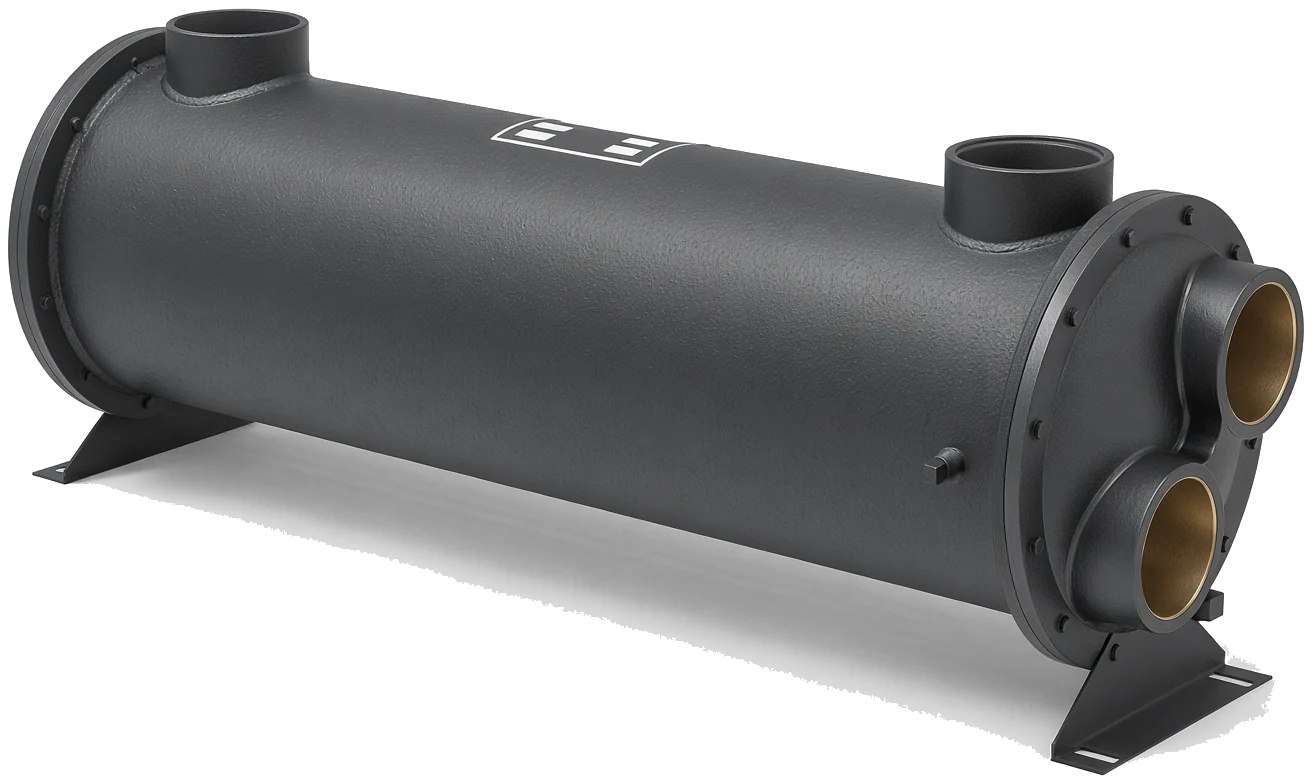
Materials are unchanged from smaller duties. Seawater on the tube side in copper-nickel or titanium tubes, coolant or oil on the shell side, bronze bonnets and brass tubesheet with zinc anodes in the raw water end. Titanium is common on these vessels because the flow rates and water temperatures are demanding. Call 1-805-484-2992 with the rating, circuit data and available envelope.
 Split Circuits
 Titanium Build
 High Flow
 Government Work
Working an MTU Circuit
We need the circuit definition before the frame, and the hydraulics before the surface.
Duty Inputs
- Series, configuration and rated output
- Which circuit is being replaced
- Inlet and outlet temperatures both sides
- Raw water flow and allowable drop
- Envelope and bundle pull clearance
What We Supply
- Titanium tube seawater coolers
- Large HC frames in marine build
- Parallel and split duty layouts
- Lube oil and gear oil coolers
- Bronze bonnets with zinc anodes
Duty Profile
- Fast ferry and patrol service
- Prime power and offshore duty
- Very high raw water flow rates
- Warm water routes and long hours
| MODEL / RATING | HORSEPOWER | DUTY | TYPICAL SELECTION |
| Series 2000 vee eight and ten | About 600 to 1,300 hp | Circuit water and lube oil | HC Series with CN or T tubes |
| Series 2000 vee twelve and sixteen | About 1,300 to 2,600 hp | Split circuit duty | Parallel HC Series, call for rating |
| Series 4000 vee eight and twelve | About 1,000 to 2,400 hp | Circuit water, oil, charge air | Titanium coolers, call for rating |
| Series 4000 vee sixteen and twenty | About 2,400 to 4,000 hp and above | Multiple parallel units | Split duty arrangement, call for rating |
| Prime power generator sets | Call for rating | Constant speed circuits | HC Series or titanium build |
Define the Circuit First
High temperature or low temperature
On a split circuit engine the same seawater cooler could be serving the high temperature coolant loop, the low temperature loop or the charge air circuit, and the inlet and outlet temperatures are completely different in each case. Sizing depends far more on those temperatures than on the engine horsepower, which is why we ask for them first.
If the temperatures are not to hand, the pipe routing usually reveals the circuit. Follow the shell side connections back to their header tank or heat source and photograph the run. We can identify the duty from the routing and confirm it against the engine data sheet for your rating.
Why these vessels specify it
On high flow, warm water installations the case for titanium is straightforward. It removes the velocity limitation that constrains copper-nickel, tolerates polluted and chlorinated harbor water, and takes the material question out of a maintenance plan where a bundle failure costs a great deal in lost availability rather than in parts.
Titanium tubes are an option code on the shell and tube frames we select from, and titanium evaporators and condensers are rated per duty. Where you are replacing a titanium unit, tell us so, because a copper-nickel substitute into the same duty and flow may not last. Call for a rating on titanium builds rather than assuming the copper-nickel figures carry across.
Related

ENGINES • OTHER MARINE
MAN Blocks
The other high output European family and its frame limits
+ Learn More
HEAT EXCHANGERS • TITANIUM
Titanium Range
Shell and tube titanium for demanding seawater duty
+ Learn More
VESSELS & ENGINES • BY VESSEL
Ferries
Availability driven maintenance on scheduled passenger service
+ Learn MoreMatching the old cooler
Follow the shell side connections back to their source. High temperature loops run hotter and tie to the engine coolant header, low temperature and charge air circuits run cooler and often have their own tank. Photograph the routing and send the temperatures and we will confirm the duty against your rating.
Not with a single jacket water frame. Our selection reaches roughly 1,250 horsepower on the largest two pass frame, so at those ratings we quote parallel units or a split duty across defined circuits. Send the circuit temperatures, flows and rejection figures and we will size the arrangement.
Because the flows are large. A pass arrangement that produces ideal tube velocity can demand more head than the raw water pump provides, which cuts the actual flow below the design assumption and leaves the cooler short of duty from commissioning. We work the hydraulics and the thermal sizing together.

