
1-805-484-2992
Quotes - Engineering - SalesS6R and S12R Duty
Heavy commercial and prime power
Mitsubishi marine engines are commercial equipment and the cooling duties reflect that. The S6R and S6R2 inline sixes broadly cover about 700 to 1,300 horsepower, the S12R vee twelve runs from roughly 1,200 up toward 2,000, and the smaller S4 and S6 blocks sit below with modest requirements. Each rating has its own jacket water and lube oil heat rejection published on the engine data sheet, and that is where the selection starts.
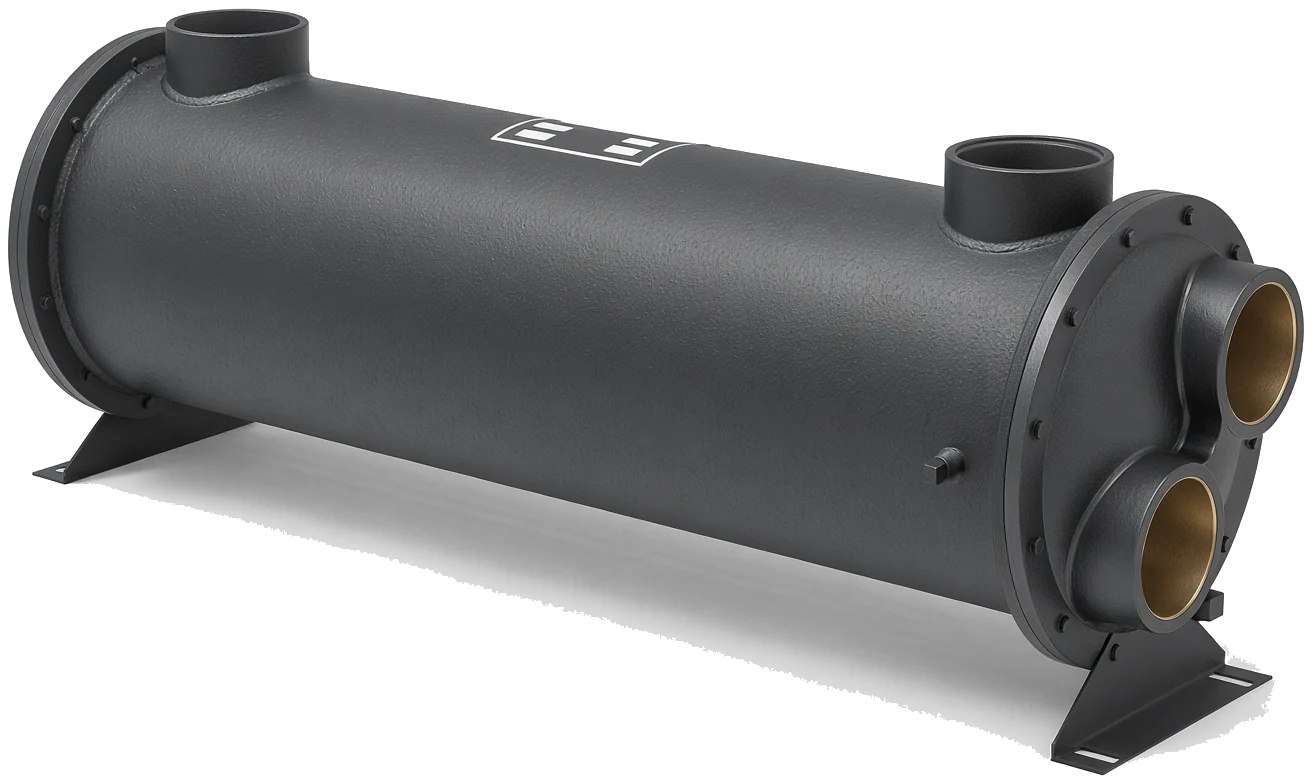
These engines go into ferries, tugs, fishing vessels and prime power generator sets, where availability matters more than first cost and running hours accumulate quickly. Our jacket water selection reaches roughly 1,250 horsepower on the largest two pass frame, so S6R work usually lands on a single large frame while S12R ratings commonly need units in parallel or a split duty arrangement.
The build stays consistent: copper-nickel or titanium tubes carrying seawater on the tube side, engine coolant or oil on the shell side, bronze bonnets and brass tubesheet with replaceable zinc anodes. Lube oil at these ratings is a substantial duty in its own right. Send the engine model, rated output, rated speed and the circuit data to Sales@HeatX.com or call 1-805-484-2992.
 Commercial Duty
 Prime Power
 Parallel Units
 Oil Duty
Sizing a Mitsubishi Duty
Commercial ratings need the operating pattern alongside the thermal data.
Duty Inputs
- Engine model and rated output
- Rated RPM and duty rating class
- Jacket water and lube oil rejection
- Load pattern and annual hours
- Raw water flow and allowable drop
What We Supply
- Large HC frames in marine build
- Parallel and split duty arrangements
- Copper-nickel or titanium tubes
- Separate lube oil and gear coolers
- Bronze bonnets with zinc anodes
Duty Profile
- Scheduled ferry and workboat service
- Continuous prime power generation
- Long annual running hours
- Harbor and coastal raw water
| MODEL / RATING | HORSEPOWER | DUTY | TYPICAL SELECTION |
| S4 and S6 smaller blocks | About 60 to 350 hp | Jacket water | B Series or small HC |
| S6R lower ratings | About 700 to 1,000 hp | Jacket water and lube oil | HC Series large frame |
| S6R2 higher ratings | About 1,000 to 1,300 hp | Jacket water, oil, charge air | HC Series plus lube oil cooler |
| S12R ratings | About 1,200 to 2,000 hp | Split jacket water duty | Parallel HC Series units, call for rating |
| Prime power generator sets | Call for rating | Continuous constant speed | Titanium or HC Series |
Continuous Load Cooling
Prime power against propulsion
A propulsion engine varies load with the vessel and gets periods at low output where deposits do not bake on. A prime power set at high continuous load never gets that break, so scaling behaves differently and the cooler needs more fouling margin from the outset. The heat rejection figure also comes from a different column on the data sheet.
Tell us which it is and, for a generator, give the electrical rating and the expected load factor. A set running at ninety per cent load around the clock is a different sizing problem from one that picks up peaks for a few hours a day, even at the same nameplate rating.
Above one frame
Most S12R jacket water duties exceed what a single frame in our range covers, which reaches roughly 1,250 horsepower on the largest two pass selection. Those installations take two units in parallel or a split duty across separate circuits, and the choice usually follows the space available rather than the thermal preference.
Parallel units need symmetrical headers and equal branch lengths so both shells carry equal flow, otherwise one does most of the work and fouls twice as fast. They also allow staged cleaning with the vessel still operating at reduced capability, which on a scheduled service is often the deciding argument.
Related

ENGINES • OTHER MARINE
Yanmar Range
The other Japanese marine family and its commercial blocks
+ Learn More
APPLICATIONS • ENGINE COOLING
Genset Cooling
Continuous load duty and the margin it needs
+ Learn More
HEAT EXCHANGERS • PARTS
Tube Bundles
Bundle replacement for sound shells on large frames
+ Learn MoreWhat owners of this engine ask
Broadly, the S6R and S6R2 inline sixes sit around 700 to 1,300 horsepower and the S12R vee twelve from roughly 1,200 toward 2,000, depending on duty rating class. Work from the plate on your engine, since jacket water and lube oil rejection are published against that specific rating.
Usually not on jacket water. Our selection reaches roughly 1,250 horsepower on the largest two pass frame, so most S12R ratings take two units in parallel or a split duty across circuits. Send the rejection figures and the space you have and we will propose the arrangement.
It usually needs more fouling margin. Continuous high load gives the cooler no recovery period, so deposits build differently and the heat rejection comes from a different data sheet column than the propulsion figure. Tell us the electrical rating and the expected load factor and we will size accordingly.
Balanced piping. Symmetrical headers and equal length branches give both shells the same flow, so they foul at the same rate and can be cleaned on the same schedule. An asymmetric connection loads one and starves the other. Tell us the space available and we will advise the layout.
Yes, where hulls and engine ratings match. We agree frame size, option code, materials and pressure ratings once and record them, so replacements become reorders and spares held ashore fit every vessel. Send the vessel and engine list to Sales@HeatX.com and we will work through it with you.
It is a seperate calculation with different inputs. The oil heat load comes off the data sheet for your rating, but the oil grade and the pressure drop the lube circuit can give up decide the pass arrangement, and the binding case is a cold start with thick oil rather than full load at operating temperature. Send the grade and the circuit pressure with the engine rating and we quote the oil cooler alongside the jacket water selection.

