
1-805-484-2992
Quotes - Engineering - SalesD-Series Cooling Duty
From D1 auxiliaries to D16 propulsion
Volvo Penta covers a wider output range than any other builder on this site. The D-series runs from the small D1 and D2 auxiliaries in the low tens of horsepower, through the D3, D4 and D6 blocks broadly around 110 to 480 horsepower, up to the D8, D11, D13 and D16 families that reach a thousand horsepower and beyond. That range means the frame selection changes completely from one end to the other, so the rating on your plate matters more here than anywhere.
The cooling arrangements vary as much as the outputs. Small engines often use a compact exchanger integrated into the marinizing package, mid range blocks run a separate jacket water cooler with a charge air circuit alongside, and the large blocks carry multiple exchangers with separate low temperature loops. We size the circuit you are replacing against the heat rejection published for your rating and the routing you actually have.
The marine build does not change with size. Seawater on the tube side in copper-nickel or titanium tubes, engine coolant or oil on the shell side, bronze bonnets and brass tubesheet with replaceable zinc anodes in the raw water end. Metric or BSP connections on the old unit are handled with adapters specified on the quote. Call 1-805-484-2992 with the measurements.
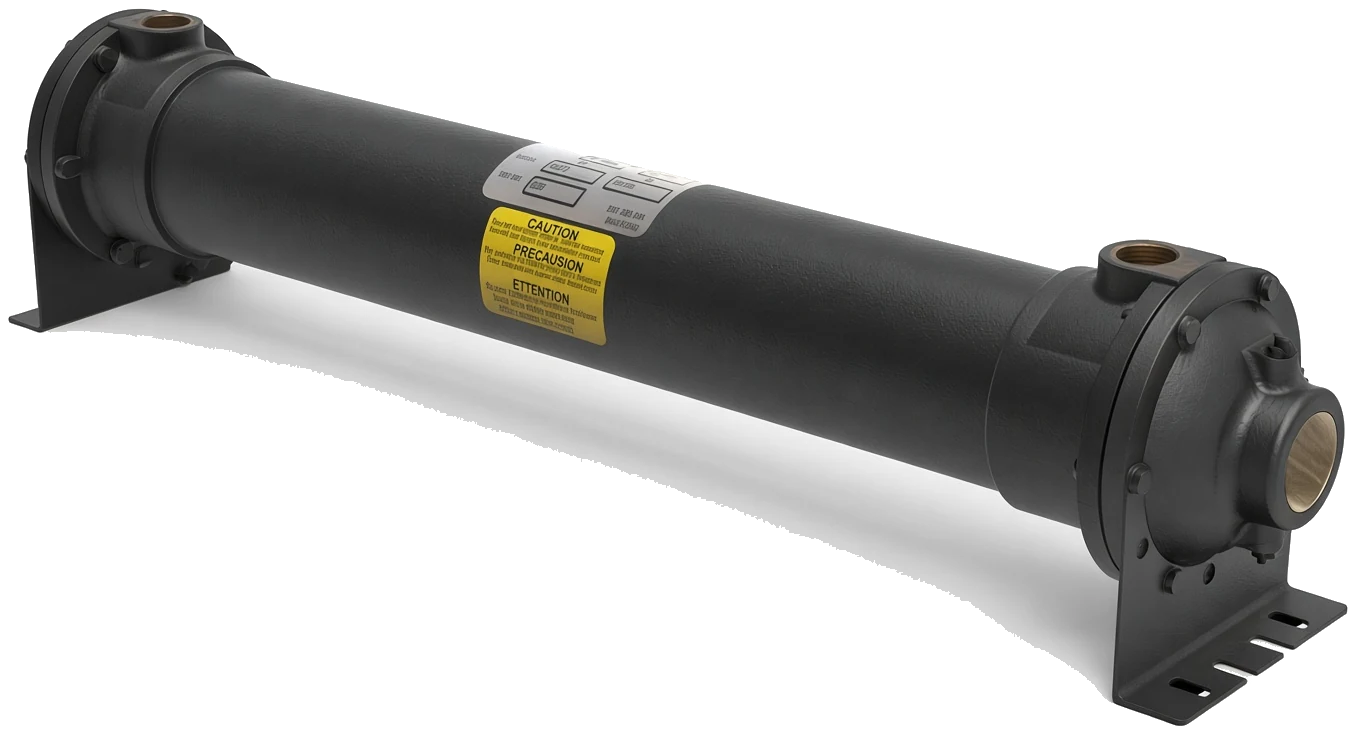
 Wide Range
 Yacht Duty
 Metric Fits
 Zinc Anodes
Volvo Penta Selection Inputs
Across this range the circuit you are replacing matters as much as the engine model.
Duty Inputs
- Engine designation and rated output
- Rated RPM and duty rating class
- Which circuit is being replaced
- Heat rejection from the engine data sheet
- Connection thread form and size
What We Supply
- Compact through mid HC frames
- Copper-nickel or titanium tubes
- Bronze bonnets with zinc anodes
- Adapters for metric or BSP piping
- Lube oil and gear coolers
Duty Profile
- Seasonal leisure use and lay-up
- Marina berths with stray current
- Commercial coastal running
- Mixed propulsion and auxiliary loads
| MODEL / RATING | HORSEPOWER | DUTY | TYPICAL SELECTION |
| D1 and D2 auxiliaries | About 10 to 75 hp | Jacket water | B Series small frame |
| D3 and D4 | About 110 to 300 hp | Jacket water and charge air | B Series or small HC |
| D6 | About 300 to 480 hp | Jacket water and lube oil | HC Series with CN tubes |
| D8 and D11 | About 450 to 750 hp | Jacket water, oil, charge air | HC Series plus lube oil cooler |
| D13 and D16 | About 700 to 1,000 hp and above | Multiple circuits | HC Series, call for rating |
Which Circuit Failed
Identifying the unit in front of you
On the mid and large D-series there is more than one exchanger aboard and they are not interchangeable. Before ordering, establish what the failed unit was doing: engine coolant to seawater, charge air circuit water to seawater, lube oil to seawater, or gear oil to seawater. The shell side fluid decides the sizing method entirely.
The easiest way to tell is to trace the shell side connections back to their source rather than to read the label. Oil circuits have smaller connections and different fittings, charge air circuit water often runs its own header tank. Photograph the pipe runs before disconnecting anything and we can identify the duty from the photographs.
Thread forms and adapters
Volvo Penta installations arrive with metric or BSP connections far more often than NPT. Our frames are cataloged in NPT and SAE, so adapters are a normal part of these orders. What matters is identifying the existing thread form correctly, because a metric thread will start in to a similar sized NPT fitting and then fail under pressure.
Use a thread gauge rather than a guess, note the form and size at both ends, and tell us what hose or pipe you intend to reuse. We list the adapters on the quotation so nothing is discovered on the day of installation. If you are unsure, photograph the fittings against a rule and send them to Sales@HeatX.com.
Related

ENGINES • OTHER MARINE
Yanmar Coolers
Japanese blocks in the same output bands and their frames
+ Learn More
APPLICATIONS • JACKET WATER
B Series
Compact shells from two to eight inches for small installations
+ Learn More
ENGINEERING • CORROSION
Galvanic Effects
How stray current and dissimilar metals consume anodes
+ Learn MoreReplacement questions
Yes. D6 ratings broadly sit around 300 to 480 horsepower, and the jacket water duty typically lands on an HC Series frame in the marine option set. Send the engine designation, rated output and rated speed plus the old unit dimensions and connection forms and we will confirm the frame.
No, but it needs stating up front. Our frames are cataloged in NPT and SAE and metric or BSP piping is handled with adapters listed on the quotation. Gauge the thread form at both ends rather than estimating, because a mismatched thread will start and then fail under pressure.
That usually points at stray current rather than at the cooler. Shore power earthing faults and neighboring vessels in a marina can drive anode wastage far beyond normal. Check bonding continuity and the shore power arrangement, and log wastage over time. The anodes are doing their job, just against the wrong problem.
Their installations normally carry several, with separate high and low temperature circuits and dedicated charge air and oil coolers. Replacing one changes the loop balance if the surface differs from the original, so send the circuit temperatures and the loop contents and we will size against the whole system.
A compact B Series frame in the marine option set: copper-nickel tubes, bronze bonnets, brass tubesheet and zinc pencils. On low hour engines the damage comes from lay-up and marina conditions rather than running, so drain the raw water side each winter and inspect anodes at every service.

