
1-805-484-2992
Quotes - Engineering - SalesCoolers for the 71 Series
Inline six and vee eight ratings
A Detroit 8V71 heat exchanger replacement starts with the rating, not the model number. The 71 series covers naturally aspirated, turbocharged and turbocharged aftercooled builds, and injector size and rated speed move the output across a wide band. A 6-71 commonly sits somewhere around 165 to 320 horsepower and an 8V71 around 250 to 450, which is a big enough spread to change the frame size we select.
The 71 series has been pushing boats for seventy years and the coolers rarely last half that. We supply the replacement jacket water cooler and lube oil cooler sized to your rating, in the bronze and copper-nickel marine build.
The duty itself is straightforward once the rating is fixed. Seawater runs on the tube side through copper-nickel tubes with zinc anodes in the bronze bonnets, engine coolant runs on the shell side, and the pass arrangement sets the raw water velocity. Jacket water heat rejection comes off the engine data sheet for your specific rating, and the lube oil circuit is sized separately on heat load, oil grade and allowable pressure drop.
Most 71 series boats we deal with are on their second or third cooler. The original may have been an ITT Standard unit, a yard-built assembly or an engine builder part that is long out of circulation. None of that stops the job. Send the engine details and the measurements of the old unit and we confirm a replacement that lands on the existing brackets.
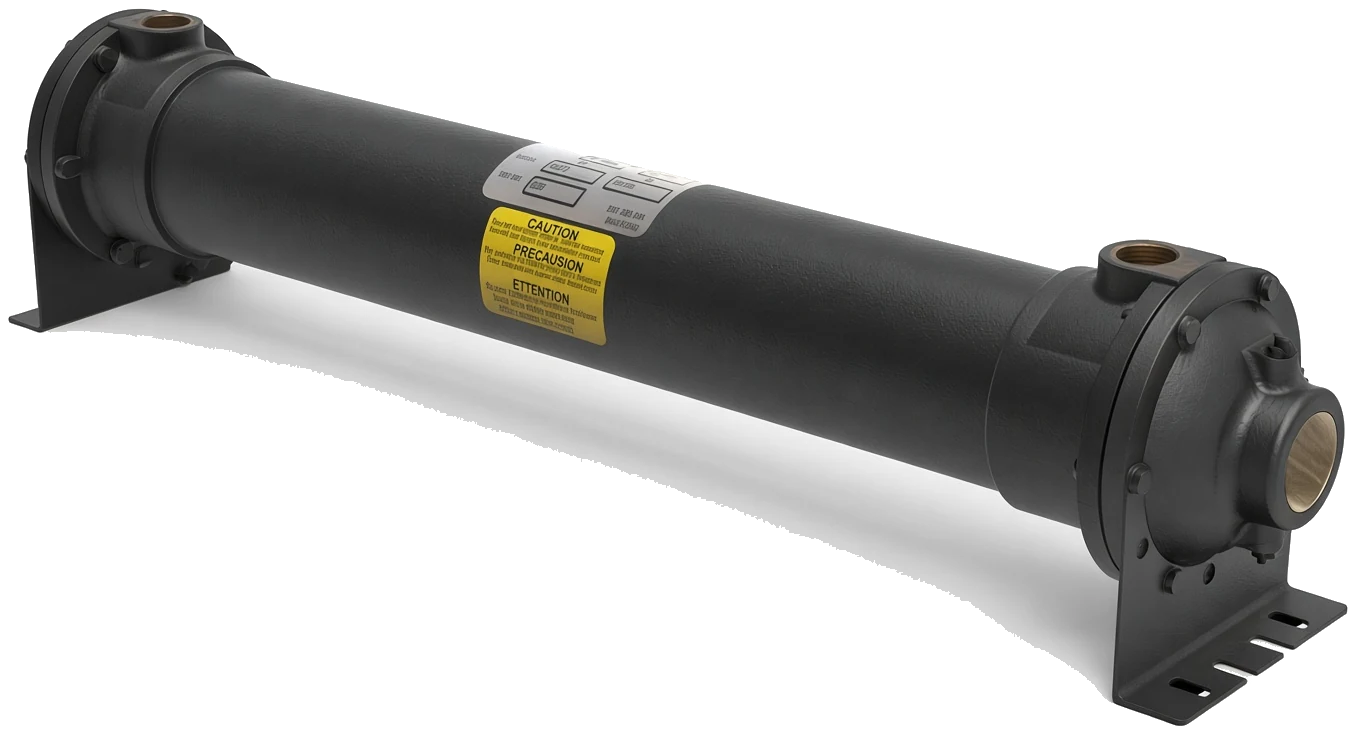
 Bronze Bonnets
 CN Tubes
 Jacket Water
 Lube Oil
Selecting a 71 Series Cooler
Three sets of information decide the frame size, the option set and the pass arrangement.
Duty Inputs
- Engine model and rated horsepower
- Rated RPM and aspiration
- Jacket water heat rejection from the data sheet
- Seawater inlet temperature
- Available raw water flow
What We Supply
- Complete shell and tube unit
- Bronze bonnets and gaskets
- Copper-nickel tubes, brass tubesheet
- Zinc anodes fitted
- Replacement bundles where the shell is sound
Duty Profile
- Continuous fishing and towing duty
- Harbor and estuary raw water
- Frequent seasonal lay-up
- Older piping with limited flow
| MODEL / RATING | HORSEPOWER | DUTY | TYPICAL SELECTION |
| 6-71 naturally aspirated | About 165 to 230 hp | Jacket water | B Series marine build |
| 6-71 turbocharged | About 230 to 320 hp | Jacket water and lube oil | HC Series with CN tubes |
| 8V71 naturally aspirated | About 250 to 320 hp | Jacket water | HC Series four pass |
| 8V71 turbocharged | About 320 to 400 hp | Jacket water and lube oil | HC Series plus lube oil cooler |
| 8V71 turbo aftercooled | About 400 to 450 hp | Jacket water, oil, gear | AB Series or HC, call for rating |
What Usually Fails First
Tube ends and the tubesheet
On a 71 series installation the damage concentrates at the raw water inlet end. Turbulence is highest where the water turns into the tubes, and any sand or shell fragment that gets past the strainer works on the same few inches of tube wall. A bundle that leaks at the inlet tubesheet has usually been running fast, not simply running long.
Scale is the other half of the story. Warm harbor water deposits inside the tubes, the rodding brush takes some tube wall with the deposit, and the cycle repeats. Two or three cleanings in, the wall thickness no longer supports the pressure it started with. Replacing the bundle at that point is cheaper than the coolant contamination that follows a failure.
Where the horsepower comes from
The Detroit rating plate carries the model and often an assembly number that pins the injector set and the governed speed. That combination, not the block, sets the heat rejection column we work from. If the plate is gone, the injector size stamped on the injectors themselves and the governed speed from the tachometer stop give us enough to place it.
Where the engine has been rebuilt with a different injector set, tell us. Boats get repowered inside their own model number more often than owners expect, and a cooler sized for a naturally aspirated rating will not hold temperature behind a turbocharger. That mismatch is one of the more common causes of a cooler that appears to fail early.
Related

ENGINES • DETROIT DIESEL
12V71 and 16V71
The larger vee blocks and how the duty scales up
+ Learn More
VESSELS & ENGINES • BY VESSEL
Commercial Fishing
Cooling duty on boats that run long seasons in dirty water
+ Learn More
ENGINEERING • SERVICE
Cleaning Tubes
What descaling costs you in tube wall over repeated cleanings
+ Learn MoreRating and sizing questions
Use the rating on the engine plate rather than the family figure. An 8V71 spans roughly 250 to 450 horsepower depending on aspiration, injector set and governed speed, and the jacket water heat rejection follows that rating on the engine data sheet. If the plate is unreadable, tell us the injector size and governed speed.
Possibly, but check the raw water side first. A partly blocked strainer, a tired impeller or scaled tube ends all show up as temperature that climbs only under load. Pull a bonnet and look into the tubes. If the tube ends are scaled or thinned, the bundle is the answer; if they are clean, look upstream.
Usually yes, within the engine bay. More surface will not harm the engine, and where the original was marginal for the rating it is often the right call. The limits are physical: length between bonnet faces, mounting arrangement and the seawater flow available. Send the envelope and we will select within it.
Yes, and they are worth stocking aboard. Anodes are consumable protection for the tubesheet and bonnets, and running without them moves corrosion onto components you cannot buy at a chandlery. Inspect at every service, replace at about half wasted, and keep a spare set on the boat.
It can be, where the boat lies in silty harbor water or works warm tropical routes and has already been through more than one copper-nickel bundle. Titanium tubes are an option code on the shell and tube frames we select from. Call 1-805-484-2992 and we will price both against your service history.
Probably, because the injector set and governed speed are what fix the rating, and a larger set moves the engine into a higher heat rejection column on the data sheet. A cooler selected for the original injectors can be a frame size short of the duty, and the first sign is coolant temperature creeping up at wide open throttle with everything else clean. Give us the new injector size and the governed RPM and we check the existing frame against the rebuilt rating.

