
1-805-484-2992
Quotes - Engineering - SalesFour-Stroke Cooling Duty
11.1, 12.7 and 14.0 liter
The Series 60 is a different cooling problem from the two-strokes that came before it. Marine ratings across the 11.1, 12.7 and 14.0 liter versions broadly span about 350 to 825 horsepower, and the four-stroke heat balance puts a different split between jacket water, charge air and lube oil than a 71 or 92 does. A replacement jacket water cooler for a Series 60 has to be selected against that split, not against a two-stroke rule of thumb.
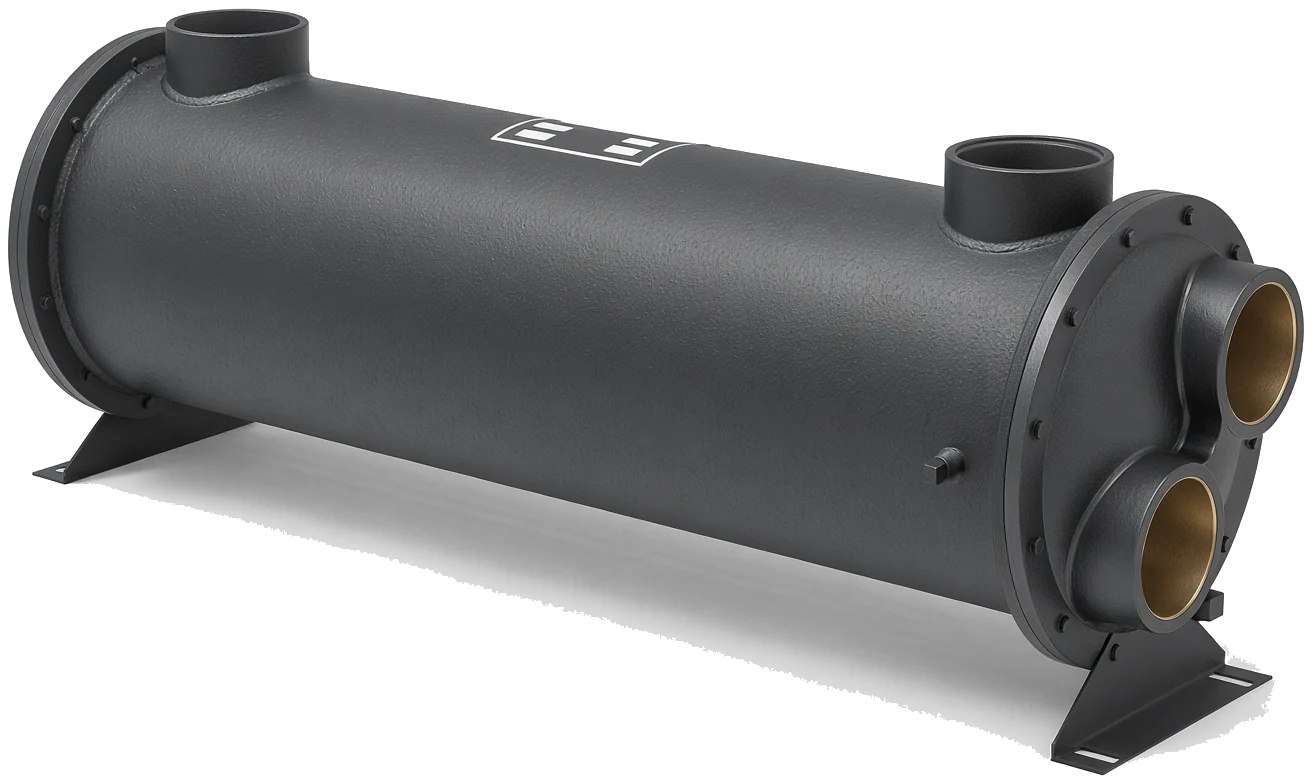
Most Series 60 marine installations we see are ferries, passenger vessels, patrol boats and auxiliary generator sets, which means duty cycles that are steady rather than peaky and survey regimes that care about documentation. The build is unchanged: seawater on the tube side in copper-nickel tubes, coolant on the shell side, bronze bonnets, brass tubesheet and replaceable zinc anodes.
Where the engine drives a generator, tell us the set rating and the constant speed, because the auxiliary column on the engine data sheet gives a different heat rejection from the propulsion column. Send the engine plate, the old cooler measurements and the connection sizes and we will confirm the frame. Call 1-805-484-2992 if the vessel is in survey and you need the selection written down.
 Passenger Duty
 Charge Air
 Auxiliary Sets
 CN Tubes
Series 60 Selection Inputs
Four-stroke installations need the circuit split as well as the engine rating.
Duty Inputs
- Displacement and rated horsepower
- Rated RPM and duty rating class
- Jacket water and charge air rejection
- Raw water routing between coolers
- Seawater inlet temperature
What We Supply
- Complete units in marine build
- Copper-nickel or titanium tubes
- Bronze bonnets with zinc anodes
- Charge air circuit coolers, rated per duty
- Documentation of materials and ratings
Duty Profile
- Scheduled passenger service
- Constant speed auxiliary running
- Survey and inspection regimes
- Coastal and harbor raw water
| MODEL / RATING | HORSEPOWER | DUTY | TYPICAL SELECTION |
| Series 60 at 11.1 liter | About 350 to 450 hp | Jacket water and lube oil | HC Series with CN tubes |
| Series 60 at 12.7 liter | About 450 to 600 hp | Jacket water, oil, charge air | HC Series plus lube oil cooler |
| Series 60 at 14.0 liter | About 600 to 825 hp | Jacket water, oil, gear | HC Series larger frame |
| Auxiliary generator ratings | Call for rating | Constant speed jacket water | AB Series or HC Series |
Propulsion Against Auxiliary
Two columns on one data sheet
The same Series 60 in a ferry and in a generator set does not reject the same heat. Propulsion ratings vary load with speed while an auxiliary set holds constant speed at whatever load the board demands, and the data sheet publishes them separately. Working from the wrong column is the most common sizing error we correct on these engines.
Tell us which it is, and for a generator set give the electrical rating in kilowatts along with the engine model. The extra thirty seconds on the phone avoids a frame that is either short of surface at full load or larger and more expensive than the installation needs.
What inspectors ask for
Passenger vessels and small ferries carry inspection regimes that ask what a component is rated for and what it is made of. We provide the frame size, option code, materials and pressure ratings for the unit supplied, so the paperwork matches the hardware in the engine room rather than a guess made at survey time.
Keep that record with the vessel file alongside the anode replacement dates. When the next replacement comes around it turns an investigation in to a phone call, and when an inspector asks about the raw water side you have an answer rather than a shrug.
Related

ENGINES • DETROIT DIESEL
8V92 and 12V92
The two-stroke family the Series 60 replaced in many hulls
+ Learn More
APPLICATIONS • ENGINE COOLING
Charge Air
How aftercooling changes the raw water side load
+ Learn More
APPLICATIONS • JACKET WATER
AB Series
Fixed tube frames at 300 PSI for auxiliary set duty
+ Learn MoreBefore you order a cooler for this engine
Across the 11.1, 12.7 and 14.0 liter versions the marine ratings broadly span about 350 to 825 horsepower. Size from your engine plate rather than the range, because the heat rejection published on the data sheet follows the specific rating and duty class rather than the displacement alone.
It depends on the installation. Some arrangements handle charge air through a separate exchanger, others share the raw water supply with the jacket water cooler. Both are workable, but the flow split changes what each shell can do. Send the routing and circuit temperatures and we will size to the real condition.
Yes. We provide the frame size, option code, materials and pressure ratings for the unit supplied so the vessel file matches the hardware. Keep it with the anode replacement dates and the cleaning log. If an inspector wants a specific figure confirmed, call 1-805-484-2992 and we will put it in writing.
It is more often than it should be on a steady timetable. Check strainer bypass and raw water flow first, then look at whether the frame is marginal for the rating. Send the cleaning history and the engine rating and we will review the selection rather than repeat it.
Not usually. Copper-nickel handles normal coastal seawater well on this duty. Titanium earns its cost where the raw water is warm, polluted or carries chlorides beyond ordinary seawater, or on evaporator and condenser duty. It is available as an option code, and ratings on titanium builds are set per duty.

