
1-805-484-2992
Quotes - Engineering - SalesHigh Output Two-Strokes
8V92 and 12V92 cooling duty
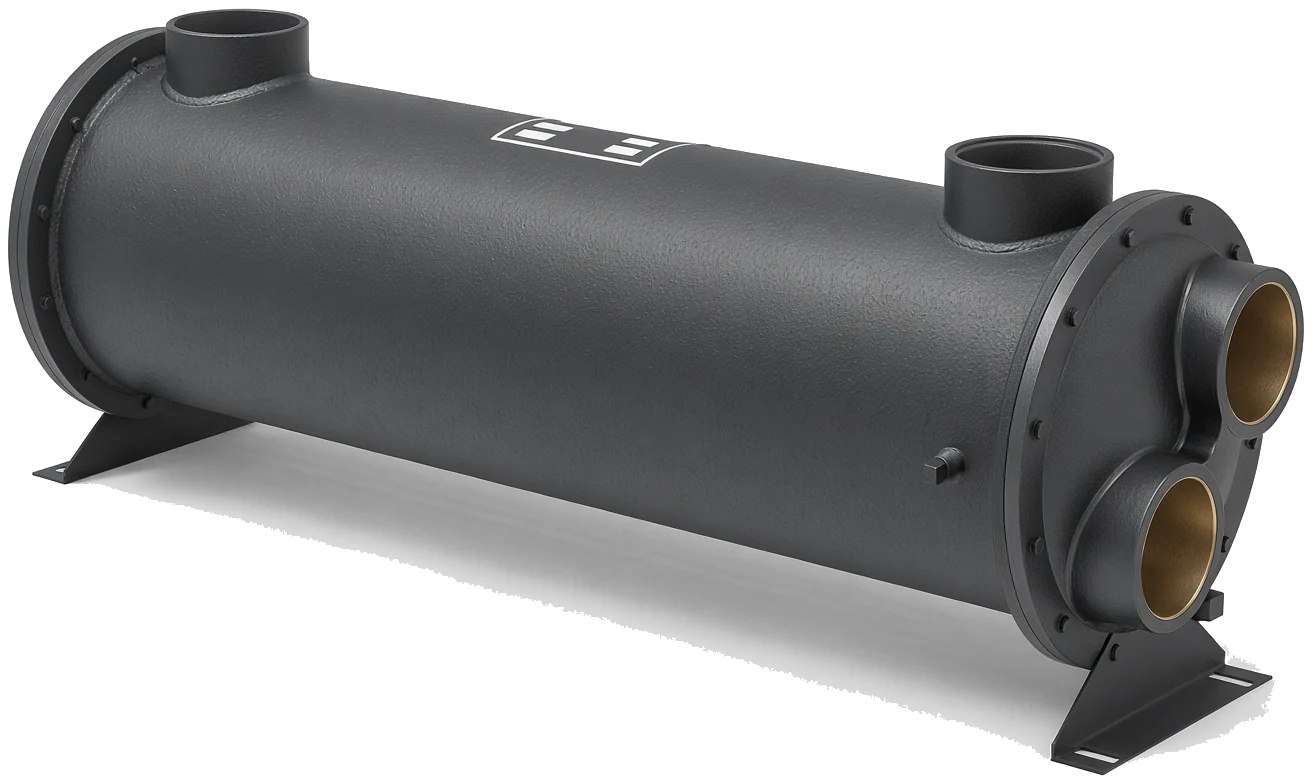
The 92 series is where two-stroke heat rejection stops being forgiving. An 8V92 commonly runs somewhere in the region of 400 to 750 horsepower and a 12V92 from roughly 650 up past 1,000, and the turbocharged aftercooled ratings sit at the top of those bands. A replacement jacket water cooler for a 12V92 has to be selected on the published heat rejection for that exact rating, because a frame that suited a lower rating will run out of surface at cruise.
The 92 series carries more heat into a smaller engine room than anything else of its era. When the jacket water cooler goes, the margin goes with it. We build the replacement to the rejection figures for your rating.
These engines usually live in fast boats: sportfishers, crew boats, patrol hulls. That means short raw water runs, high pump speeds and installations where nobody left spare room around the shell. The selection is therefore a pair of constraints. Enough surface for the duty, inside the envelope the old unit occupied, with the pass arrangement holding seawater velocity inside the range copper-nickel tolerates.
We supply complete units and replacement bundles for both families, with bronze bonnets, copper-nickel tubes, brass tubesheet and zinc anodes as the marine build. Lube oil coolers on the 92 series carry serious load and are worth quoting at the same time. Send the engine plate, the old unit measurements and the connection sizes to Sales@HeatX.com.
 High Rejection
 Charge Air
 Lube Oil
 Velocity Limits
Sizing a 92 Series Replacement
The 92 leaves less margin than any other Detroit family, so the inputs have to be exact.
Duty Inputs
- Rated horsepower and rated RPM
- Aspiration and aftercooling arrangement
- Heat rejection from the engine data sheet
- Raw water flow at the shell
- Seawater inlet temperature at cruise
What We Supply
- Complete units with bronze bonnets
- Copper-nickel or titanium tubes
- Zinc anodes in both bonnets
- Matching lube oil and gear coolers
- Gaskets and mounting hardware
Duty Profile
- High load fraction at cruise
- Twin engine installations
- Tight engine bay envelopes
- Warm water and coastal running
| MODEL / RATING | HORSEPOWER | DUTY | TYPICAL SELECTION |
| 8V92 turbocharged | About 400 to 550 hp | Jacket water and lube oil | HC Series with CN tubes |
| 8V92 turbo aftercooled | About 550 to 750 hp | Jacket water, oil, charge air | HC Series plus lube oil cooler |
| 12V92 turbocharged | About 650 to 850 hp | Jacket water and lube oil | HC Series two pass |
| 12V92 turbo aftercooled | About 850 to 1,050 hp | Jacket water, oil, gear | HC Series plus gear oil cooler |
| Genset variants | Call for rating | Auxiliary jacket water | AB Series or HC Series |
Where the Heat Goes
Three circuits, one seawater supply
On an aftercooled 92 the raw water supply feeds more than one heat exchanger, and the order in which it does so matters. Water that has already picked up heat arrives at the next shell warmer, which reduces the temperature difference available and therefore the surface effectiveness. Sketch the routing when you inquire, even roughly, and we will size against the real inlet condition.
That routing is also why a cooler can appear undersized when it is not. If the aftercooler upstream has fouled, the jacket water shell sees hotter inlet water and the gauge climbs. Before condemning the jacket water cooler, check every seawater component between the sea chest and the overboard discharge.
Fast pumps, short runs
The raw water pumps on these engines move real volume, and installations are short on pipe length. That combination puts velocity at the top of the acceptible range for copper-nickel before anyone specifies anything. Where the previous bundle failed with thinned, grooved tube ends at the inlet, the answer is not an identical replacement.
The fix is usually a pass arrangement change, sometimes a larger frame that drops velocity for the same flow, and occasionaly titanium tubes where the water is warm and dirty as well as fast. All three are decisions we make from the failure evidence. Keep the failed bundle and photograph the inlet tubesheet before it goes in a skip.
Related

ENGINES • DETROIT DIESEL
149 Series
The largest Detroit vee blocks and their split duty coolers
+ Learn More
VESSELS & ENGINES • BY VESSEL
Yachts and Sportfishers
High load cruising and what it does to cooler margin
+ Learn More
ENGINEERING • CORROSION
Velocity Limits
Why fast raw water thins tube ends at the inlet
+ Learn MoreFitting and connection questions
Because that is where the heat rejection peaks and the surface runs out. Check the seawater side first: strainer, impeller and any cooler upstream of the jacket water shell. If they are clean and the tube ends are scaled or thinned, the bundle has lost effectiveness and a correctly sized replacement will restore the margin.
Some installations share the raw water supply across both duties, which is why routing matters as much as surface area. We size against the water condition arriving at each shell rather than at the sea chest. Send a sketch of the routing and the circuit temperatures and we will confirm what each unit has to carry.
Broadly 400 to 750 horsepower depending on aspiration, injector set and rated speed, with the aftercooled ratings at the upper end. Do not size from the range. Use the rating on your engine plate and we will look up the jacket water and lube oil heat rejection published for it.
Consider it where velocity is high, the water is warm and you have already replaced a copper-nickel bundle prematurely. Titanium tubes are an option code on the shell and tube frames we select from and they take the material question off the table. Call 1-805-484-2992 and we will price both.

