
1-805-484-2992
Quotes - Engineering - SalesLarge Bore Two-Strokes
8V149, 12V149 and 16V149
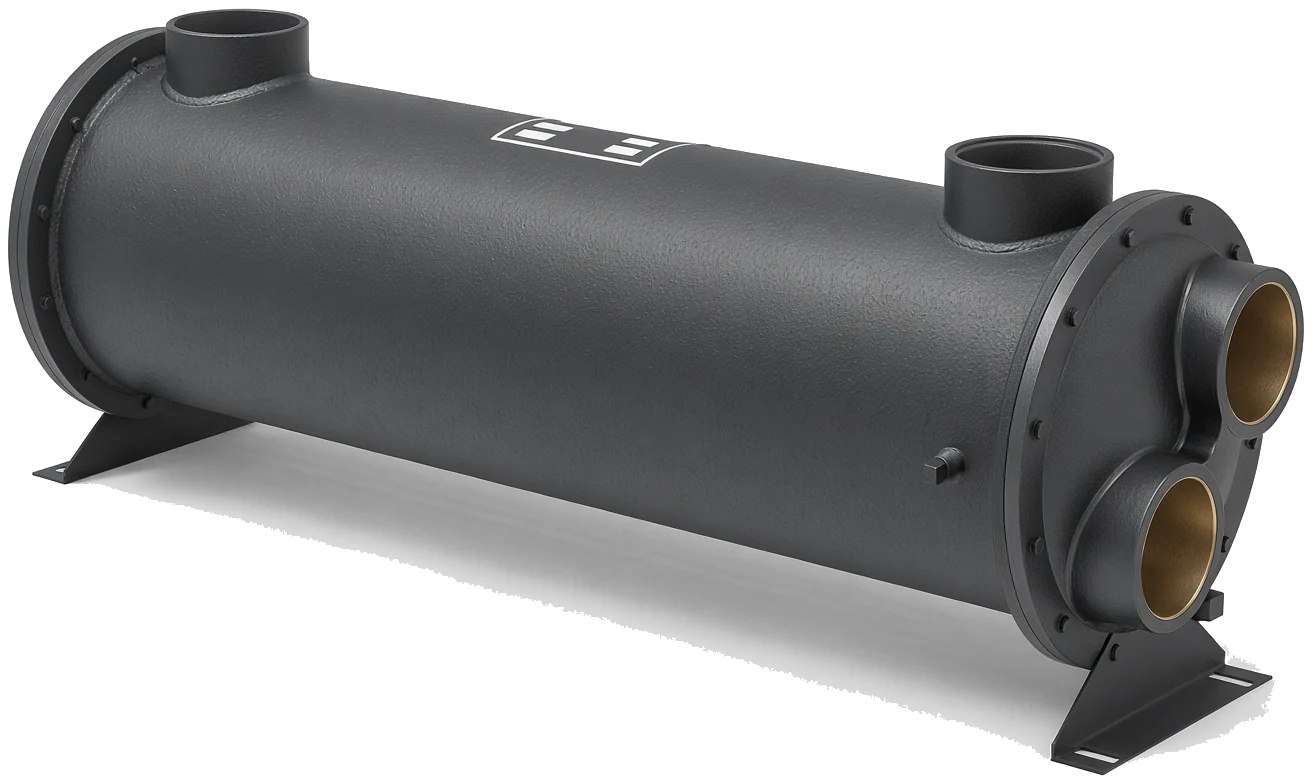
A 16V149 jacket water cooler is a sizing exercise, not a catalog lookup. The 149 family broadly spans about 700 to 2,000 horsepower across the vee eight, vee twelve and vee sixteen blocks, and the top ratings reject more heat than a single shell and tube frame in our jacket water range will take. That means either a large frame, units in parallel or a split duty arrangement, and the answer depends on the rejection figure for your rating.
The 149 is the largest of the Detroit two-strokes and the heat it rejects reflects that. These duties often need a large frame or a split arrangement, and both start with the rejection figure for your rating.
These engines went into large workboats, offshore vessels, dredges and standby generator sets, and they were often installed with fabricated coolers or with discontinued ITT Standard units. Replacement therefore starts with identification: shell diameter, overall length between bonnet faces, connection sizes and thread form, mounting arrangement and bonnet style, plus the engine rating.
The materials do not change with scale. Seawater stays on the tube side in copper-nickel or titanium tubes, coolant or oil on the shell side, bronze bonnets with replaceable zinc anodes in the raw water end. What changes is that at this size the flow and pressure drop numbers matter to the pump as much as the heat transfer numbers matter to the engine. Call 1-805-484-2992 with the rating and the circuit data.
 Split Duty
 Large Frames
 Offshore Duty
 Titanium Option
Working at 149 Scale
Above about 1,250 horsepower the arrangement question comes before the frame question.
Duty Inputs
- Block, rated horsepower and RPM
- Jacket water and oil rejection figures
- Raw water flow and pump curve
- Allowable pressure drop each side
- Available length and mounting centers
What We Supply
- Large HC frames in marine build
- Parallel unit arrangements
- Copper-nickel or titanium tubes
- Bronze bonnets and zinc anodes
- Separate lube oil and gear coolers
Duty Profile
- Offshore and dredging service
- Standby and prime power sets
- High raw water flow rates
- Long continuous running periods
| MODEL / RATING | HORSEPOWER | DUTY | TYPICAL SELECTION |
| 8V149 turbocharged | About 700 to 900 hp | Jacket water and lube oil | HC Series large frame |
| 8V149 turbo aftercooled | About 900 to 1,100 hp | Jacket water, oil, charge air | HC Series plus lube oil cooler |
| 12V149 ratings | About 1,000 to 1,500 hp | Jacket water, oil, gear | HC Series or parallel units, call for rating |
| 16V149 ratings | About 1,400 to 2,000 hp | Split jacket water duty | Parallel HC Series units, call for rating |
| Standby generator sets | Call for rating | Constant speed jacket water | AB Series or HC Series |
Pressure Drop at High Flow
What the raw water pump will tolerate
At these flow rates pressure drop stops being a footnote. A pass arrangement that gives ideal velocity may ask more of the raw water pump than it can deliver, and the result is less flow than the calculation assumed and a cooler that underperforms from the day it is fitted. We work the hydraulics and the heat transfer together rather than one after the other.
That is why we ask for the pump details or at least the flow you believe you have. If the figure is unknown, tell us the pump size and the pipe run and we will work with a conservative assumption and flag it. An honest assumption stated in the quote is worth more than a precise number nobody verified.
Two shells, one duty
Where a single frame will not fit or will not carry the load, two units in parallel share the duty. The piping has to balance flow between them, which usually means symmetrical headers and equal length branches rather than a tee taken off wherever it was convenient. Get that wrong and one shell does most of the work and fouls twice as fast.
The upside is real: shorter individual units fit engine rooms that will not take one long shell, maintenance can be staged so the vessel keeps partial cooling, and a single failure does not stop the boat. On offshore and government work that redundancy is often the deciding argument rather than a bonus.
Related

ENGINES • DETROIT DIESEL
Detroit Diesel
All the Detroit families and the coolers we select for them
+ Learn More
VESSELS & ENGINES • BY VESSEL
Offshore Work
Redundancy and staged maintenance on government and offshore hulls
+ Learn More
ENGINEERING • SERVICE
Bundle Pulling
Access and clearance needed to change a large tube bundle
+ Learn MoreQuestions on this engine
At the lower 149 ratings yes, at the top ratings usually not. Our jacket water selection runs to roughly 1,250 horsepower on the largest two pass frame, so above that we quote parallel units or a split duty. Send the rejection figure for your rating and we will set out the arrangement options.
With symmetrical headers and equal length branches, so both shells see the same flow and foul at the same rate. An asymmetric tee sends most of the water to one unit and the other becomes decoration. Tell us the space available and we will advise on a header layout that balances properly.
Broadly about 700 to 2,000 horsepower across the vee eight, vee twelve and vee sixteen blocks, depending on aspiration, injector set and rated speed. Size from your engine plate rather than the range, because the jacket water and lube oil rejection published for your specific rating drives everything else.
Yes, at these flow rates it can decide it. A pass arrangement that gives ideal tube velocity may ask more head than the raw water pump provides, which reduces flow and undercuts the whole calculation. We work the hydraulics alongside the heat transfer and state the assumptions in the quote.
Where the water is warm, polluted or high in chlorides, often yes, because a bundle failure on a large unit costs far more in downtime then the tube material premium. Titanium is an option code on the shell and tube frames we select from, and ratings on titanium builds are set per duty, so call for a rating.

