
1-805-484-2992
Quotes - Engineering - SalesVee Twelve and Vee Sixteen
Tug, seiner and offshore duty
A 16V71 jacket water cooler is a workboat part, not a yacht part. These engines commonly sit between roughly 400 and 925 horsepower across the 12V and 16V blocks depending on aspiration, injector set and rated speed, and they run at high load fractions for long periods. That duty cycle, not the peak rating, is what wears the cooler out, and it is what we ask about first.
The big vee 71s went into tugs, seiners and offshore crew boats and many are still on their original mounting brackets. We select the replacement cooler on published heat rejection and build it to fit that bracket.
Selection follows the same route as any Detroit: engine model and rating, jacket water and lube oil heat rejection taken from the engine data sheet for that rating, seawater condition and available flow. From there the frame size and pass arrangement fall out. The marine build is bronze bonnets, copper-nickel tubes, brass tubesheet and replaceable zinc anodes in the raw water end.
On boats like these there is normally more than one shell to replace. Marine gear coolers on a big single or a twin screw installation are the same age and see the same water, and deck hydraulics on a trawler or a crane boat run their own circuits. Send us the list rather than the single item and we will quote the set to one delivery.
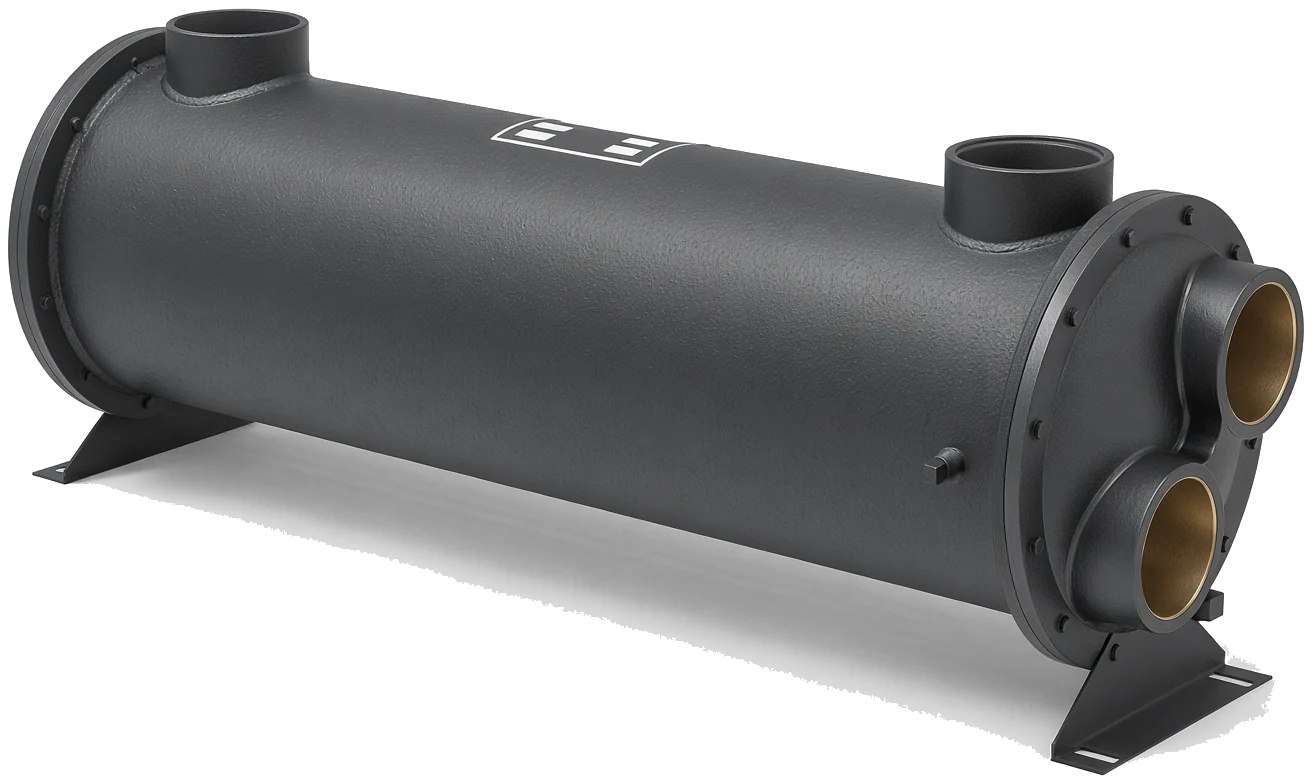
 Workboat Duty
 Gear Coolers
 Large Frames
 Anode Service
Specifying for Long Hours
On high hour workboats the inputs that matter most are the ones about how the boat is used.
Duty Inputs
- Rated horsepower and rated RPM
- Typical load fraction and hours per year
- Heat rejection from the engine data sheet
- Seawater source and silt load
- Existing bracket and envelope dimensions
What We Supply
- Large HC frames in marine build
- Bronze bonnets and brass tubesheet
- Copper-nickel or titanium tubes
- Zinc anodes and spare sets
- Gear and hydraulic oil coolers
Duty Profile
- Towing and trawling at sustained load
- Harbor berths with silty water
- Year round operation
- Multiple oil circuits aboard
| MODEL / RATING | HORSEPOWER | DUTY | TYPICAL SELECTION |
| 12V71 naturally aspirated | About 400 to 500 hp | Jacket water | HC Series four pass |
| 12V71 turbocharged | About 500 to 650 hp | Jacket water and lube oil | HC Series with CN tubes |
| 16V71 turbocharged | About 650 to 800 hp | Jacket water, oil, gear | HC Series plus gear oil cooler |
| 16V71 turbo aftercooled | About 800 to 925 hp | Jacket water, oil, charge air | HC Series large frame |
| Auxiliary and genset | Call for rating | Constant speed jacket water | AB Series marine build |
Sizing for the Real Load
Not the peak on the plate
A cooler sized for a peak rating the boat never sees is money spent on surface that fouls. A cooler sized for an average load the boat regularly exceeds is a temperature alarm waiting for a tow job. We work from the rated heat rejection and then talk about the duty cycle, because that conversation decides how much cleaning margin to build in.
On towing and trawling boats we generally recommend building in that margin rather than shaving it. The cost difference between adjacent frame sizes is small next to a lost trip, and the larger frame gives you more time between cleanings in silty water. Where the engine bay will not take the bigger shell, we say so and select within the space.
The rest of the seawater load
Marine gear coolers on the big vee 71s are sized on gear heat load, oil grade and allowable pressure drop, and on a heavily loaded reduction gear the load is meaningful. Deck hydraulics add more, and on trawlers and crane boats those circuits often work harder than the propulsion engine during a set or a lift.
Some of those circuits are better served by air cooled coolers than by another seawater shell, particularly where the equiptment runs while the boat is stopped and the raw water pump is idling. Heresite coated air cooled units are built for that salt air exposure. Tell us what each circuit does and we will recommend the right type rather than defaulting to shell and tube.
Related

ENGINES • DETROIT DIESEL
6-71 and 8V71
The smaller 71 series blocks and their frame selections
+ Learn More
APPLICATIONS • OIL COOLING
Reduction Gear
Sizing gear oil coolers on heavily loaded marine gears
+ Learn More
ENGINEERING • SELECTION
Replacing a Cooler
Matching a discontinued unit from measurements and duty data.
+ Learn MoreWhat owners of this engine ask
Depending on aspiration, injector set and rated speed, broadly 650 to 925 horsepower, with the aftercooled ratings at the top. Size from the plate on your engine rather than the range. We take the jacket water and lube oil heat rejection published for that rating and select the frame from it.
Some margin is usually worth buying. Sustained high load and silty harbor water foul a bundle faster than intermittent duty, and the next frame size up buys running time between cleanings. The limit is the engine bay and the existing mounting, so send the envelope and we will select the largest sensible frame within it.
You can, but it is not always the best answer. Winch and crane circuits often work hardest while the boat is stopped and raw water flow is lowest. Heresite coated air cooled units suit that pattern better. Tell us the duty cycle for each circuit and we will recommend shell and tube or air cooled accordingly.
Yes. Those units are discontinued and we replace them regularly. Identification comes from shell diameter, overall length, connection sizes and thread form, mounting centers and bonnet style rather than from a part number. Photograph both ends before dismantling and send the measurements with the engine rating.
On a high hour workboat in silty water, plan on annual inspection with cleaning as required, and pull the anodes at every service. Log what you find. A bundle that needs rodding twice a season is telling you the frame is undersized or the strainer is bypassing, and both are fixable.

